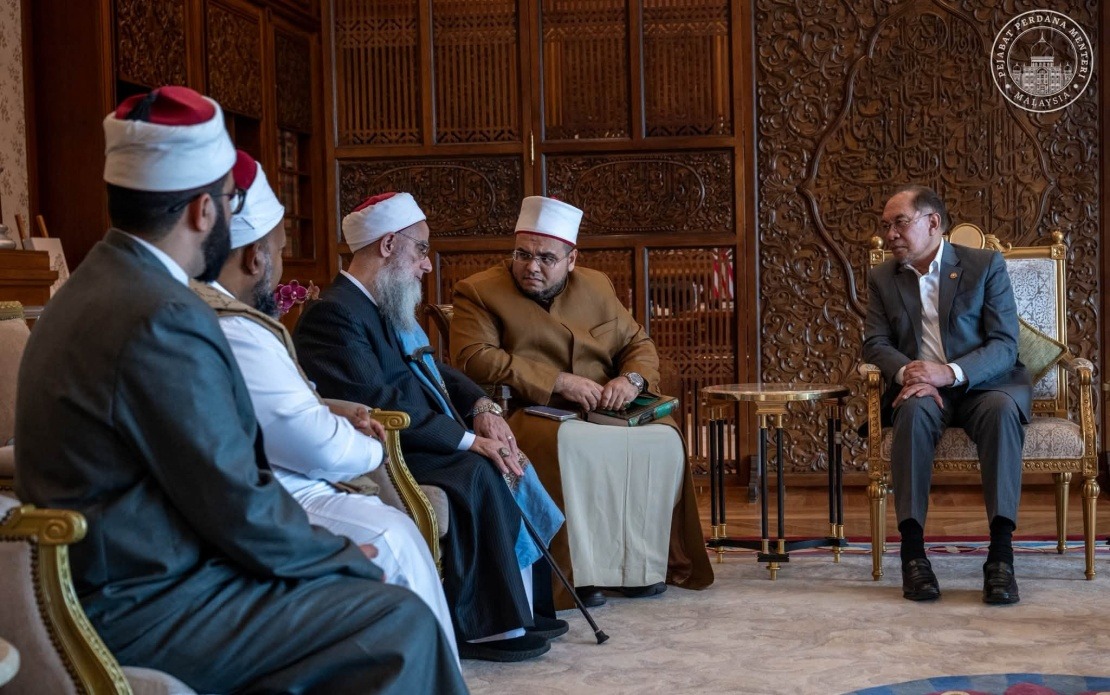
Prime Minister Datuk Seri Anwar Ibrahim has received a courtesy visit from Sheikh Dr Mustafa An-Nadwi Al-Hasani Mansurah, a distinguished Egyptian Islamic scholar, at the Prime Minister's office in Putrajaya. The meeting, which took place on July 20, reflected Malaysia's continued engagement with leading Islamic intellectuals from the Arab world and underscored the government's commitment to fostering dialogue on faith-based governance and moral leadership in contemporary times.
Sheikh Dr Mustafa, who hails from Mansurah in Egypt, is recognised internationally as an authority on Islamic jurisprudence and hadith studies, the recorded traditions and sayings of the Prophet Muhammad. His scholarly credentials are further elevated by his status as a student of the late Sheikh Abul Hasan Ali al-Nadwi, whose influence shaped modern Islamic thought across numerous countries and whose teachings continue to guide Muslim intellectuals globally. The connection between Malaysian leadership and such eminent scholars signals the deliberate positioning of the country within broader networks of Islamic learning and discourse.
In reflecting on the meeting through a Facebook post, Anwar characterised Sheikh Dr Mustafa as an exemplary figure whose work emphasises the intrinsic value of moral principles, considered wisdom, and scholarly rigour. The Prime Minister's remarks highlighted a particular concern with what he termed the prevalence of sensationalism in contemporary discourse, a phenomenon that arguably extends beyond religious scholarship into politics, media, and public life across Southeast Asia. By elevating the scholar's work, Anwar implicitly advocated for a return to substance-driven engagement in both intellectual and public spheres.
The Prime Minister articulated a philosophical position through his meeting and subsequent commentary, suggesting that in an era dominated by rapid information flows and attention-seeking narratives, the quiet accumulation and transmission of genuine knowledge carries an almost counterintuitive power. His metaphor comparing wisdom to morning dew—quiet, unassuming, yet life-giving—represented an attempt to reframe intellectual authority and spiritual guidance as inherently valuable commodities that operate outside conventional frameworks of publicity and validation. This rhetorical stance carries implications for how Malaysia's government frames its engagement with religious scholarship and moral guidance.
During their discussions, the two men exchanged perspectives on contemporary affairs, demonstrating that the visit was substantive rather than merely ceremonial. Anwar also noted that Sheikh Dr Mustafa was conducting knowledge sessions and teaching engagements throughout Malaysia during his current visit, indicating that the scholar's presence in the country extended beyond a single diplomatic courtesy. The scheduling of these knowledge sessions alongside high-level government meetings suggests a coordinated effort to maximise the Islamic intellectual's influence within Malaysian society across multiple platforms and audiences.
For Malaysian policymakers and religious scholars, the reception of such prominent Arab Islamic figures carries symbolic weight. Egypt remains a significant centre of Islamic learning and Arabic scholarship, and personalities from Al-Azhar and related institutions command considerable respect within Muslim-majority countries. The visit reflects Malaysia's aspiration to maintain intellectual connections with Arab centres of Islamic thought while simultaneously positioning itself as a destination for such scholars and a hub for Islamic discourse in Southeast Asia.
The Prime Minister extended gratitude to Sheikh Dr Mustafa for counsel he had provided and prayers offered for Malaysia's ongoing stability and national prosperity. This expression of appreciation for the scholar's spiritual support illustrates the Malaysian government's recognition of religious figures as contributors to national wellbeing beyond their academic roles. The invocation of prayers for national unity appears particularly significant given Malaysia's multicultural composition and the consistent political emphasis on communal harmony as a foundational national value.
Anwar's public remarks also encompassed prayers for Sheikh Dr Mustafa's continued health, the flourishing of his knowledge and scholarly endeavours, and his continued capacity to offer guidance to Muslim communities. These benedictions reflected a reciprocal respect and suggested an ongoing relationship rather than a one-off engagement. The emphasis on the scholar's role in guiding believers toward moderation and compassion aligned with Anwar's previously articulated vision for Islam's role in contemporary governance, one that prioritises balanced interpretations and ethical conduct.
The meeting occurred within a broader context of Malaysia's foreign policy emphasising civilisational engagement and interfaith dialogue. By receiving prominent religious scholars and facilitating their public teaching engagements, the government signals openness to intellectual exchange and positions Malaysia as intellectually secure enough to host diverse Islamic voices. This approach contrasts with more restrictive models of religious governance and reflects confidence in Malaysia's capacity to engage with international Islamic scholarship without perceived threat to national stability or social cohesion.
For Southeast Asia more broadly, the visit exemplifies how individual nations within the region leverage relationships with established Islamic intellectual centres to enhance their own standing within global Muslim networks. Malaysia, as the region's most developed Muslim-majority economy and a functioning parliamentary democracy, frequently hosts such visits and engagements as part of a deliberate strategy to maintain relevance within transnational Islamic discourse while projecting an image of stability and openness.
The substantive nature of Anwar and Sheikh Dr Mustafa's discussions on current affairs remained largely unpublicised, reflecting diplomatic discretion regarding sensitive topics. However, such high-level engagements typically encompass perspectives on regional geopolitics, the state of Islamic scholarship in different contexts, and how religious leadership navigates contemporary challenges including secular governance models, technological disruption, and evolving social values. The Prime Minister's willingness to engage in such detailed discussions underscores his personal interest in intellectual matters and his positioning as a leader engaged with Islamic thought rather than merely with political Islamism.
Moving forward, the visit and its public acknowledgment will likely strengthen Malaysia's connections with scholarly networks based in Egypt and the broader Arab world. Such relationships prove valuable for knowledge exchange, student recruitment, and the development of collaborative research initiatives between Malaysian and Arab Islamic institutions. The meeting also provides a platform for Malaysia to project its particular model of Islamic governance and social organisation to influential international figures who might subsequently influence perceptions of the country within their own networks and educational institutions.

