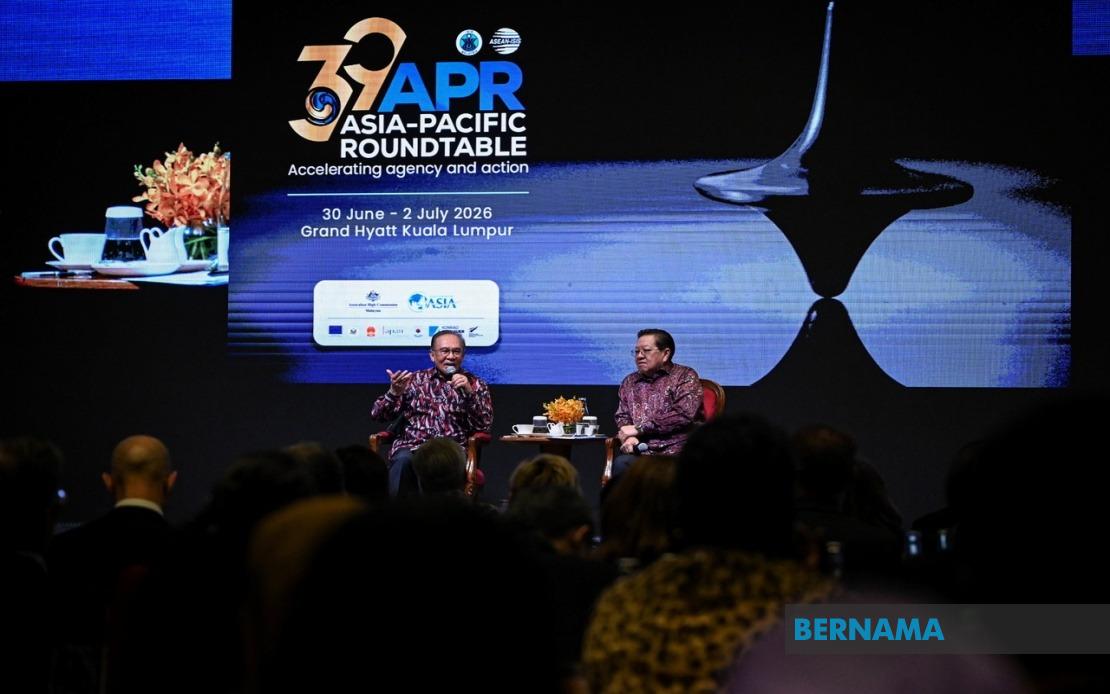
Malaysia's Prime Minister Datuk Seri Anwar Ibrahim has firmly rejected the widespread perception that conflict in the South China Sea is an unavoidable outcome, instead championing a philosophy rooted in dialogue, confidence-building and respect for international law as the foundation for enduring regional peace. Speaking during a question-and-answer session at the 39th Asia-Pacific Roundtable in Kuala Lumpur on Thursday, Anwar presented a notably optimistic assessment of Malaysia's bilateral relations with China, countering narratives that emphasise rising tensions and military posturing across one of the world's busiest maritime corridors.
Anwar's characterisation of Malaysia-China engagement stands in contrast to the prevailing anxiety expressed in certain quarters regarding the South China Sea's geopolitical trajectory. The Prime Minister explicitly distanced himself from what he termed a "phobia" about potential threats emanating from the disputed waterway, acknowledging that while legitimate maritime issues exist, Malaysia's practical experience with Beijing has been marked by substantive and productive exchanges rather than confrontation. This measured stance reflects the government's pragmatic approach to managing competing territorial claims whilst maintaining robust economic and diplomatic ties with its northern neighbour.
Critically, Anwar pointed to his direct engagements with Chinese leadership, including President Xi Jinping and Premier Li Qiang, to substantiate his assertion that bilateral relations have flourished without fundamental friction. He noted the absence of major outstanding grievances that might trigger escalatory dynamics, suggesting that behind-the-scenes diplomacy has effectively managed potential flashpoints before they crystallise into public disputes. This observation carries particular weight given Malaysia's exposure to maritime boundary complexities and its stake in ensuring free passage through strategically vital sea lanes.
The Prime Minister emphasised that China has demonstrated its commitment to the United Nations Convention on the Law of the Sea (UNCLOS), the principal international framework governing maritime rights and responsibilities. Furthermore, he highlighted ongoing ASEAN-China negotiations over a Code of Conduct in the South China Sea as a mechanism through which regional actors can institutionalise norms and procedures for managing disagreements. These negotiating processes, Anwar suggested, should remain the primary vehicle for resolving disputes, demonstrating his confidence in multilateral diplomatic architecture over unilateral assertions or military posturing.
Anwar's remarks implicitly critique the narrative ecosystem in some Western and regional commentaries that frequently predict impending military confrontation or hegemonic competition in the South China Sea. By cautioning against excessive focus on conflict scenarios, he advocated for ASEAN to maintain its historical commitment to diplomacy and engagement as the default posture. This positioning allows ASEAN economies, including Malaysia, to preserve their strategic autonomy whilst avoiding alignment pressures that could fragment the bloc's hard-won consensus on regional issues.
The Prime Minister underscored the critical role of personal relationships among ASEAN leaders in maintaining regional stability. He attributed much of the bloc's success in preserving peace over decades to the practice of direct leader-to-leader communication and the willingness to resolve differences before they escalate into formal disputes or crisis situations. This observation points to a distinctly Southeast Asian approach to conflict management that prioritises quiet diplomacy and consensus-building over public posturing or institutionalised confrontation mechanisms.
Anwar also addressed the Cambodia-Thailand border dispute, welcoming both countries' commitment to continued negotiations as a model for resolving regional differences. He characterised many such territorial disagreements as historical legacies of colonial-era boundary demarcation, implying that their resolution requires patient, long-term engagement rather than zero-sum competition. His confidence in dialogue's eventual success reflects an underlying faith in the capacity of Southeast Asian actors to manage their differences autonomously without external mediation or intervention.
The Prime Minister's remarks must be contextualised within Malaysia's specific position in the South China Sea. The country maintains its own territorial claims and has experienced incidents involving Chinese maritime assets, yet Anwar has consistently sought to compartmentalise these disputes from broader bilateral cooperation. This approach allows Malaysia to pursue economic integration with China, particularly in infrastructure and trade, whilst maintaining diplomatic space to articulate its legal positions on maritime boundaries.
Anwar's emphasis on international law and UNCLOS reflects Malaysia's strategic interest in maintaining a rules-based order that constrains the exercise of raw power in favour of legal frameworks. For a medium-sized maritime nation, such institutional structures offer greater protection than reliance on military capability or great-power patronage. By promoting adherence to UNCLOS and negotiated codes of conduct, Malaysia advances its own security interests whilst presenting itself as a responsible regional actor committed to stability.
The Prime Minister's call for ASEAN to advocate reforms of global multilateral institutions, including the United Nations and World Trade Organisation, signals Malaysia's broader concern with ensuring that regional voices carry weight in shaping international governance structures. This agenda reflects frustration with a post-World War II institutional architecture that ASEAN members view as inadequately representative of Asian interests and perspectives. Anwar's framing suggests that regional stability cannot be decoupled from questions of global institutional legitimacy and equitable representation.
Looking forward, Anwar's rhetoric suggests Malaysia will continue pursuing a balanced approach to the South China Sea, neither acquiescing to any single power's assertions nor adopting confrontational stances that might provoke security dilemmas. This calibrated positioning allows the government to manage domestic constituencies with differing security perspectives whilst maintaining flexibility in its external relationships. The consistent emphasis on dialogue and confidence-building mechanisms indicates that Malaysia sees these tools as more durable and cost-effective than military build-ups or alliance formalisations for achieving its security objectives in contested waters.

