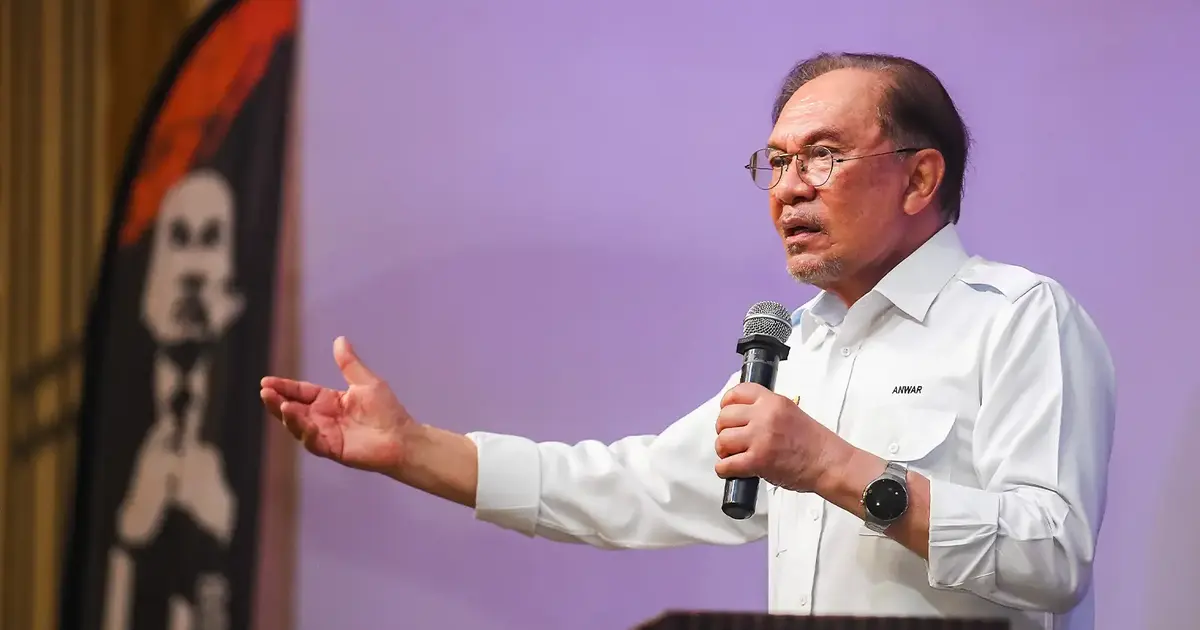
Prime Minister Anwar Ibrahim has blamed the 'Free Najib' movement for pressuring Pakatan Harapan into contesting Johor's early state election, arguing that no legitimate grounds existed for calling the polls ahead of schedule. Speaking in his capacity as PH chairman, Anwar suggested that the coalition's involvement in the Johor election was a consequence of external political maneuvering rather than a strategic decision made by PH leadership on its own terms.
The 'Free Najib' group refers to supporters of former Prime Minister Najib Razak, who remains central to Malaysian political discourse despite his 2023 royal pardon from his convictions in the 1Malaysia Development Berhad (1MDB) scandal. This faction has maintained considerable influence within UMNO and the broader Barisan Nasional coalition, shaping political calculations even as Malaysia's transition toward the Anwar-led government has proceeded. Their activities demonstrate how legacy political movements continue to exert pressure on current electoral outcomes, particularly in states where UMNO maintains traditional strongholds.
Anwar's assertion that there was no necessity for an early election in Johor speaks to broader questions about the timing and justification of state-level polls in Malaysia's federal system. Under the constitution, state assemblies have fixed terms, and dissolving them early requires specific triggering events or political consensus among sitting legislators. The fact that Johor's election was called early suggests either that such conditions were met or that political calculations at the state level necessitated an early mandate from voters. Anwar's position implies dissatisfaction with how these circumstances unfolded, viewing them as orchestrated rather than organically arising.
From a strategic perspective, Anwar's comments reveal tensions within the broader Malaysian political ecosystem regarding who controls the political agenda. Pakatan Harapan, having won federal power in 2022, faces ongoing challenges in translating that mandate into consistent state-level dominance. Johor remains historically a Barisan Nasional bastion, and an election called in that state—whether early or on schedule—presents inherent challenges for the PH coalition. By attributing the decision to external 'Free Najib' pressure, Anwar positions PH as reactive rather than strategic, a framing that may have implications for how voters perceive the coalition's political agency.
The tension between Anwar and the 'Free Najib' camp highlights unresolved questions within Malaysia's political settlement following the 1MDB crisis and its aftermath. Najib's pardon, granted by the Agong in 2024, represented a significant moment that many civil society observers viewed as undermining accountability for one of Malaysia's most significant financial scandals. The continued mobilization of political actors around Najib's legacy suggests that the national conversation about corruption, institutional reform, and political rehabilitation remains unsettled. For regional observers, this indicates that Malaysia's political transition remains incomplete, with fundamental questions about how the country will address its recent past still contested.
Anwar's statement also carries implications for Pakatan Harapan's internal cohesion and its broader political messaging. The coalition has emphasized themes of institutional reform, anti-corruption governance, and modernization as central to its identity since returning to power. When external political movements—particularly those mobilized around a figure pardoned from major corruption charges—succeed in shaping the electoral calendar, it potentially undermines PH's narrative about controlling Malaysia's political trajectory and advancing its reform agenda. This dynamic creates space for critics to argue that the coalition lacks the political capital or strategic acumen to advance its platform effectively.
The Johor election itself carries specific weight within Malaysian politics. As the second-most economically significant state after Selangor and a historically UMNO-controlled territory, Johor's political direction influences broader national electoral dynamics. A strong showing by PH in Johor would strengthen Anwar's position nationally and signal that his coalition can compete effectively in traditionally opposition-weak areas. Conversely, a UMNO-led victory would reinforce the impression that Barisan Nasional retains deep organizational and electoral advantages despite the coalition's loss of federal power. Against this backdrop, Anwar's suggestion that PH was drawn into the contest against its strategic preferences becomes politically significant.
For Malaysian voters assessing the current political landscape, Anwar's comments invite reflection on questions of political agency and democratic control. Elections in any democracy should ideally reflect the considered judgment of political parties and the electorate rather than the calculated maneuvering of particular factions seeking to advance narrower interests. If Johor's election was indeed called to serve the interests of the 'Free Najib' movement—whether by creating an opportunity to strengthen UMNO's position or by other means—this raises broader concerns about whose interests are being served when electoral timing becomes a contested political decision.
The comments also underline the continuing volatility of Malaysian politics even as formal democratic institutions function. Anwar's administration has made significant institutional changes, from appointing new anti-corruption leadership to pursuing various governance reforms. However, the ability of organized political movements to influence fundamental matters like election timing demonstrates that institutional change alone does not automatically translate into predictable or controllable political outcomes. This reality shapes both the immediate political calculations of all Malaysian parties and longer-term assessments of whether Malaysia's political system is evolving toward greater stability or remaining subject to sudden shifts driven by factional maneuvering.
Looking forward, Anwar's framing of the Johor election as externally imposed rather than internally chosen may influence how the coalition campaigns and how voters interpret its performance in the state. Should PH perform better than historical precedent in Johor, Anwar can credibly claim that his coalition overcame unfavorable circumstances. Should results disappoint, the explanation is already partially constructed: PH was compelled to contest on unfavorable terrain at an inopportune moment. This strategic narrative management reflects the sophisticated political communication required to maintain coalition cohesion and public support in Malaysia's complex multiparty environment.

