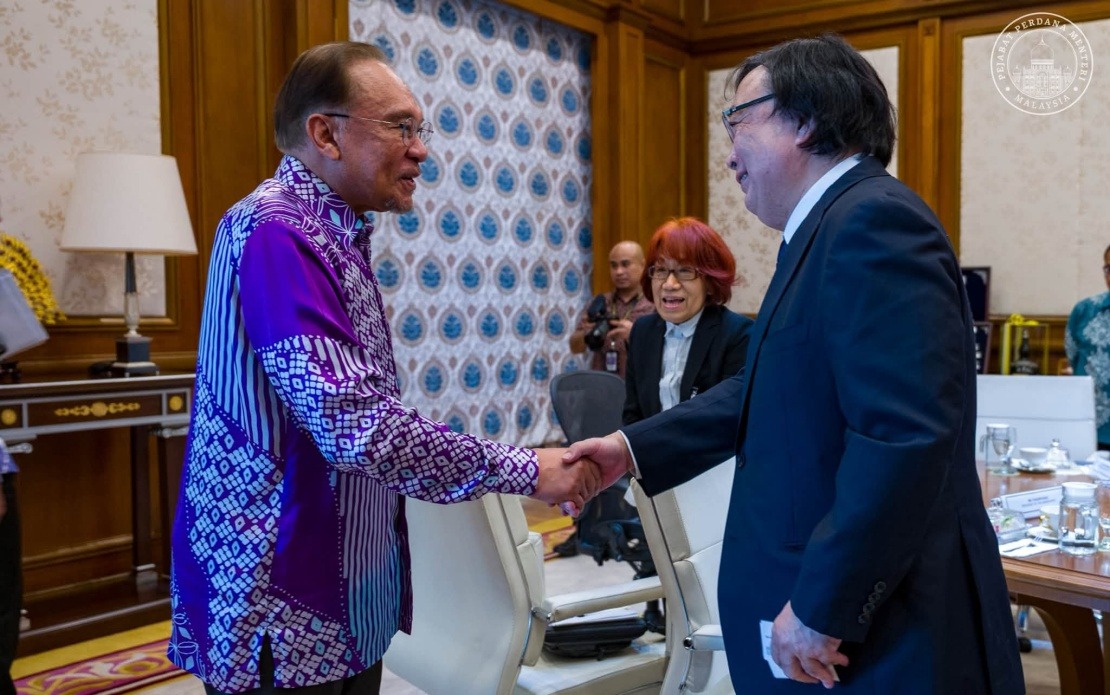
Prime Minister Datuk Seri Anwar Ibrahim received The Genron NPO President Yasushi Kudo on July 23 for a courtesy visit centred on deepening Malaysia and Japan's institutional connections and collaborative frameworks for addressing contemporary regional and global issues. The engagement underscores Kuala Lumpur's commitment to leveraging multilateral platforms that bring together Asian leaders to tackle transnational challenges through sustained dialogue.
The Genron NPO, Japan's leading independent think tank founded to foster policy discussions and strategic analysis, has positioned itself as a key convener for intellectual and political exchange across Asia. Its initiatives, particularly the Asia Leaders Roundtable, serve as informal forums where policymakers, academics, and business leaders can engage candidly on matters ranging from security architecture to economic integration. For Malaysia, participation in such platforms reflects the nation's broader strategy of remaining deeply embedded in regional diplomatic networks despite shifting geopolitical currents.
During the discussion, both sides reaffirmed their commitment to the Comprehensive Strategic Partnership established between Malaysia and Japan, a relationship that extends beyond conventional diplomatic ties into areas of defence cooperation, technological collaboration, and people-to-people exchanges. Anwar highlighted Japan's position as one of Malaysia's most consequential strategic and economic partners in Asia, a status earned through decades of investment, trade, and institutional partnerships. Japan's contribution to Malaysia's industrial development and technological capacity has been substantial, making the bilateral relationship foundational to Kuala Lumpur's economic prosperity and strategic autonomy.
Anwar used the occasion to express gratitude for Japan's hospitality during his June official visit, signalling Malaysia's appreciation for the warm reception accorded to senior Malaysian delegations. Such gestures, though ceremonial, carry diplomatic weight in East Asian political culture, where acknowledgment of hospitality and respect reinforces mutual goodwill. The Prime Minister's personal gratitude, communicated through a Facebook post, demonstrates his engagement with relationship-building at the highest level and reflects Malaysia's investment in maintaining warmth within its partnerships amid broader regional tensions.
The meeting also centered on Malaysia's participation in The Genron NPO's flagship conferences. Anwar extended appreciation for his invitation to address the Tokyo Conference 2027, an event anticipated to draw Asia's leading policymakers. Additionally, he acknowledged the platform provided to him at the 2026 conference, where he delivered a video message. These opportunities allow Malaysian leadership to articulate the nation's perspectives on regional issues to an influential gathering of Asian decision-makers, enhancing Malaysia's soft power and positioning on matters affecting Southeast Asian interests.
The Asia Leaders Roundtable initiative holds particular relevance for Malaysia at a time when regional cohesion is being tested by great power competition, maritime disputes, and divergent strategic priorities. As ASEAN struggles to maintain unity and effectiveness in responding to external pressures, Track Two dialogues facilitated by think tanks like Genron NPO provide valuable spaces for frank discussions that official channels may not accommodate. Malaysia's active engagement in these forums reflects Kuala Lumpur's pragmatic approach to navigating a multipolar Asia where informal networks complement formal institutional arrangements.
Japan itself has increased investment in regional dialogue mechanisms as it seeks to bolster its strategic influence in Asia through intellectual and diplomatic engagement rather than military posturing alone. The Genron NPO's expansion of its Asia Leaders Roundtable serves Tokyo's broader objective of shaping regional norms and supporting a rules-based order that underpins Japan's prosperity and security. Malaysia, with its geographic centrality, maritime significance, and position as a trusted voice within ASEAN, holds particular value to Japan's regional strategy.
For Malaysia specifically, deepening ties with Japan through channels such as The Genron NPO offers several advantages. First, it provides access to one of Asia's most developed economies and most influential policymaking circles at a time when Southeast Asia seeks partnerships with developed nations to balance great power pressures. Second, it reinforces Malaysia's identity as a responsible regional actor committed to peaceful resolution of disputes and institutional cooperation. Third, it creates pathways for Malaysian voices to influence regional discourse on critical issues affecting Southeast Asian stability and prosperity.
The timing of this engagement is significant given the evolving security landscape in the Indo-Pacific. With maritime disputes in the South China Sea remaining contentious, with tensions in the Taiwan Strait affecting regional stability, and with competing visions for regional order gaining traction, forums that bring Asian leaders together for candid discussion become increasingly valuable. Malaysia, which has territorial interests in the South China Sea yet maintains careful diplomatic balance with all major powers, benefits from participating in dialogues that emphasise shared prosperity and peaceful coexistence.
Anwar's emphasis on pursuing shared peace, stability, and prosperity reflects Malaysia's foundational approach to foreign policy, one rooted in non-alignment principles adapted to contemporary geopolitical realities. By engaging actively with Japan through platforms like The Genron NPO, Malaysia demonstrates that strengthening bilateral relationships and participating in multilateral dialogue mechanisms are complementary rather than contradictory strategies. This approach allows Kuala Lumpur to deepen ties with individual partners while maintaining space for independent policy choices.
The meeting itself, though not producing headline-grabbing announcements, represents the ongoing institutional engagement that characterises mature strategic partnerships. The renewal of commitments to dialogue, the exchange of courtesies, and the alignment of expectations for future cooperation all contribute to the stability and depth of the Malaysia-Japan relationship. Such interactions, multiplied across numerous bilateral pairs and institutional forums throughout the region, create a denser web of connections that incentivises peaceful resolution of disputes and cooperative approaches to shared challenges.
Looking forward, Malaysia's continued participation in The Genron NPO's initiatives and the Asia Leaders Roundtable offers opportunity for Malaysian policymakers to contribute to regional thinking on critical issues and to position the nation's perspectives within influential networks of Asian leaders. As regional dynamics continue to shift, maintaining and strengthening such connections becomes ever more important for small and medium powers seeking to influence outcomes affecting their interests. The visit by Yasushi Kudo thus exemplifies the quiet diplomatic work that underpins Malaysia's strategic engagement with one of Asia's most important partners.

