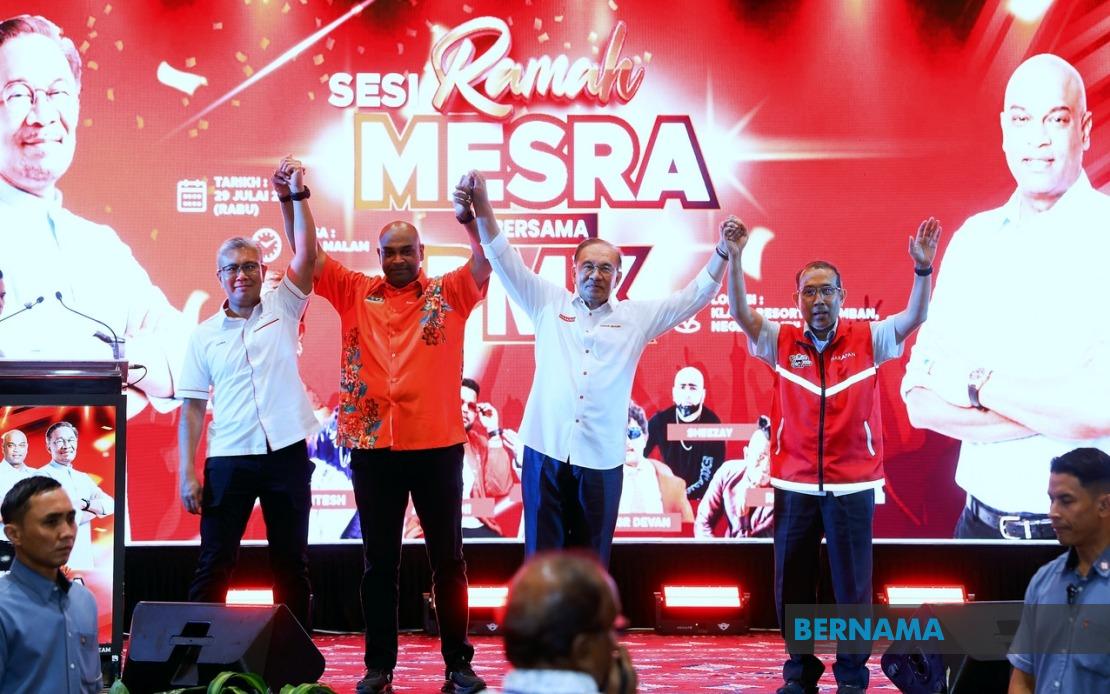
Prime Minister Datuk Seri Anwar Ibrahim has signalled a significant shift in how the federal government will handle policy matters affecting the Indian community by assuming direct personal oversight of the portfolio. Speaking at a community engagement event in Seremban on July 29, Anwar outlined his intention to monitor and guide issues affecting Indian Malaysians, a move he framed as essential for ensuring that government responses remain comprehensive and responsive to community needs across multiple economic and social dimensions.
The Prime Minister's decision to take the reins directly does not represent a diminishment of Human Resources Minister Datuk Seri R. Ramanan's responsibilities, according to Anwar's clarification. Instead, the arrangement reflects a dual-layer governance approach in which Ramanan continues executing programmes and initiatives already in motion, while Anwar provides strategic direction and ensures that cross-ministry coordination remains robust. This structure suggests recognition that Indian community issues, which span economic development, entrepreneurship, and welfare, require coordination beyond any single ministry's traditional remit.
Among the specific areas Anwar indicated he would personally monitor are the financing mechanisms available to Indian entrepreneurs and small business owners. The National Entrepreneurial Group Economic Fund, commonly known as TEKUN, and Amanah Ikhtiar Malaysia represent critical pathways through which community members access capital for business ventures. By placing these programmes under his direct purview, Anwar is signalling that access to financing and entrepreneurial support will receive prime ministerial attention, potentially accelerating approvals or removing bureaucratic bottlenecks that may have previously hindered applications.
Financing guarantee schemes also fall within Anwar's expanded scope of personal oversight. These mechanisms are particularly important for Indian Malaysians seeking to access bank credit, as guarantee schemes reduce lender risk and make borrowing more accessible to those without substantial collateral. By taking direct responsibility for this area, Anwar is positioning himself to ensure that guarantee schemes function smoothly and that any systemic issues impeding access are addressed swiftly at the highest level of government.
Beyond economic development initiatives, Anwar's commitment encompasses broader welfare and social development programmes targeting the Indian community. This encompasses healthcare access, education support, housing assistance, and other dimensions of social welfare that significantly impact quality of life. The Prime Minister's personal involvement suggests that such matters will receive elevated priority in budget allocations and policy formulation, rather than being treated as secondary concerns within larger ministerial portfolios.
The Malaysian Indian Community Transformation Unit, referred to locally as MITRA, constitutes another focal point of Anwar's oversight, though he clarified that his expanded remit extends beyond this single entity. MITRA was established as a dedicated institutional mechanism to develop and implement community-focused policies and programmes. By taking personal charge of matters both within and beyond MITRA's formal scope, Anwar is essentially creating an informal but powerful mechanism for rapid problem-solving and policy adjustments whenever Indian community concerns emerge.
Anwar's public announcement of this commitment carries significant political implications within Malaysia's multicommunal context. The Indian community, comprising approximately six percent of the national population, has historically expressed concerns about representation and resource allocation at the federal level. By visibly and directly engaging with Indian community affairs at the prime ministerial level, Anwar is attempting to address perceptions of marginalization and demonstrate substantive political commitment beyond rhetorical gestures. Such visible leadership on community-specific issues can influence electoral dynamics, particularly in constituencies with substantial Indian populations.
The move also reflects pragmatic recognition that effective governance in multicommunal Malaysia requires deliberate mechanisms to ensure that minority communities receive adequate policy attention. Without such structural arrangements, issues affecting smaller communities can be subsumed within broader national agendas or inadvertently neglected through bureaucratic processes designed primarily for majority-community concerns. By creating a direct reporting line to his office, Anwar is establishing institutional guardrails against such marginalization.
For the Indian community itself, the implications extend across multiple dimensions. Entrepreneurs may experience more responsive processing of financing applications when prime ministerial oversight ensures that bureaucratic workflows prioritize expeditious decision-making. Communities experiencing welfare challenges may find that problems reaching Anwar's attention receive rapid escalation and resource mobilization. At a systemic level, the presence of high-level political attention creates incentives for civil servants implementing community programmes to maintain performance standards and responsiveness.
The statement also carries subtle messaging about Anwar's broader governance philosophy. By personally involving himself in what might be considered specialized policy areas, he signals that his leadership style emphasizes hands-on engagement rather than purely delegative management. This approach, while potentially labour-intensive, can generate political capital by demonstrating attentiveness to constituent concerns and willingness to intervene directly when systemic issues arise.
For Malaysian policymakers and officials working on community development programmes, Anwar's announcement creates both opportunity and accountability. The opportunity lies in potential acceleration of initiatives that receive prime ministerial attention, as bureaucratic processes often move more swiftly when senior political leadership has visibly invested in outcomes. The accountability dimension means that officials responsible for Indian community programmes now operate under enhanced scrutiny, with performance expectations clearly elevated by the Prime Minister's public commitment.
Regionally, Anwar's focus on community-specific governance reflects trends visible across Southeast Asia, where successful political leaders increasingly employ targeted policies addressing ethnic or religious communities rather than treating all citizens through identical policy frameworks. This approach acknowledges that communities have distinct historical experiences, socioeconomic circumstances, and policy requirements. Whether Anwar's personal oversight of Indian community affairs becomes a model for handling other communities' concerns remains to be seen, but the statement suggests recognition that inclusive governance in diverse societies requires deliberate, community-attentive mechanisms.

