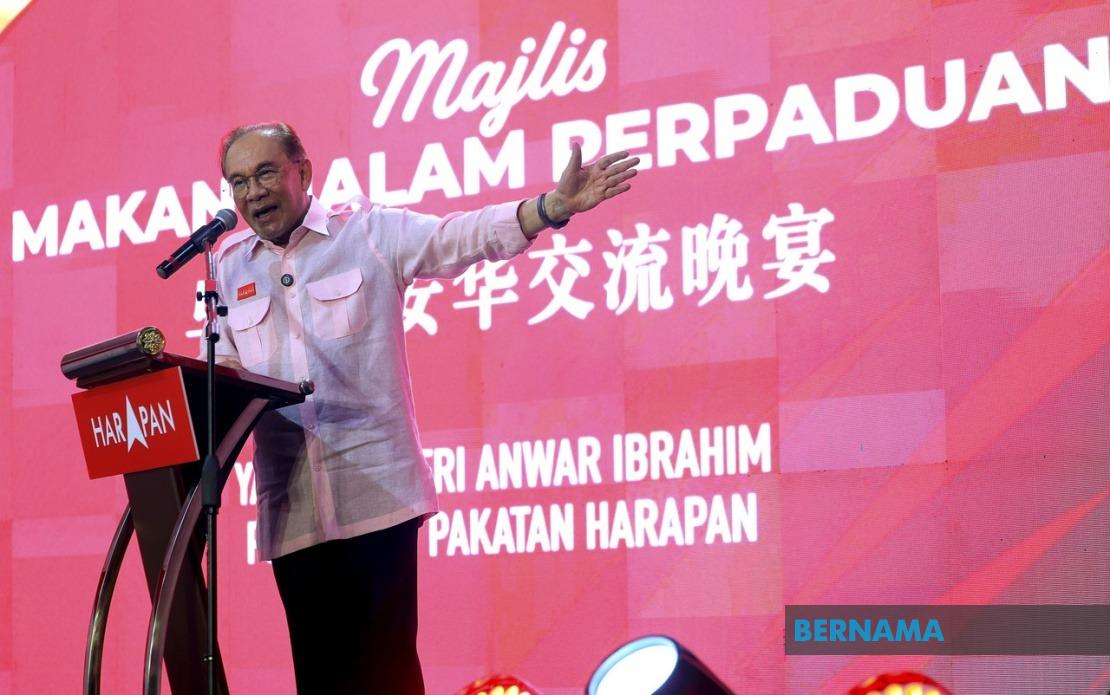
Prime Minister Datuk Seri Anwar Ibrahim has cast a critical eye on what he characterises as the unseemly scramble among opposition parties to claim the menteri besar's post in Negeri Sembilan, warning that internal squabbling undermines effective governance. Speaking at a campaign dinner in Sikamat on Monday evening, the Pakatan Harapan chairman highlighted the contrasting priorities of the coalitions contesting the August 1 state election, framing the choice for voters as one between proven leadership and factional competition.
Anwar's remarks carry strategic weight in a closely watched state contest that will test the Unity Government's electoral fortunes outside federal territories. The implicit argument presented to Negeri Sembilan voters centres on stability and focus: rather than allowing opposition factions to fracture over leadership spoils, the electorate should consolidate support behind an administration with a documented record. The timing of such criticism—made during an official campaign event—signals that PH strategists view opposition infighting as a tangible electoral asset.
The Prime Minister expressly praised Negeri Sembilan Menteri Besar Datuk Seri Aminuddin Harun, who is contesting his seat as the PH candidate for Linggi. Anwar emphasised Aminuddin's stewardship of the state administration, pointing to governance metrics including fiscal discipline and the absence of major corruption scandals under his tenure. This endorsement serves multiple purposes: it consolidates the menteri besar's standing within PH ahead of polling day, neutralises any potential internal challenges to his re-nomination, and provides voters with a clear continuity narrative.
Beyond the leadership question, Anwar took aim at what he termed divisive racial narratives being deployed by unnamed quarters during campaign activities. His critique suggests that some opposition candidates or sympathetic voices are employing communal messaging designed to mobilise along ethnic lines. The Prime Minister countered this approach by restating the Unity Government's commitment to inclusive governance, a cornerstone of the coalition's positioning since its 2022 formation.
Anwar's articulation of inclusive governance extended to specific policy commitments affecting multiple communities. He referenced enhanced socio-economic allocations, expanded housing programmes, and salary adjustments for civil servants as concrete manifestations of the Unity Government's cross-communal approach. For Malaysian voters accustomed to zero-sum communal politics, such framing—coupling rhetorical inclusivity with material benefits across demographics—represents a distinct strategic positioning.
The Negeri Sembilan contest features Pakatan Harapan contesting all 36 state assembly seats in a straight-up battle against a fragmented opposition. The coalition's internal seat distribution reflects its federal composition: PKR fields 16 candidates, DAP 11, and Amanah nine. This allocation mirrors PH's agreed power-sharing structure and signals internal equilibrium, a contrast to opposition formations where leadership vacancies and succession questions have generated instability. Early voting is scheduled for July 28, with the main polling day on August 1.
For Negeri Sembilan specifically, the menteri besar's office holds particular symbolic and administrative importance. The state has experienced relative economic growth under PH administration, with visible infrastructure development and improved fiscal management compared to previous tenures. Aminuddin's personal profile—seen as technocratic and relatively low-profile—has allowed PH to govern without the kind of political theatre that sometimes overshadows state-level administration elsewhere in Malaysia.
The opposition's apparent disunity over the menteri besar succession presents a vulnerability that Anwar explicitly seeks to weaponise. In Malaysian state politics, where menteri besar posts command considerable influence over resource distribution and patronage networks, such jostling for position before an election is uncommon and suggests confidence gaps within opposition ranks regarding electoral prospects. Whether this internal competition reflects genuine uncertainty or merely routine manoeuvring will become clearer once nomination lists are finalised.
Anwar's messaging also implicitly addresses voter fatigue with traditional Malaysian political narratives. Rather than counter opposition racial appeals with competing communal arguments, the Prime Minister presents a forward-looking alternative centred on delivery and competence. This tactic assumes that significant voter segments, particularly in urbanised and swing constituencies, prioritise material outcomes over identity-based messaging—a calculation that successive electoral cycles have validated to varying degrees.
The presence of other PH candidates at the Sikamat event—including Nor Azman Mohamad for Sikamat and Datuk Muhammad Nazri Kassim for Ampangan—underscored the coalition's unified campaign structure. Unlike opposition formations, where internal competition sometimes spills into public criticism, PH candidates appeared aligned behind a common narrative. This organisational coherence, however difficult to sustain across a multiparty coalition, represents an institutional advantage in state-level contests where local issues interact with federal political currents.
Looking beyond Negeri Sembilan, the election serves as a barometer for Unity Government resilience amid ongoing federal political volatility. Anwar's personal focus on the campaign—appearing at grassroots events rather than confining himself to ceremonial duties—signals that PH considers this contest consequential for coalition morale and federal political momentum. Conversely, a strong opposition showing could energise voices critical of the Unity Government at the federal level.
The August 1 polling will ultimately determine whether voters respond to Anwar's framing of governance competence over internal opposition squabbling, or whether other factors—local grievances, communal concerns, or anti-incumbency sentiment—prove decisive. In either scenario, the election outcome will reverberate across Malaysian politics and provide fresh evidence of where voter preferences lie in an era of coalition-based governance.

