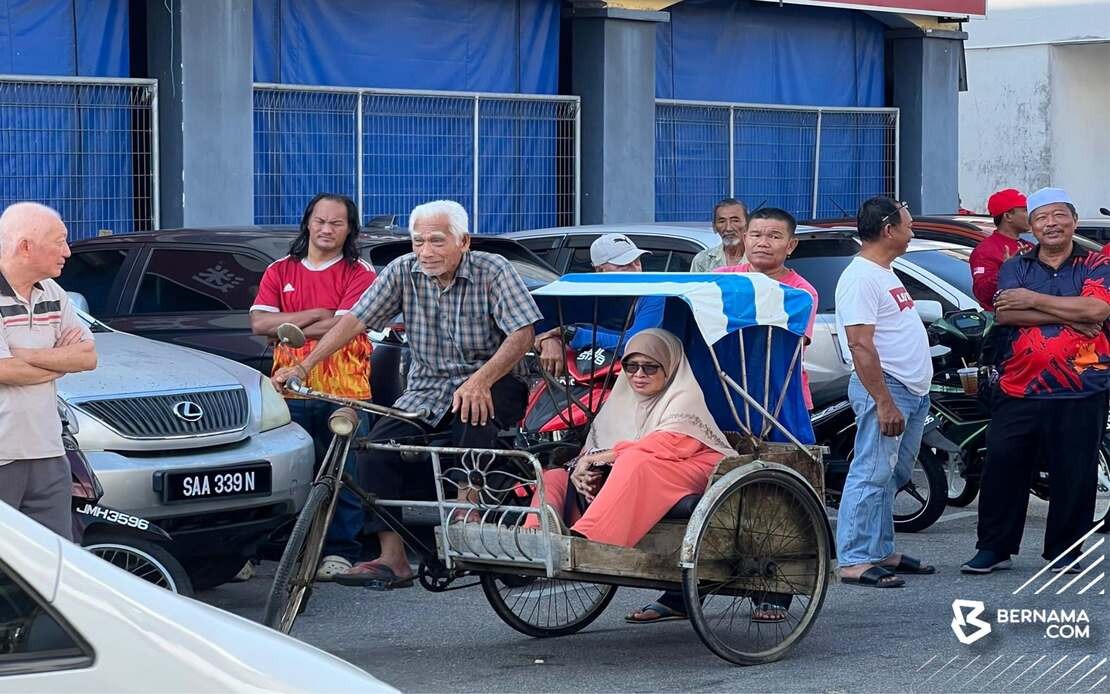
Prime Minister Datuk Seri Anwar Ibrahim has publicly acknowledged the touching gesture of an elderly Johor resident who made an extraordinary effort to catch a glimpse of the country's leader during a campaign visit to the state. The premier took to social media to express his gratitude toward Abdul Razak Pelangga, an 86-year-old who embarked on a trishaw journey from his home in Kampung Parit Bugis to meet Anwar at a local coffee shop in Senggarang, Batu Pahat.
The incident unfolded during a routine campaign stop on behalf of the Senggarang state constituency in connection with the Johor State Election. When Anwar made a breakfast visit to Kedai Kopi Hailam Sri Medan in this modest Johor town, he spent approximately 50 minutes engaging with local residents through an informal meet-and-greet session. What Anwar later discovered, however, was that one couple's determination to participate in this opportunity had gone well beyond typical attendance.
According to accounts of the encounter, Abdul Razak Pelangga learned of Anwar's planned visit only the day before. Rather than simply hoping to catch the prime minister's attention, he resolved to personally introduce his 64-year-old wife, Jamilah Samsudin, to the nation's top political leader. The couple lived in a neighbourhood not immediately adjacent to Senggarang, creating a logistical challenge that would have deterred most individuals of advanced age.
Despite having access to alternative transportation methods—a car and motorcycle were available to him—Abdul Razak made the deliberate choice to pedal his trishaw with his wife aboard for the nearly one-kilometre distance. He calculated that using motorised transport would create complications in locating adequate parking at the crowded establishment, a practical consideration that shaped his decision-making. His role as imam of Masjid Raudhatul Jannah Parit Bugis suggests a community-minded individual accustomed to thinking through logistics and maintaining dignity in public engagement.
Unfortunately, the couple's heroic effort to connect with Anwar did not result in an in-person meeting during the breakfast service. Despite their journey and evident commitment to attending, the timing and logistics of the crowded venue meant that direct contact between the couple and the prime minister was not realised. Rather than expressing disappointment, however, Anwar opted to acknowledge their gesture through a later Facebook statement, demonstrating awareness of their sacrifice.
In his social media response, Anwar conveyed sincere apologies for missing the opportunity to meet the couple face-to-face. He framed the missed encounter not as a final closing of dialogue but as a deferral of connection, expressing confidence that "InsyaAllah, we will meet another time." This language carries religious significance within Malaysia's Islamic cultural context, invoking God's will while maintaining openness to future interaction. Such phrasing also resonates with Malaysian audiences familiar with the integration of faith-based expressions in political discourse.
The prime minister's message extended beyond simple courtesies to include explicit appreciation for their encouragement and political support. He invoked a blessing upon the couple, wishing them continued good health and resolution of their life circumstances through divine grace. Such language reflects both genuine sentiment and an understanding of how Malaysian voters—particularly older citizens in rural areas—value acknowledgment and respect from national leadership.
This episode carries broader significance for understanding Malaysian politics beyond the immediate personal interaction. It illustrates the enduring appeal of direct engagement between political leaders and constituents, particularly in regional towns and villages where such visits represent significant events. For an elderly couple in Batu Pahat, meeting the prime minister held sufficient importance to motivate a physically demanding journey, indicating the symbolic weight that such encounters carry in Malaysian political culture.
The incident also reflects generational attitudes toward civic participation and respect for national leadership. Abdul Razak Pelangga's willingness to exert himself physically on behalf of his wife's wish to see Anwar speaks to values of familial duty and commitment to meaningful political participation that characterise older Malaysian voters. His trishaw journey, while capturing public attention, represents a more general pattern of how rural and semi-rural Malaysians engage with campaigns and leadership visits.
From a political strategy perspective, Anwar's public acknowledgment of the couple's gesture demonstrates sophisticated understanding of how single acts of human connection can amplify campaign messaging far beyond the immediate moment. Rather than allowing the missed encounter to fade unnoticed, his Facebook statement transformed it into a story of popular engagement and mutual respect, reaching far broader audiences than those physically present in Senggarang that morning.
The story also underscores the particular significance of the Johor State Election context within which this visit occurred. Johor has traditionally represented contested political territory, with different parties competing for voter support across various demographic groups. Moments of authentic human connection between political leadership and voters—whether fully realised or poignantly missed—contribute to the broader narrative that campaigns construct around themselves.

