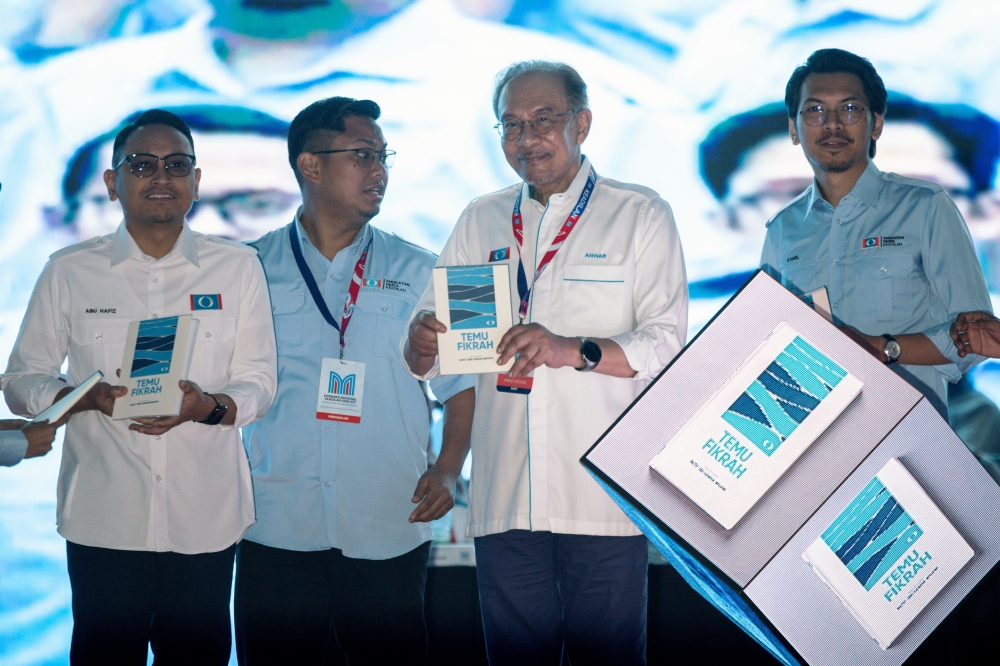
Prime Minister and Parti Keadilan Rakyat (PKR) president Datuk Seri Anwar Ibrahim has introduced Temu Fikrah, an ambitious ideological document from the party's youth wing that synthesizes party values with contemporary governance approaches. The launch in Melaka represents a significant moment for PKR's generational transition, positioning younger party members as architects of the Madani governance framework that continues to define the administration's policy direction.
The document functions simultaneously as both political manifesto and operational manual, a dual structure that reflects PKR Youth's ambition to bridge abstract political philosophy with tangible policy implementation. Rather than serving merely as aspirational rhetoric, Temu Fikrah is designed to provide younger party cadres and potential administrators with concrete guidelines for translating party ideology into governmental practice. This approach signals confidence in the youth wing's capacity to shape institutional decision-making and resource allocation across multiple sectors.
Courage emerges as a central pillar throughout the manifesto, framed not as reckless action but as principled commitment to reform despite institutional resistance and entrenched interests. Within the Malaysian political context, where institutional conservatism and bureaucratic inertia frequently obstruct progressive initiatives, this emphasis on courageous governance carries particular resonance. The document appears to challenge younger PKR members to confront systemic barriers that have historically impeded transformation, positioning them as catalysts for deeper institutional change than incremental adjustments alone might achieve.
Creativity constitutes the second foundational element, acknowledging that persistent governance challenges require innovative problem-solving beyond conventional approaches. This recognition reflects global trends toward design-thinking and experimental policy-making, yet applies these concepts within Malaysia's specific administrative and political environment. For a government navigating competing demands from urban and rural constituencies, balancing development with sustainability, and managing expectations across diverse communities, creative governance frameworks offer pathways that traditional bureaucratic solutions may not provide.
The Madani governance concept, which anchors both the document and broader government initiatives, emphasizes civilisational values, dignity, and human-centric development. By explicitly connecting youth activism to Madani principles, Temu Fikrah positions younger generation engagement not as peripheral youth engagement but as foundational to the government's strategic direction. This integration suggests that PKR Youth will play expanding roles in policy formulation and programme implementation across priority areas including education, digital transformation, economic competitiveness, and social cohesion.
For Malaysian readers observing domestic politics, this launch reflects internal PKR consolidation following leadership transitions and organisational restructuring. Strengthening the youth wing through ideological documentation and operational frameworks indicates deliberate succession planning within the party. As the current political generation looks toward eventual transitions, investing in youth capacity and clarity around institutional values becomes essential for maintaining organisational coherence and electoral competitiveness.
The manifesto-manual format also signals awareness that contemporary governance demands require party members to function as both political advocates and competent administrators. Rather than separating ideological commitment from technical competence, Temu Fikrah insists that effective governance emerges from synthesizing both dimensions. This has implications for how PKR structures training, mentorship, and career development for younger members aspiring to electoral candidacy or civil service leadership roles.
Regionally, Malaysia's approach to youth political engagement through structured ideological frameworks contrasts with patterns in neighbouring Southeast Asian democracies where youth political participation often remains fragmented or institutionally marginalised. By explicitly documenting youth-centred governance philosophy, PKR contributes to regional conversations about generational transitions within political parties and institutional adaptation to demographic change.
The emphasis on both courage and creativity within a documented framework also addresses a persistent tension in Malaysian governance: the need for decisive action balanced against institutional constraints and competing stakeholder interests. By framing these competing demands as creative challenges rather than paralyzing contradictions, Temu Fikrah offers younger administrators conceptual tools for navigating complexity without succumbing to either paralysis or overreach.
Looking forward, the practical impact of Temu Fikrah will depend substantially on whether PKR Youth can translate the document's principles into sustained institutional change. The manifesto's utility will be measured not by its eloquence but by its influence on party recruitment criteria, civil service appointment recommendations, budget allocation decisions, and policy prioritisation within PKR-led state and federal initiatives. If successfully operationalised, this document could reshape how Malaysia's ruling coalition approaches generational transitions and institutional renewal during a period of significant political realignment and electoral competition.

