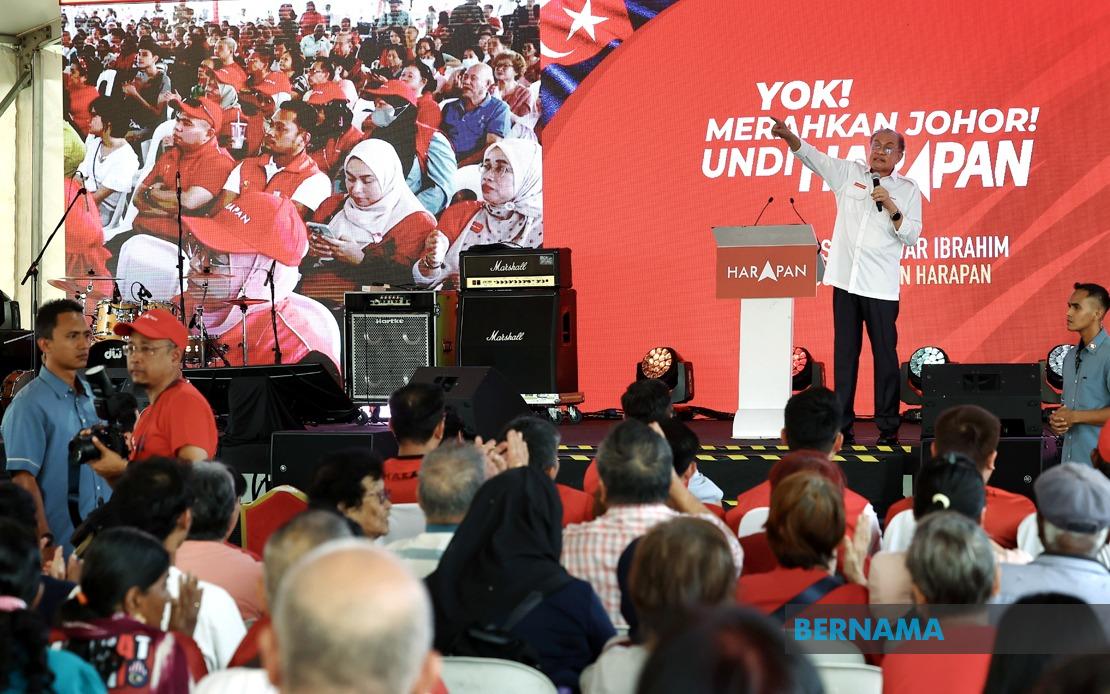
Prime Minister Datuk Seri Anwar Ibrahim has drawn a line under the question of Datuk Seri Najib Razak's imprisonment, warning political contenders in the Johor state election to cease exploiting the matter as campaign ammunition. Speaking at a Pakatan Harapan rally in Kulai on July 10, Anwar made clear his position that continued references to the former premier's custodial status have become counterproductive to substantive political discourse, particularly when pressing matters demand attention.
The premier's intervention reflects growing concern about the tone and content of the Johor campaign, where opposition figures have repeatedly called for Najib's release since his conviction on corruption charges. Anwar's message was unequivocal: with Najib already serving his sentence, parties ought to move beyond this line of attack and concentrate instead on policies affecting everyday Malaysians. His remarks suggest an attempt to steer public conversation away from a divisive issue that may polarise voters along factional rather than substantive policy lines.
An underlying tension animates Anwar's position, however. His government continues to grapple with the financial aftermath of the 1MDB scandal that triggered Najib's downfall. The administration faces a RM51 billion debt burden inherited from the controversial sovereign wealth fund's mismanagement under the previous administration. This colossal sum represents not merely a historical accounting problem but an ongoing constraint on the government's ability to deliver on electoral promises to voters.
Acknowledging this reality, Anwar articulated the opportunity cost of servicing 1MDB obligations. Were the government not burdened by these repayments, those funds could theoretically be redirected toward essential infrastructure and social programmes. Schools could be better equipped, hospitals adequately staffed and resourced, roads maintained to higher standards, and targeted assistance delivered to vulnerable populations. The gap between what could be and what is remains a tangible source of frustration for policymakers attempting to address Malaysia's development agenda.
The timing of Anwar's intervention carries political significance. With the Johor state election underway, his appeal to competing parties represents an effort to elevate campaign discourse above personalised attacks on individual political figures. By suggesting that continued focus on Najib's fate constitutes politicisation rather than legitimate democratic debate, the prime minister has attempted to reframe the terms of engagement. This manoeuvre may also serve domestic coalition management, signalling to Pakatan Harapan components that unity around forward-looking policy platforms matters more than reopening unresolved grievances.
Yet the request implicitly acknowledges that Najib's imprisonment remains politically potent for certain constituencies. Opposition parties, particularly those in the Perikatan Nasional coalition, have successfully mobilised segments of the electorate by framing the former premier as a victim of selective prosecution. The fact that Anwar felt compelled to address this issue publicly suggests the opposition strategy has gained sufficient traction to warrant prime ministerial attention. This dynamic reveals a fracture in Malaysian politics where the 1MDB scandal continues to divide voters along lines that do not neatly correspond to conventional left-right ideological spectrums.
The 1MDB question also illuminates broader governance challenges confronting the current administration. Beyond the immediate budgetary constraints, the scandal's legacy complicates Malaysia's international standing and investor confidence. Global perceptions of governance quality and institutional integrity remain shadowed by associations with the fund's mismanagement, even as new leadership attempts to chart a different course. Anwar's emphasis on moving past Najib therefore serves not only immediate electoral interests but also signals to international observers that Malaysia intends to consolidate reforms rather than relitigate historical disputes.
From a Southeast Asian perspective, Malaysia's handling of high-level corruption cases matters for regional governance standards. Neighbouring countries closely observe how major democracies in the region address elite misconduct. Anwar's call for restraint, while potentially frustrating to those seeking more severe accountability measures, reflects recognition that sustainable governance depends on transitional justice frameworks that balance accountability with institutional stability. This approach contrasts sharply with prosecutorial approaches in other regional contexts where political rivalries have generated cycles of revenge prosecutions.
The presence of Youth and Sports Minister Mohammed Taufiq Johari and other coalition figures at the rally underscored the unified messaging Pakatan Harapan seeks to project. By anchoring the campaign around economic management and welfare rather than backward-looking reckonings, the government coalition hopes to appeal to future-oriented voters concerned with livelihood improvement rather than political history. This strategic recalibration reflects lessons from previous campaigns where excessive focus on personal grievances alienated swing voters.
Anwar's appeal ultimately rests on a wager about voter priorities. If Johor constituents prove more responsive to promises of improved services and economic opportunities than to broader narratives about accountability and justice, his approach may yield electoral dividends. Conversely, should opposition framing of the Najib issue resonate powerfully despite his dismissal, the prime minister's attempt to change the subject may prove ineffective. The coming weeks will test whether his authority is sufficient to redirect a campaign already shaped by competing versions of recent political history.

