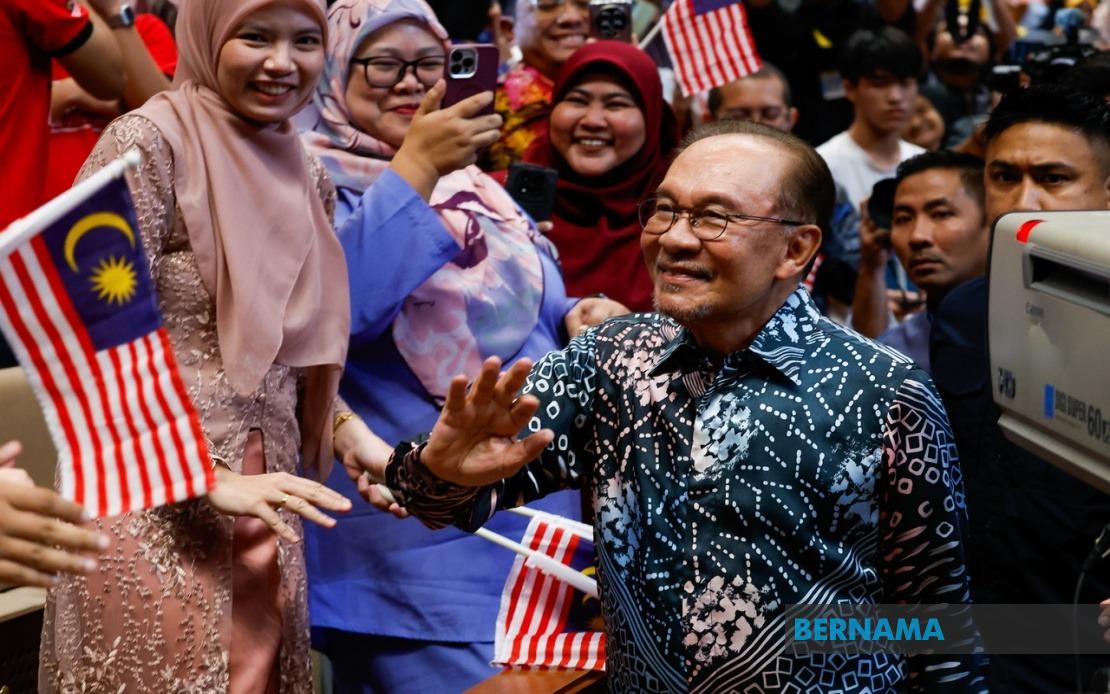
Prime Minister Datuk Seri Anwar Ibrahim has issued a clarion call for Malaysians to internalize and sustain the spirit of independence not as a historical milestone to be commemorated annually, but as a living, breathing ethos that should guide contemporary nation-building efforts. Speaking at the Putrajaya International Convention Centre during the National Day address, Anwar articulated a vision of independence that extends far beyond constitutional arrangements or governmental structures, positioning it instead as a philosophical commitment that must reside within the conscience of every citizen regardless of background or circumstance.
The Prime Minister's framing represents a deliberate shift in how Malaysia's independence narrative is typically presented. Rather than focusing on the date of sovereignty or the mechanics of institutional independence, Anwar has repositioned the concept to encompass psychological and spiritual dimensions. He contends that the nation's greatest remaining challenge lies not in external threats or systemic inadequacies alone, but in the collective capacity of Malaysians to embrace authentic independence of thought, purpose, and action. This reorientation suggests that decades after formal independence, the country continues to grapple with deeper questions about national identity and the meaning of self-determination in contemporary Southeast Asian context.
Central to Anwar's message is the imperative of unity across Malaysia's diverse communities. He referenced the wisdom of founding leaders who conceived of nation-building not through the lens of racial or geographic divisions, but as a generational endeavor requiring every citizen's participation and commitment. The invocation of this founding principle carries particular resonance given ongoing tensions within Malaysian society over resource distribution, religious interpretation, and the proper balance between collective welfare and individual liberty. By anchoring contemporary unity efforts to historical precedent, Anwar frames inter-communal cooperation not as a modern innovation but as fidelity to established national foundations.
Anwar's emphasis on Malays and Bumiputeras as the constitutional and cultural core of the nation, coupled with his simultaneous call for inclusive participation from all communities, reflects the delicate political balance Malaysia must navigate. This articulation acknowledges constitutional provisions while asserting that demographic and historical primacy need not preclude genuine partnership across racial lines. The formulation suggests that true independence cannot be realized when significant portions of the population feel marginalized or excluded from meaningful participation in nation-building and governance.
The dignity and rights framework that Anwar introduced into his independence message carries particular weight for regional observers. By positioning the defense of rights and upholding of justice as central components of maintaining independence, the Prime Minister signals that political freedom without equitable treatment of citizens remains incomplete. This approach resonates with broader Southeast Asian struggles to reconcile rapid development with democratic accountability, and to ensure that economic progress does not come at the expense of fundamental human dignity.
The gathering of senior government figures, including Deputy Prime Minister Datuk Seri Dr Ahmad Zahid Hamidi, Communications Minister Datuk Seri Fahmi Fadzil, and Chief Secretary to the Government Tan Sri Shamsul Azri Abu Bakar, underscores the formal nature of this articulation of national vision. These individuals collectively represent the government's executive machinery, suggesting that Anwar's message carries institutional weight beyond mere rhetorical flourish. The presence of such figures indicates coordinated messaging around themes of unity, independence, and collective responsibility.
For Malaysian readers, particularly younger citizens who may not have experienced the independence struggle firsthand, Anwar's address presents independence not as a historical achievement to be preserved unchanged, but as an ongoing project requiring perpetual recommitment. This frames contemporary challenges not as departures from original national vision, but as the inevitable work of each generation in translating founding principles into practical governance. The emphasis on continuous renewal suggests that complacency represents a greater threat to independence than external challenges.
The reference to rebuilding from ruins carries metaphorical weight, suggesting that the nation confronts substantial reconstruction challenges across multiple dimensions. These could encompass institutional integrity, social cohesion, economic resilience, or public trust in democratic institutions. By linking this reconstruction to the internalization of independence spirit, Anwar proposes that material development and institutional reform must proceed alongside cultivation of shared values and common purpose among citizens.
From a regional perspective, Malaysia's insistence on positioning independence as an internal spiritual and philosophical matter rather than merely a formal political status distinguishes it from some neighboring states that emphasize sovereignty and territorial integrity more prominently. This orientation reflects Malaysia's particular history as a federation formed through negotiation among diverse communities, where the maintenance of independence has always required managing internal complexity rather than confronting external domination alone.
The practical implications of Anwar's vision extend to how citizens engage with institutions, discharge civic responsibilities, and participate in democratic processes. If independence genuinely depends on each person cultivating an independent spirit, then voters, civil servants, business leaders, and community members all bear responsibility for sustaining national autonomy. This distribution of responsibility moves beyond expecting political leadership alone to safeguard national interests, instead implicating every segment of society in the ongoing project of maintaining genuine independence.

