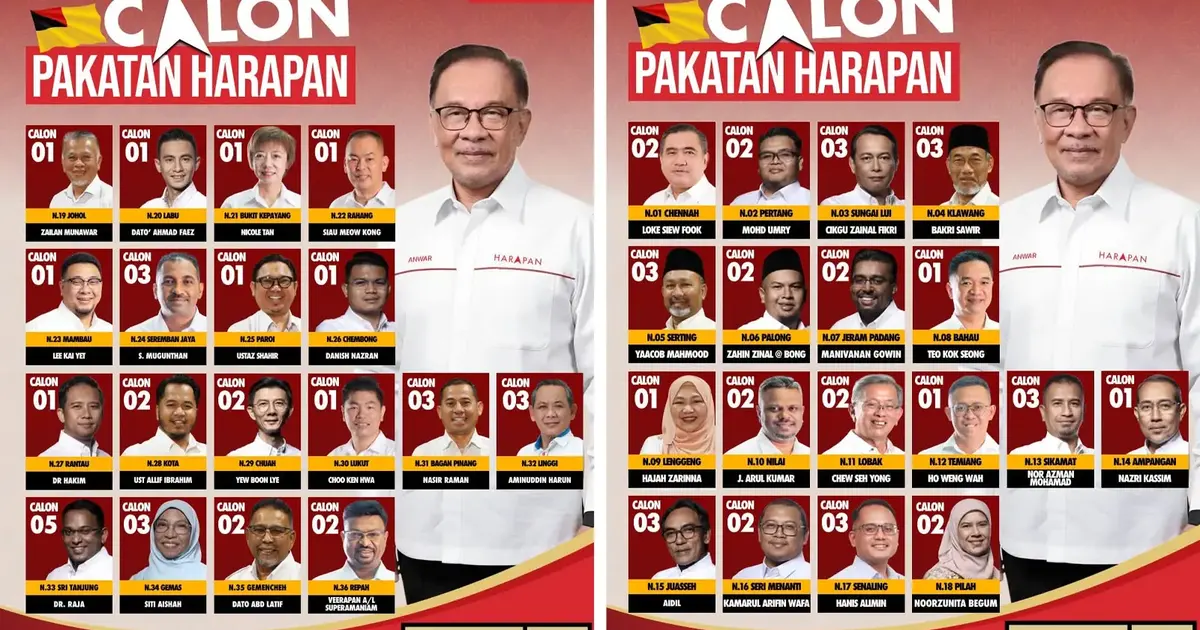
Pakatan Harapan chairman Anwar Ibrahim has made a direct appeal to voters in Negeri Sembilan, urging them to grant the ruling coalition an enhanced electoral mandate in what appears to be preparation for state-level polls. The coalition leader framed the request not as a matter of political ambition, but as a necessity for maintaining the trajectory of administrative reform and institutional integrity that has characterised the state's governance in recent years. His message reflects broader concerns within the coalition about translating widespread political support at the federal level into commanding state-level majorities.
The underlying rationale for this appeal centres on the continued stewardship of menteri besar Aminuddin Harun, whose tenure has become emblematic of the coalition's commitment to clean governance and principled administration. Anwar's invocation of Aminuddin's leadership suggests that the coalition views the Negeri Sembilan state administration as a demonstration project for its larger governance agenda, one that merits protection through electoral reinforcement. This framing transforms the election from a routine democratic exercise into a mandate on the administration's performance record and its vision for the state's future.
For Malaysian readers assessing the political landscape, this appeal warrants careful examination of what "stronger mandate" actually entails. In Malaysian electoral mathematics, state governments derive their legitimacy from assembly majorities, and increased margins fundamentally alter a menteri besar's capacity to advance substantive policy initiatives. A more commanding legislative bloc creates greater insulation against floor-crossing, provides enhanced negotiating power in state cabinet management, and signals public endorsement for specific policy directions. Conversely, narrow majorities constrain executive flexibility and expose administrations to perpetual coalition management challenges.
Anwar's emphasis on stability and principled governance reflects the coalition's attempt to position itself around institutional competence rather than purely partisan advantage. This rhetorical strategy acknowledges that Malaysian voters increasingly evaluate state governments on service delivery, corruption mitigation, and administrative efficiency. The appeal thus transcends simple party loyalty and instead grounds itself in demonstrated performance, a significant shift from traditional patronage-based political messaging. Whether this resonates with Negeri Sembilan's electorate will provide important indicators about voter priorities across the region.
The invocation of cleanliness in administration carries particular weight in Negeri Sembilan's context, given the state's historical experience with political controversies and governance challenges. A reinvigorated commitment to anti-corruption frameworks and transparent decision-making represents a clear break from preceding administrations. For a state attempting to position itself as an attractive investment destination and to restore institutional credibility, this messaging serves dual purposes: it addresses immediate electoral audiences while signalling to business communities and civil society that governance standards have fundamentally improved.
Anwar's appeal also reflects strategic calculations within Pakatan Harapan regarding state-level performance as a foundation for federal political resilience. Should the coalition achieve decisive victories in state elections, it strengthens the party leadership's narrative about grassroots support and provides political capital for navigating federal legislative challenges. Conversely, diminished state-level support, even where Harapan retains formal control, signals erosion of electoral enthusiasm that can complicate federal governance dynamics. State elections therefore function as critical barometers of coalition health in the eyes of both party members and potential coalition partners.
For Southeast Asian observers monitoring Malaysian politics, this appeal underscores persistent tensions between democratic mandates and governance stability. Malaysia's federal system creates scenarios where state administrations operate as semi-independent political entities, yet their performance substantially influences national political momentum. Anwar's intervention in Negeri Sembilan demonstrates the importance coalition leaders place on consistent state-level victories, viewing electoral setbacks as threats to broader political stability regardless of formal control retention.
The emphasis on Aminuddin Harun's particular leadership style merits attention as well. The menteri besar appears to have cultivated a reputation transcending routine partisan association, instead embedding himself as a representative of meritocratic governance and professional administration. This personalization of state governance creates interesting dynamics where individual leader credibility becomes intertwined with coalition legitimacy. Should Aminuddin achieve continued electoral validation, he simultaneously strengthens his personal political standing and validates the coalition's administrative model.
Looking toward broader implications for Malaysian politics, Anwar's appeal suggests the coalition recognizes that federal-level dominance alone provides insufficient foundation for long-term political sustainability. State governments shape citizen experiences with public services, infrastructure development, and bureaucratic responsiveness—the granular dimensions of governance that determine popular satisfaction. A coalition commanding state administrations across Malaysia's peninsular geography possesses substantially greater capacity to demonstrate administrative competence than one confined to federal levers of power.
The timing of this appeal also suggests coalition preparation for eventual state elections, indicating that political strategists anticipate electoral cycles converging within a manageable timeframe. By beginning articulation of mandate requirements well in advance, coalition leadership aims to shape voter expectations and mobilize organizational resources before formal campaigns commence. This forward planning reflects lessons absorbed from previous state election cycles where coalition coordination challenges complicated campaign execution and resource allocation.

