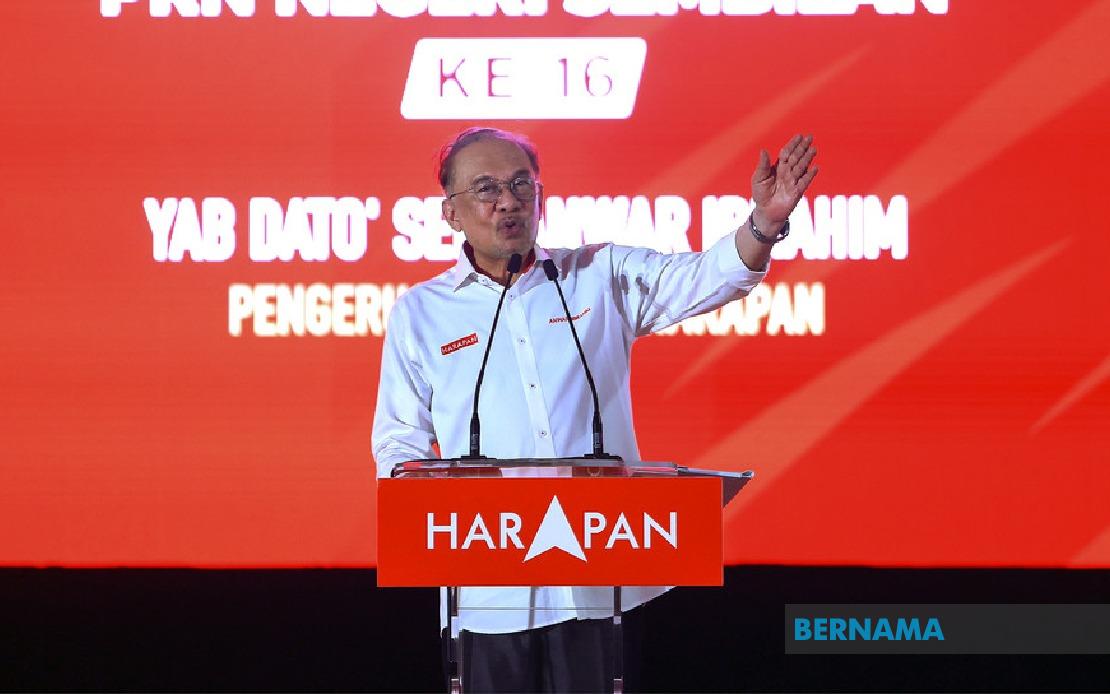
Prime Minister Datuk Seri Anwar Ibrahim has made a direct appeal to voters in Negeri Sembilan to maintain their backing for Pakatan Harapan in the state's forthcoming election, presenting the coalition's continued mandate as essential for sustaining the development trajectory established over recent years. In remarks shared on social media ahead of the 16th Negeri Sembilan state election, Anwar highlighted the tangible benefits that have materialised through joint efforts between the state and federal administrations, while signalling that the work remains incomplete without renewed electoral support.
The Prime Minister's intervention reflects the national coalition's determination to retain control of the state assembly, a prize that carries symbolic significance within Malaysia's political landscape. Anwar's framing of the election as a choice between momentum and stagnation positions Pakatan Harapan's continued governance not merely as a political preference, but as a prerequisite for forward motion on infrastructure, economic development, and public services. This messaging strategy seeks to remind voters of achievements accomplished since the coalition assumed office and to underscore the risks of allowing those initiatives to be derailed by a change in administration.
Central to Anwar's appeal has been his characterisation of Menteri Besar Datuk Seri Aminuddin Harun's leadership since 2018. The Prime Minister praised Tok Min—as he is commonly known—for stewarding the state with what he describes as integrity, humility, and a demonstrable commitment to public accountability. By coupling personal attributes with operational outcomes, Anwar has sought to build a narrative that positions the incumbent administration as trustworthy custodians of public resources and responsive to community needs. This personalisation of leadership has become increasingly important in Malaysian electoral contests, where voter decisions often hinge on perceptions of individual character alongside policy platforms.
The state-federal partnership that Anwar emphasised has indeed enabled the realisation of numerous projects across Negeri Sembilan, though the precise inventory of these initiatives remains largely implicit in public messaging. The synergy between concurrent Pakatan Harapan administrations at both levels has created conditions for coordinated policy implementation and resource allocation, advantages that would be forfeited should the state electorate choose a different political direction. For Malaysian observers tracking federalism's practical workings, Negeri Sembilan presents a instructive case study in how aligned governments at different tiers can expedite project delivery.
Anwar's call for continuity carries particular weight given the fractious nature of Malaysian coalition politics in recent years. The formation and maintenance of Pakatan Harapan itself represents a hard-won compact among disparate political forces, and every electoral victory reinforces the viability of that arrangement. A loss in Negeri Sembilan would conversely provide ammunition to coalition critics and potentially embolden rival camps seeking to fracture support. For political analysts monitoring the health of Malaysia's post-2018 reconfiguration, the outcome in this state election will offer important signals about the staying power of Pakatan Harapan as an electoral force.
The election timeline that Anwar outlined provides voters with several key dates to mark. Nominations are scheduled for Saturday, with early voting following on July 28, and the main polling day set for August 1. This compressed schedule reflects the electoral commission's operational procedures and means that campaign periods are intense and tightly choreographed. The brevity of the campaign window underscores why both coalition and opposition parties place such emphasis on pre-election messaging and mobilisation infrastructure.
Negeri Sembilan's political complexion has historically reflected broader national trends, making the state a barometer of public sentiment more generally. The state has oscillated between different political masters over recent decades, and its electoral preferences have often presaged shifts in the national political landscape. The forthcoming contest will therefore be watched closely not merely by those directly concerned with state-level governance in Negeri Sembilan, but by political operatives throughout Malaysia seeking to gauge voter receptivity to different political narratives and configurations.
For Pakatan Harapan, retaining the state represents a crucial holding operation as the coalition seeks to consolidate its position following its return to federal power in 2022. Electoral losses in any constituency feed narratives of declining momentum, whereas victories—particularly in states where the coalition already governs—demonstrate resilience and continued public confidence. Anwar's direct intervention in the campaign underscores the national-level stakes involved, signalling that the party leadership views this election as consequential rather than routine.
The opposition's alternative vision for Negeri Sembilan remains less clearly articulated in the public domain, though the contest will presumably centre on competing claims regarding economic management, developmental priorities, and administrative competence. Malaysian elections at the state level invariably blend local concerns—such as infrastructure quality, service delivery, and land management—with broader narratives about coalition viability and national direction. Negeri Sembilan voters will weigh both these layers of consideration when casting their ballots.
Anwar's appeals to voters have historically emphasised themes of progressive governance, anti-corruption, and inclusive development—values that resonate with significant sections of the Malaysian electorate, though their persuasive force varies by locality and demographic group. In Negeri Sembilan specifically, these messages will compete against local grievances, community attachments, and rival parties' counterarguments. The outcome will ultimately reflect how effectively Pakatan Harapan has translated its national messaging into tangible benefits perceived by voters in the state.

