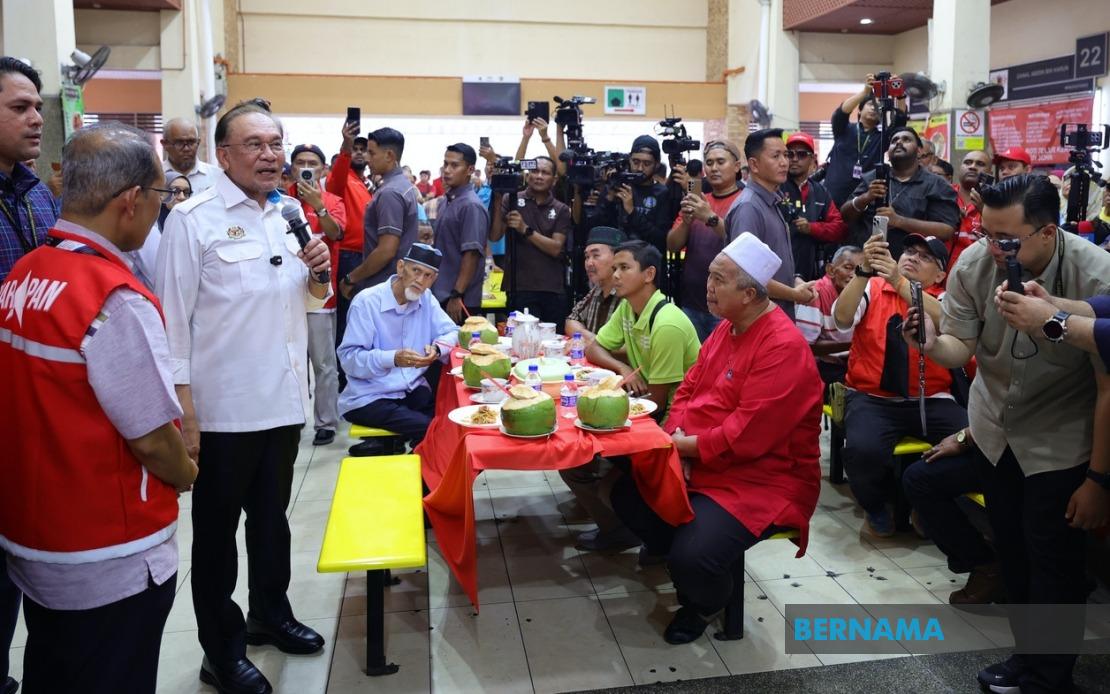
Prime Minister Datuk Seri Anwar Ibrahim made a direct appeal to voters in Negeri Sembilan on Tuesday, asking them to maintain their support for Pakatan Harapan in the forthcoming state election scheduled for August 1. Speaking during a series of campaign events across the state, the PH chairman and federal leader stressed that a renewed mandate would strengthen the coalition's capacity to deliver on governance and public welfare initiatives at both state and national levels.
Anwar's campaign message centred on the linkage between electoral outcomes and administrative effectiveness, arguing that alignment between state and federal governments leads to smoother implementation of development programmes. He highlighted how three years of PH governance in Negeri Sembilan under Menteri Besar Datuk Seri Aminuddin Harun had maintained relative political equilibrium, a condition he presented as foundational to sustained progress. The Prime Minister framed the election not merely as a local contest but as part of a larger federal stability equation, where state-level consolidation of support translates into policy coherence across jurisdictions.
Acknowledging the imperfections inherent in any governance arrangement, Anwar adopted a tone of humility rather than triumphalism. He conceded that PH's policies and implementations were not flawless, inviting voters to provide constructive feedback that would inform future refinements. This stance differs notably from typical campaign rhetoric, positioning the coalition as open to criticism and responsive to ground-level concerns. By framing the election as an ongoing mandate rather than a final verdict, Anwar suggested that voter engagement extended beyond the polling booth into a continuous cycle of governance and accountability.
The composition of PH's candidate slate in Negeri Sembilan reveals the internal power distribution within the coalition ahead of this electoral test. Fielding candidates across all 36 state seats, PH has allocated 16 positions to PKR, 11 to DAP, and nine to Amanah. This distribution reflects both the relative strength of each component party and the coalition's strategy for territorial coverage. For Malaysian political observers, such allocations often signal where each party expects to perform strongest and where compromises within the coalition structure have been negotiated.
The Election Commission's decision to hold polling on August 1, with early voting permitted from July 28, provides a relatively compact campaign window. This timeline compresses the period during which PH must consolidate its messaging and mobilise its grassroots machinery. In the contemporary Malaysian electoral context, where voter volatility has increased notably since the 2018 watershed election, compressed campaigns can either work to an incumbent coalition's advantage by reducing time for opposition narratives to crystallise, or they can disadvantage it by providing insufficient space for comprehensive ground engagement.
Anwar's emphasis on unity and the prevention of abuse speaks to deeper concerns within Malaysian politics regarding institutional integrity and the management of internal party dynamics. By invoking the need to "safeguard the people's interests" and prevent "abuse", the PM implicitly addressed concerns that have animated recent Malaysian politics, from internal party factionalism to questions about how power at different governmental levels is exercised. This framing suggests that for PH, the Negeri Sembilan election carries implications beyond local governance, touching on questions of how the coalition itself will evolve and consolidate power.
The reference to Aminuddin Harun's three-year tenure as Menteri Besar serves multiple functions within Anwar's campaign narrative. It provides evidence of PH's capability to deliver stable governance at the state level, countering any opposition suggestion that the coalition is inherently fractious or incompetent. Simultaneously, it stakes Aminuddin's political future on the outcome, making the incumbent administration's performance directly relevant to the election outcome. For state-level analysts, this creates incentives for the Menteri Besar's administration to demonstrate concrete achievements in the final weeks before polling.
Negeri Sembilan's position within Malaysia's federal structure adds particular significance to this state election. As a sultanate-based state with a unique governance structure and a middling population compared to peninsular peers, electoral outcomes here ripple through both national coalition calculations and intra-party power dynamics. A strong PH performance would reinforce the coalition's federal standing, while a weakened result could trigger internal recalibrations about candidate selection, resource allocation, and strategic messaging for other upcoming elections.
The invitation extended to voters to provide feedback and trust PH candidates reflects a softer campaign approach than seen in previous Malaysian electoral cycles. Rather than emphasising past achievements or attacking opponents, this messaging prioritises the transactional relationship between government and governed—voters grant permission to govern, and in exchange, government remains receptive and responsive. Whether such positioning resonates with Negeri Sembilan's electorate, which has demonstrated independent political preferences across recent elections, remains to be seen during the intensive campaign phase ahead of polling day.

