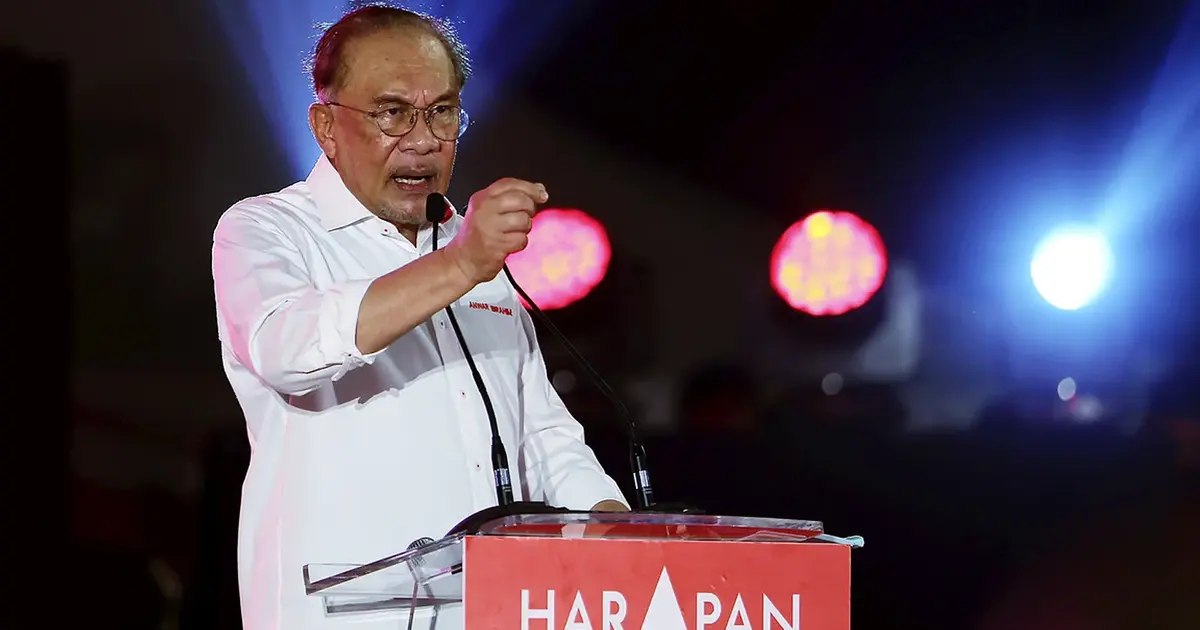
Prime Minister Anwar Ibrahim has issued a forceful appeal to all contesting political parties in the Negeri Sembilan state election to refrain from turning matters involving the state's royal institution into campaign fodder. Speaking as chairman of Pakatan Harapan, Anwar stressed that such institutions must remain above the partisan fray and that responsible political actors should protect their sanctity rather than exploit them for electoral advantage.
The warning reflects growing concern about campaign rhetoric in the lead-up to Negeri Sembilan's state polls. Malaysia's constitutional monarchies occupy a unique and protected space in the nation's political framework, with the institution itself shielded from routine political contestation by both law and deeply rooted convention. The royal institution serves as a unifying symbol of stability and continuity, transcending the temporary nature of electoral cycles and party politics. When political parties venture into territory touching on royal prerogatives or functions, they risk destabilising the careful balance that the system requires.
Anwar's intervention as Pakatan Harapan's leader carries particular weight, given his party's central role in Malaysian politics. His explicit call for restraint serves as a leadership signal to other coalitions and individual parties competing in Negeri Sembilan that there are boundaries to acceptable campaign conduct. The PH coalition, which governs Malaysia at the federal level, has positioned itself as the custodian of institutional integrity and democratic norms. By publicly addressing this issue before tensions escalate, Anwar seeks to establish a baseline of political civility that transcends partisan competition.
The timing of this appeal is significant. State elections in Malaysia often become testing grounds for broader political strategies, with different coalitions experimenting with messaging and voter mobilisation tactics. Negeri Sembilan, as a crucial state with a long history of political competition, represents precisely the kind of arena where parties might be tempted to push boundaries. The state's governance involves intricate constitutional relationships between the elected administration and the Yang di-Pertuan Besar, the state ruler. These relationships, while governed by constitutional provisions, can sometimes become points of friction during intense electoral campaigns.
The Malaysian public has historically demonstrated strong attachment to its royal institutions, which are regarded as fundamental anchors of the constitutional order and national identity. Voters expect their elected representatives to demonstrate respect for these institutions, and campaigns that appear disrespectful can backfire politically. By warning against politicising royal issues, Anwar is also reminding parties that such tactics may ultimately harm their own electoral prospects rather than benefit them. The Malaysian electorate generally responds negatively to perceived attacks on the monarchy or constitutional institutions.
This appeal also reflects international best practices in established democracies, where certain institutions—whether monarchies, judiciaries, or constitutional bodies—remain formally outside partisan contestation. Such conventions strengthen democracies by creating zones of consensus that transcend electoral cycles. In Malaysia's context, the royal institution's constitutional role means that its integrity directly affects the legitimacy and stability of state governance structures. When parties drag such institutions into campaigns, they implicitly suggest that these institutions are legitimate targets of political manipulation—a dangerous proposition for constitutional stability.
For Negeri Sembilan specifically, the state has experienced periods of political transition and realignment in recent years. The state government's composition and the relationship between the executive and the ruler's office have been subjects of political change. Against this backdrop, Anwar's warning takes on additional significance. It represents an attempt to prevent those historical tensions from becoming weaponised during the current campaign, thereby allowing the election to turn on substantive policy differences and governance records rather than on constitutional questions.
The message also carries implications for Malaysia's broader political culture at a moment when electoral competition has intensified significantly. Multiple coalitions compete across the country, each seeking to expand its footprint and influence. The temptation to exploit any available advantage—including issues touching on state symbols and institutions—is substantial. However, Anwar's intervention demonstrates that even in highly competitive environments, there is a place for statesmanship and boundary-setting. Senior political figures can shape campaign norms through their own conduct and explicit statements about acceptable behaviour.
For voters in Negeri Sembilan, Anwar's statement offers reassurance that the election will focus on matters directly relevant to their governance and welfare. Roads, education, economic development, and public services should dominate campaign discourse rather than constitutional abstractions. This reorientation toward practical governance concerns serves the interests of ordinary citizens far more than disputes about institutional prerogatives. The warning thus attempts to recalibrate the campaign toward issues that genuinely affect people's daily lives.
Moving forward, the extent to which political parties respect this boundary will test the health of Malaysia's democratic culture. Anwar's appeal depends ultimately on voluntary compliance rather than legal enforcement, making it a test of political maturity and institutional respect among competing parties. The coming weeks will reveal whether parties view the royal institution as genuinely protected territory or merely as another arena for political manoeuvre. The outcome will signal important lessons about the resilience of Malaysia's constitutional conventions and the willingness of political actors to place institutional integrity above short-term electoral advantage.

