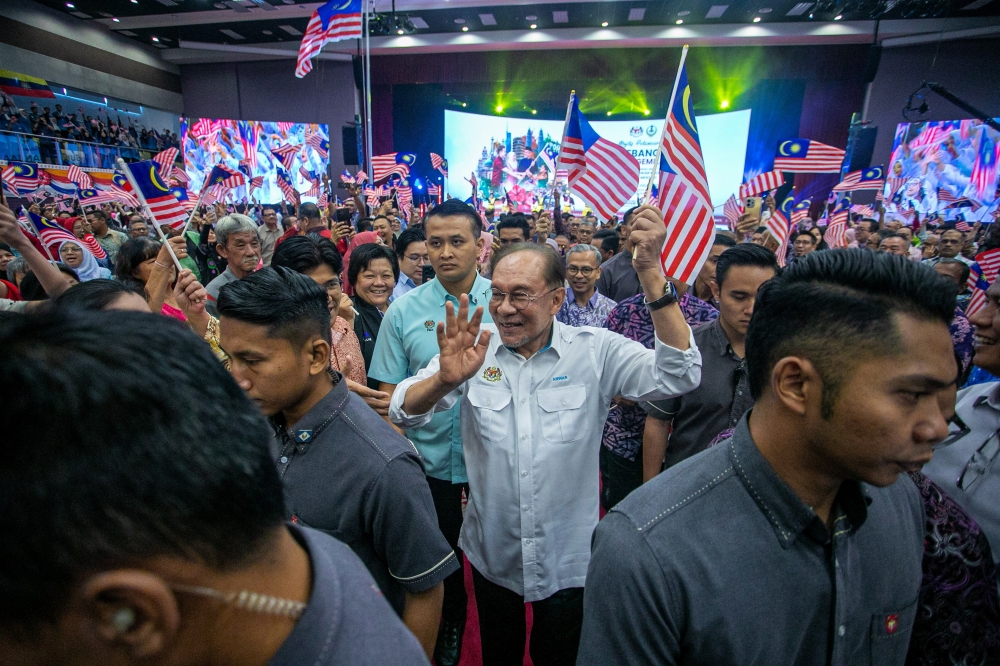
Prime Minister Datuk Seri Anwar Ibrahim has issued a carefully calibrated message to his cabinet members and senior government officials regarding their political activities, drawing a distinction between permissible campaign engagement and conduct that crosses ethical and legal thresholds. Speaking in Ipoh, Anwar emphasised that while ministers and government leaders retain their rights as citizens to participate in political advocacy, such activities must remain within established constitutional and regulatory frameworks governing public sector conduct.
The warning reflects the delicate balance Malaysian political culture must maintain between democratic participation and the integrity of public institutions. Government officials occupy dual roles—as administrators bound by civil service codes and as political representatives elected or appointed through party mechanisms. This inherent tension has historically generated disputes over resource allocation, official platforms being used for partisan purposes, and the blurred lines between state and party activities. Anwar's intervention suggests heightened awareness within his administration of potential vulnerabilities that could undermine public confidence in governmental neutrality or invite legal challenges to ministerial conduct.
The timing of the Prime Minister's remarks carries particular significance within Malaysia's contemporary political landscape. The nation has witnessed several high-profile controversies involving the mixing of governmental and party machinery, particularly during election cycles when ministerial incumbents leverage their positions for partisan advantage. Such practices can include directing civil service resources toward campaign logistics, utilising official media or communications channels for party promotion, or employing state apparatus in ways that disadvantage opposition parties. These concerns transcend partisan considerations—they strike at the foundational principle that public resources and governmental authority should serve the entire nation rather than enriching particular political factions.
Anwar's directive implicitly acknowledges that his government encompasses politicians with varying levels of restraint and understanding regarding propriety. Some ministers may genuinely misunderstand where boundaries exist, interpreting their leadership positions as mandates for aggressive partisan mobilisation using state machinery. Others might deliberately test limits, calculating that political gains outweigh risks of mild reprimand. By issuing this public reminder, Anwar establishes clear expectations while maintaining diplomatic language that avoids personalising accusations toward specific individuals. This approach preserves cabinet unity while signalling to the broader public that violations will be monitored and addressed.
The constitutional framework governing ministerial conduct in Malaysia provides the legal foundation for such standards. The Federal Constitution establishes principles of ministerial responsibility and the proper use of public office, while the civil service code of conduct reinforces restrictions on partisan activity during official hours or using state resources. These provisions exist not to suppress political expression but to protect democratic institutions from degradation and ensure that state power serves public rather than factional interests. When ministers respect these boundaries scrupulously, they strengthen public institutions and enhance the legitimacy of their governance.
For Malaysian readers and observers, particularly those monitoring government accountability, Anwar's statement signals his administration's commitment to procedural integrity even as competitive politics intensifies. This carries implications beyond symbolic reassurance. When government leaders themselves explicitly acknowledge limits to their own conduct and agree to operate within constitutional constraints, they establish precedent and political culture that influences subordinate officials. Civil servants who witness their ministerial superiors respecting boundaries become more likely to maintain similar standards in their own conduct.
Regionally, Malaysia's approach to managing this challenge reflects broader Southeast Asian struggles with preventing state capture by ruling parties. Neighbouring democracies have grappled with similar dynamics, where governing coalitions inevitably exploit their temporary control of state apparatus unless strong institutional cultures and clear articulations of principle constrain such behaviour. Anwar's statement contributes to building such culture within Malaysian governance, particularly important given the nation's history of competitive transitions between ruling coalitions with different ethnic and ideological bases.
The practical implications of Anwar's guidance extend to diverse scenarios. A minister attending a party rally during official time using government transport clearly violates standards. A minister directing civil service resources toward projects benefiting constituencies controlled by allies while disadvantaging opposition areas similarly crosses acceptable boundaries. Yet a minister making speeches on weekends advocating for party policies, fundraising within legal limits, or mobilising party members through private channels operates within permissible space. The Prime Minister's message attempts to clarify this spectrum without exhaustively itemising prohibited conduct.
Moving forward, the effectiveness of this directive depends on institutional follow-through. Establishing clear enforcement mechanisms, investigating credible allegations promptly, and applying consequences consistently regardless of ministerial seniority will determine whether the cautionary statement translates into reformed behaviour. Without such enforcement, experienced politicians may interpret the reminder as rhetorical rather than substantive. Malaysian civil society organisations monitoring government conduct will likely scrutinise ministerial behaviour closely, providing external accountability mechanisms that complement any internal party discipline.
Anwar's intervention ultimately reflects maturity in Malaysia's democratic development—a Prime Minister willing to constrain his own officials' behaviour and acknowledge that effective governance requires respecting institutional limits even when political pressures incentivise transgression. Whether his cabinet colleagues internalise this message and adjust their conduct accordingly will reveal the depth of commitment to these principles within the current administration.

