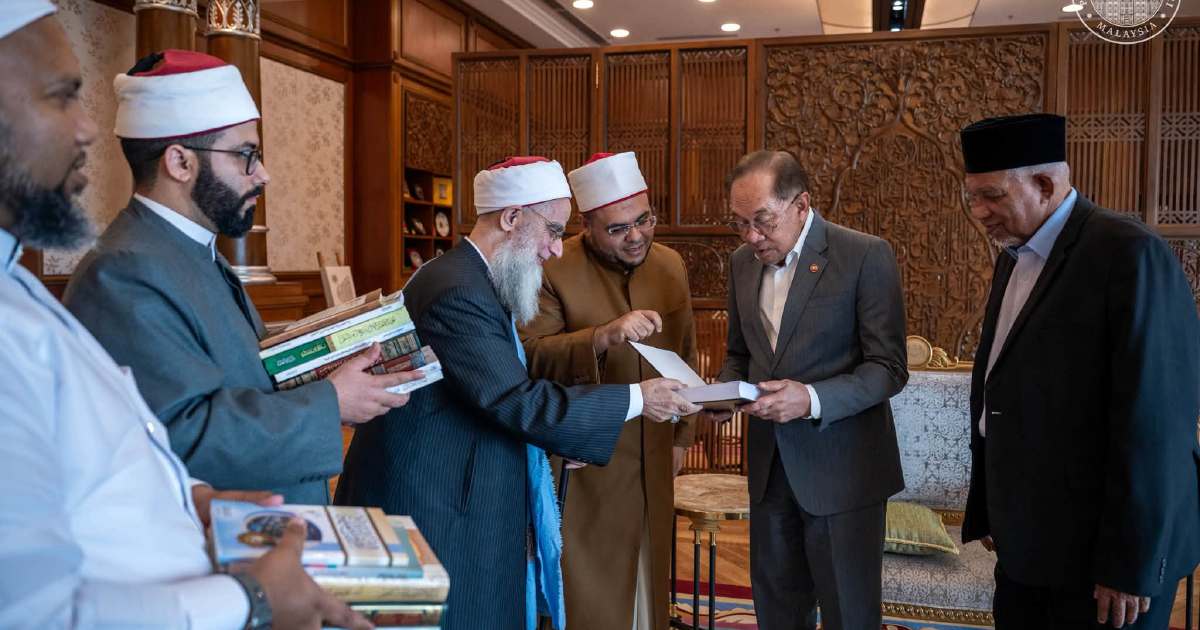
Prime Minister Datuk Seri Anwar Ibrahim received Egyptian scholar Sheikh Dr Mustafa An-Nadwi Al-Hasani Mansurah at his official residence in Putrajaya, underscoring Malaysia's continued commitment to fostering intellectual and cultural exchanges with the Arab world's leading Islamic figures.
The visit represents the type of high-level engagement that characterizes Malaysia's diplomatic strategy under Anwar's administration, particularly in strengthening ties with influential Islamic thought leaders across the Middle East. Such encounters between Malaysia's political leadership and prominent regional scholars have historically served as platforms for discussing shared theological perspectives, educational initiatives, and collaborative frameworks between Southeast Asia and the Arab world.
Sheikh Dr Mustafa An-Nadwi, whose scholarly reputation extends across Islamic academic circles throughout Egypt and beyond, brings considerable expertise in Islamic jurisprudence and religious studies. His prominence in contemporary Islamic discourse has made him a sought-after voice on matters relating to Islamic education, cultural preservation, and interfaith dialogue — all areas where Malaysia has positioned itself as a regional leader.
The timing of this engagement reflects broader patterns in Malaysian foreign policy under the current administration. Anwar Ibrahim has consistently prioritized strengthening Malaysia's relationships with influential Arab scholars and institutions, viewing such connections as essential to Malaysia's role as a bridge between Southeast Asian Muslim communities and the broader Islamic world. These personal meetings at the highest political level signal the seriousness with which the Malaysian government treats such intellectual partnerships.
For Malaysia's Islamic community and policymakers, exposure to diverse scholarly perspectives from Egypt — home to Al-Azhar University, one of Islam's most respected educational institutions — carries particular significance. Egyptian Islamic scholars bring nuanced understandings of Islamic jurisprudence that have shaped Muslim thought across centuries, and their insights remain relevant to contemporary challenges facing Muslim societies throughout Asia.
The visit also comes during a period when Malaysia is actively developing its position as a center for Islamic finance, Islamic education, and moderate Islamic thought. By welcoming prominent foreign scholars, the government reinforces Malaysia's image as an open, intellectually vibrant society capable of hosting meaningful dialogue between different Islamic schools of thought and perspectives. This positioning becomes increasingly important as Malaysia competes regionally for leadership in Islamic affairs and education.
Beyond the symbolic value of such diplomatic encounters, these meetings often facilitate substantive discussions about potential collaborative projects. Academic exchanges, joint research initiatives, and educational partnerships frequently emerge from initial high-level visits, creating lasting institutional connections that extend far beyond the initial meeting. For Malaysian universities and Islamic institutions, exposure to Egyptian scholars can enhance their international standing and academic rigor.
The engagement also reflects Malaysian recognition that soft power through intellectual leadership constitutes a vital component of modern statecraft. Rather than limiting international engagement to purely political or economic channels, the Anwar administration has demonstrated interest in cultural and intellectual dimensions of foreign relations, understanding that influencing ideas and perspectives can have long-lasting geopolitical implications.
Egyptian-Malaysian relations, while not as frequently highlighted in international media as some other bilateral partnerships, have maintained steady momentum across educational, religious, and commercial sectors. The Muslim Brotherhood's historical roots in Egypt and subsequent regional influence means that Egypt remains central to understanding contemporary Islamic movements and theology throughout the Muslim world.
For Malaysian readers and observers, this visit underscores how leadership at the highest political levels engages with international intellectual figures, particularly those from the Islamic world. It illustrates how Malaysia's Prime Minister continues to invest time in cultural and scholarly diplomacy, recognizing that conversations with eminent religious intellectuals can influence policy thinking on matters ranging from Islamic education to interfaith relations.
The reception at Putrajaya also suggests potential platforms for broader Malaysian-Egyptian cooperation on challenges facing Muslim communities globally, from combating religious extremism to promoting Islamic education reform and addressing contemporary social issues through Islamic ethical frameworks. These scholarly conversations often provide the intellectual foundation for policy decisions that affect millions of citizens across both nations.

