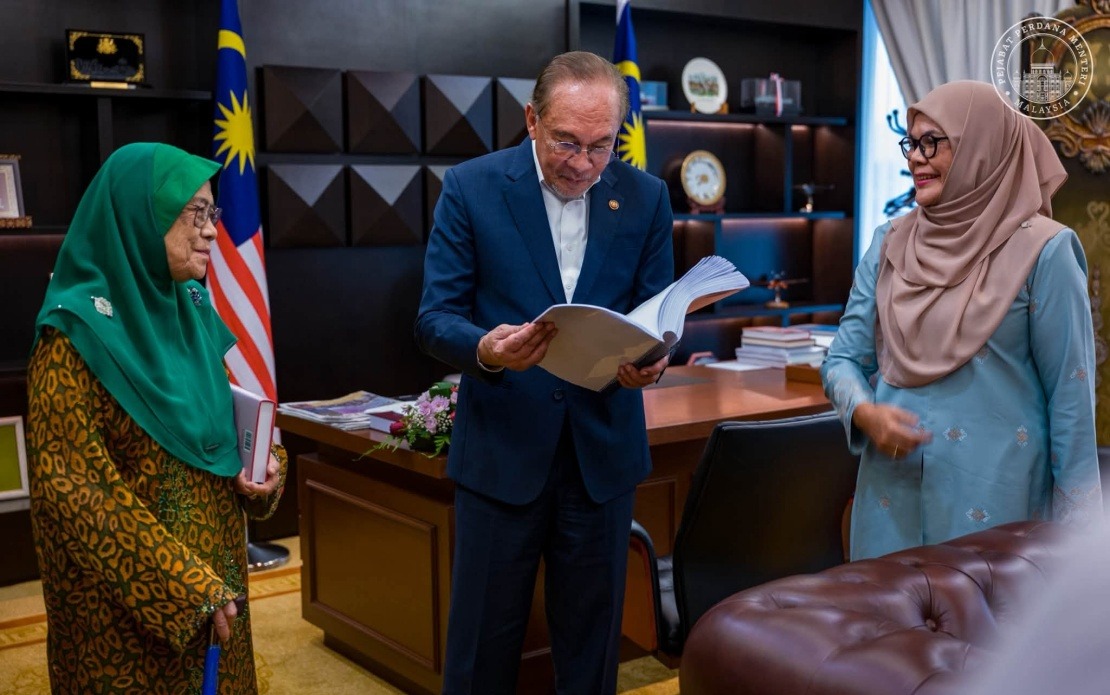
Prime Minister Datuk Seri Anwar Ibrahim has thrown his support behind an upcoming publication designed to capture and preserve his political philosophy and intellectual framework for posterity. In remarks shared through social media on July 1, Anwar expressed optimism that the work would ultimately prove valuable as a historical and intellectual resource for succeeding generations of Malaysian leaders and citizens alike.
The book, authored by Professor Dr Salinah Ja'afar—a lecturer and linguist affiliated with the Academy of Malay Studies at Universiti Malaya—represents a collaborative effort to systematically articulate Anwar's worldview and approach to governance. Rather than a standard biography or memoir, the project appears positioned as an academic examination of the Prime Minister's political thought, drawing on his lived experiences and extensive reading across multiple disciplines. This scholarly approach suggests an intention to situate Anwar's ideas within broader intellectual and historical contexts relevant to Malaysian and Southeast Asian audiences.
The manuscript development process involved Anwar's direct participation, underscoring the project's authoritative nature. The Prime Minister seized the opportunity to review and offer feedback on successive drafts, ensuring that the final publication would accurately represent his perspectives and the reasoning underpinning his policy positions. This hands-on involvement distinguishes the work from purely external biographical analyses and reflects Anwar's investment in how his legacy and ideas are documented.
The project has also benefited from the academic oversight of Professor Emeritus Datuk Dr Nik Safiah Abdul Karim, an eminent language scholar whose reputation lends additional credibility to the undertaking. Nik Safiah's role as academic adviser—guiding the book's preparation and structural development—points to a commitment to scholarly rigor and intellectual depth. Her involvement signals that the publication aims to meet academic standards while remaining accessible to broader readership, a balancing act particularly important for materials intended to influence future political and civic discourse.
Furthering this collaborative approach, the two scholars conducted exclusive interviews with Anwar to capture his thinking comprehensively. These extended conversations allowed for nuanced exploration of complex themes and ensured that the final text would reflect the full breadth and texture of the Prime Minister's intellectual development. The interview-based methodology also creates an archival record of Anwar's ideas expressed in his own voice, adding an important dimension beyond written analysis.
In his public endorsement, Anwar praised the author's efforts to systematically document and articulate his accumulated views across multiple domains. He attributed the formation of his ideas to two foundational sources: personal life experiences and intellectual engagement through extensive reading. This framework hints at a political philosophy grounded in both practical governance experience and theoretical study, suggesting the book may offer readers insights into how Anwar synthesizes experiential and academic learning.
The Prime Minister's stated aspiration carries significance beyond ceremonial publication politics. By explicitly hoping the work would serve future generations as a reference point specifically on nation-building and personal values development, Anwar has positioned the book as potentially instructional material for emerging leaders and engaged citizens. This pedagogical framing implies the text may address fundamental questions about Malaysian nationhood, inclusive governance, and the ethical foundations underpinning leadership—questions of enduring relevance across changing political cycles.
For Malaysian readers and regional observers, such a publication represents an important contribution to the archival record of contemporary Southeast Asian political thought. As regional democracies grapple with questions of governance legitimacy, intercommunal harmony, and developmental priorities, documented intellectual frameworks from sitting leaders provide valuable comparative material. Anwar's prominence both domestically and internationally—given his historical roles as finance minister, opposition leader, and current Prime Minister—makes his systematically articulated ideas particularly relevant to understanding Malaysian political trajectories and regional political economy.
The timing and nature of this project also merit consideration. By establishing an authoritative written record of his political philosophy during his tenure as Prime Minister, rather than waiting for posthumous biographical treatment, Anwar exercises some agency over his intellectual legacy. This proactive approach contrasts with leaders who allow others to define their ideas retrospectively, and it suggests confidence in the enduring value of his current policy direction and philosophical orientation.
For the broader Malaysian public and international scholars of Southeast Asian politics, the forthcoming publication offers an opportunity to move beyond fragmentary understanding of Anwar's ideas to a more coherent and comprehensive framework. Whether examining his economic philosophy, approach to religious pluralism, vision for democratic participation, or methodology for managing complex governance challenges, having consolidated and academically vetted documentation provides a more stable foundation for analysis than relying on scattered speeches, policy documents, and media representations.
The involvement of Universiti Malaya and its respected Academy of Malay Studies adds institutional legitimacy to the project while signalling that this is not merely a political document but rather an academic contribution to Malaysian intellectual history. Universities, as custodians of knowledge and critical evaluation, lend weight to publications they actively support through their scholars' participation.
Ultimately, this book project reflects broader global trends of sitting and former political leaders systematizing their ideas through collaboration with academic institutions. Whether the volume achieves Anwar's aspiration of serving as a meaningful reference for future generations will depend on several factors: the scholarly rigor of the analysis, the accessibility and clarity of presentation, and the enduring relevance of the ideas presented to evolving national and regional challenges.

