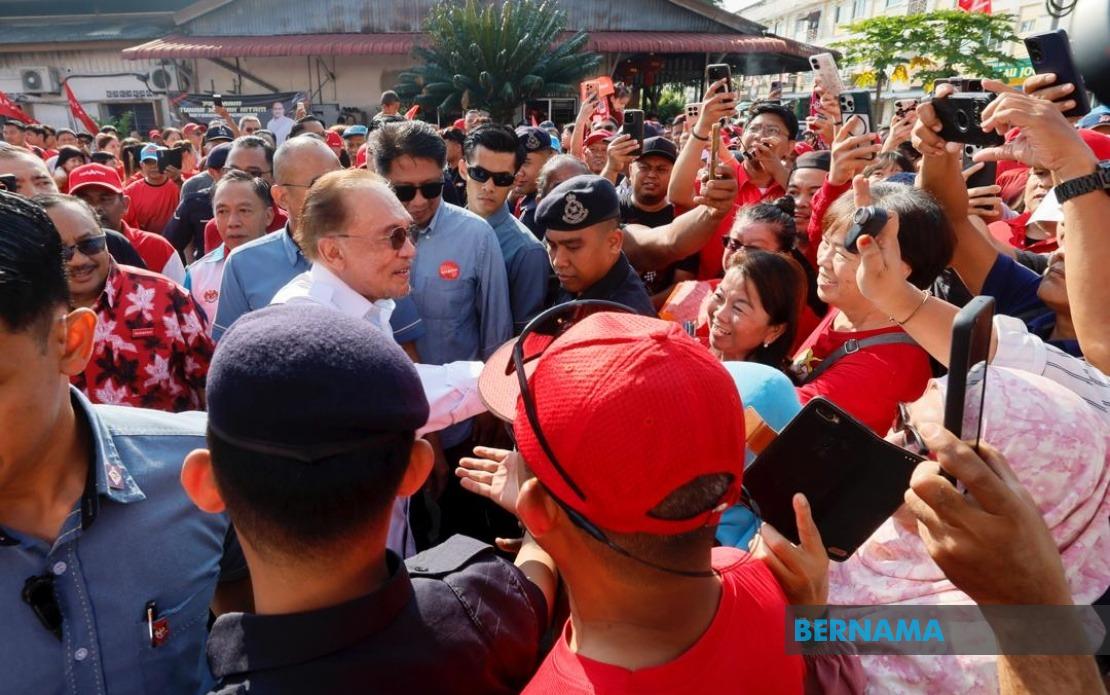
Prime Minister Datuk Seri Anwar Ibrahim's intervention on the ninth day of Johor's state election campaign has provided crucial momentum to Pakatan Harapan's election machinery, particularly in the Machap and Layang-Layang constituencies where the coalition is pressing hard to secure crucial gains before polling day on July 11. The leadership visit underscores the strategic importance PH places on Johor—a state that has traditionally favoured the ruling Barisan Nasional but where demographic shifts and economic frustrations have created openings for opposition advances.
The Prime Minister's engagement at the 'PMX Santai Sarapan Bersama Masyarakat' programme in Simpang Renggam served multiple purposes beyond mere symbolism. By adopting an informal, approachable manner, Anwar sought to counteract perceptions of political elitism whilst demonstrating commitment to grassroots constituencies. His presence effectively transmitted party discipline and strategic messaging down through local candidate ranks, reinforcing organisational coherence at a critical juncture when voter attention typically peaks.
Machap PH candidate Nur Hafiz Roslan highlighted how Anwar's visit strengthened candidate morale whilst clarifying the coalition's electoral positioning. Rather than framing the election as a zero-sum power grab, Anwar reoriented campaign narrative around service delivery and community welfare. This framing carries particular resonance in Johor, where governance quality and economic opportunity have become salient voter concerns. By instructing candidates to perform 'amal soleh'—or righteous deeds—in their community engagement, the Prime Minister injected ethical dimensions into campaign activities, potentially differentiating PH from more transactional political competitors.
Nur Hafiz's emphasis on serving people without prejudice signals an attempt to appeal beyond traditional PH support bases towards swing voters and those dissatisfied with incumbent administration. In Simpang Renggam parliamentary constituency, which encompasses both state seats, such cross-cutting messaging could prove decisive in a closely contested environment. The candidate's explicit commitment to serving all community segments addresses longstanding anxieties among non-Malay and non-Muslim voters regarding representation under coalition government.
Guna Balakrishnan, PH's Layang-Layang candidate, articulated complementary strategic objectives through his engagement with the Prime Minister. Anwar's injunction that whoever wins must develop the area and support local communities reflects recognition that electoral mandates carry expectations of tangible delivery. This conditional framing—whereby winning votes obligates developmental commitments—grounds campaign promises within accountability frameworks, distinguishing them from rhetorical flourishes that characterise many election campaigns throughout the region.
The attendance of over 1,000 residents at the Simpang Renggam programme indicates substantial grassroots receptivity to PH's campaign messaging, at least among those motivated to attend such events. However, interpreting such numbers requires caution, as event attendees typically represent more politically engaged segments rather than median voters. Nonetheless, the programme succeeded in generating personal connections between voters and leadership, with residents reporting heightened confidence in supporting PH candidates after witnessing Anwar's direct engagement with community members.
Resident testimonies provide valuable insight into campaign effectiveness among target demographics. Chuan Chee Mei and Noor Takiyudin Salleh both emphasised how observing Anwar's genuine interest in constituent concerns strengthened their electoral commitment. This dynamic reflects broader patterns wherein personal leadership visibility and perceived authenticity influence voter behaviour, particularly in contexts where trust in political institutions remains fragile. For Johor, where political switching has accelerated in recent electoral cycles, such personal connection-building may prove decisive.
The strategic context surrounding Johor's 56 state seats merits close attention. With 172 candidates contesting across multiple parties, vote fragmentation presents both opportunities and hazards for PH. The coalition must navigate complex multi-cornered contests where opposition unity remains imperfect and Barisan Nasional retains organisational advantages despite electoral headwinds. Anwar's campaign involvement signals that PH recognises Johor as pivotal—loss here would severely damage the coalition's electoral momentum heading into future national balloting, whilst gains would reinforce narrative of political renewal.
The timing of the Prime Minister's visit, arriving on day nine of a twelve-day campaign period, demonstrates sophisticated campaign management. Rather than frontloading leadership appearances, PH strategically deployed Anwar's star power at a point when voter attention typically peaks but before fatigue sets in. This temporal positioning maximises media amplification whilst allowing sufficient runway for ground teams to consolidate support before polling.
For Malaysian politics broadly, the Johor campaign illuminates evolving PH strategy beyond its 2022 national victory. The coalition has transitioned from insurgent opposition towards governing party seeking to consolidate and expand electoral reach. Anwar's personalised engagement approach reflects this repositioning—rather than purely oppositional messaging criticising incumbent governance, PH increasingly emphasises constructive vision and service commitments. Whether this rebranding resonates sufficiently to overcome Barisan's structural advantages in Johor will significantly influence broader regional political trajectories.
The July 11 polling will reveal whether grassroots enthusiasm generated by Anwar's campaign visit translates into actual electoral gains. PH's performance in Machap and Layang-Layang constituencies will provide crucial indicators regarding the coalition's capacity to expand beyond traditional support bases. Success would validate the emerging campaign model emphasising accessibility, ethical governance framing, and community-focused commitments. Conversely, underperformance might indicate that structural factors—including Barisan's administrative reach and traditional voter loyalties—continue overwhelming coalition ground efforts even at elevated intensity levels.

