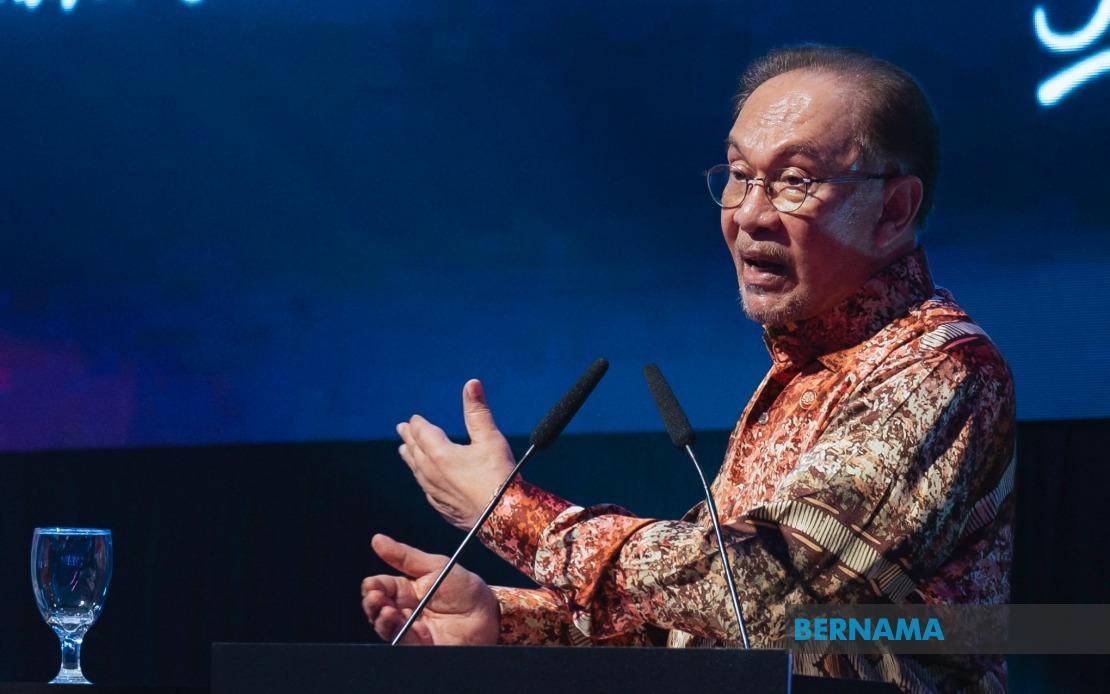
Prime Minister Datuk Seri Anwar Ibrahim's recent comments regarding Taiwan have drawn scrutiny, particularly his acknowledgment of China's position that force might be employed if peaceful reunification efforts fail. Yet interpreting these remarks as an endorsement of military action misses the analytical framework Anwar was deploying—one centred on how states maintain deterrence through preserving strategic options rather than signalling intent to use them.
Anwar's core argument rests on a distinction between retaining the capacity for action and actively pursuing it. He drew a domestic parallel, suggesting that no government, including Malaysia, would voluntarily accept the fragmentation of its federation without resistance. This analogy highlights a principle of statecraft: the ability to defend territorial integrity serves as a stabilising force, even when a nation's preferred path is peaceful resolution. The argument is fundamentally about deterrence architecture—the logic that keeps conflict at bay rather than invites it.
The deterrence framework operates on a simple premise: credible uncertainty about consequences discourages adventurism. A state that unambiguously renounces all options for self-defence may inadvertently create incentives for others to test its resolve. Conversely, when a state clearly indicates it possesses and will use the means to protect itself, potential challengers face elevated risks and must recalculate their strategies. This classical security logic does not require that force be deployed frequently or at all; its mere availability as a last resort fundamentally alters the calculations of adversaries and competitors.
Within Malaysia's diplomatic framework, Anwar's position achieves internal consistency. Malaysia formally recognises the People's Republic of China and does not grant Taiwan sovereign status in official relations, while simultaneously sustaining substantial economic exchanges and people-to-people connections with Taipei. This nuanced position—accepting the One China principle without abandoning practical ties—creates space for acknowledging Beijing's legitimate concerns about territorial integrity. If Malaysia accepts the One China position, Anwar reasoned, the country cannot logically delegitimise China's views on what constitutes an existential national issue.
The Taiwan perspective stands in sharp contrast. Taipei views itself as a functioning democracy with distinct governance and institutions, rejecting the framing of the dispute as an internal Chinese matter. From this standpoint, any invocation of force as a potential policy tool risks normalising coercion and undermining the democratic choice Taiwan claims to exercise. The gap between how Beijing frames the issue—as national reunification of a territory that never accepted separation—and how Taipei frames it—as an independent polity defending its autonomy—remains vast and fundamentally unresolved.
Yet Anwar's deterrence argument should not be conflated with warmongering. Instead, it reflects a realist appraisal of how international politics function when core interests collide. States do not pre-commit to accepting dismemberment or fundamental challenges to their territorial integrity; doing so would be politically untenable domestically and strategically irrational internationally. The capacity to resist such challenges, whether through diplomatic, legal, or ultimately military means, represents a basic requirement of statehood. Renouncing this capacity entirely would invite precisely the coercion that deterrence aims to prevent.
Malaysia occupies a particularly delicate position in this landscape. A military confrontation across the Taiwan Strait would inflict severe costs on the region and Malaysia itself. The archipelago nation depends substantially on uninterrupted maritime trade flows, semiconductors sourced from Taiwan, and manufacturing networks that span the strait. A conflict scenario would disrupt supply chains, destabilise ASEAN as a collective entity, and force Malaysia to navigate impossible diplomatic pressures. The economic interdependencies that bind East Asia together mean that regional stability is not merely a preference but an operational necessity.
This reality shapes Malaysia's appropriate diplomatic posture. The country should consistently advocate for restraint, prioritise dialogue mechanisms, and reinforce multilateral frameworks designed to manage disputes peacefully. ASEAN's established practice of not taking sides on bilateral disputes, combined with ongoing emphasis on the Code of Conduct and peaceful settlement mechanisms, provides Malaysia with tools to influence the trajectory toward de-escalation. At the same time, supporting calls for restraint does not require adopting the position that one party to a dispute has surrendered its right to self-defence.
Anwar's remarks, properly understood, do not constitute a departure from this balanced approach. He was articulating a principle—that states maintain preparedness without necessarily intending deployment—rather than signalling Malaysian sympathy for military solutions. The distinction matters enormously for regional perception and strategic messaging. Malaysian audiences and regional partners should understand that acknowledging a principle of deterrence differs fundamentally from endorsing its application.
The deeper implication extends to Malaysia's role as a voice for reasoned, middle-power diplomacy in Southeast Asia. Malaysian policymakers can acknowledge the logic of deterrence while simultaneously championing peaceful resolution, supporting confidence-building measures, and opposing adventurism by any party. This position avoids the false choice between moral clarity and realist analysis; instead, it insists that both concerns—respecting state sovereignty and preventing conflict—are legitimate and can be held simultaneously.
Moving forward, Malaysia should continue refining its public messaging on cross-strait issues to distinguish between understanding structural incentives and endorsing particular outcomes. The country's diplomatic influence, rooted partly in its reputation for pragmatism and balance, allows it to speak to all parties in ways that rigid positions cannot. By maintaining clarity that deterrence is not aggression, that acknowledging others' concerns is not capitulation, and that pursuing peace is compatible with respecting sovereignty, Malaysia can contribute to a regional environment that discourages conflict even as it recognises the legitimate interests at stake.

