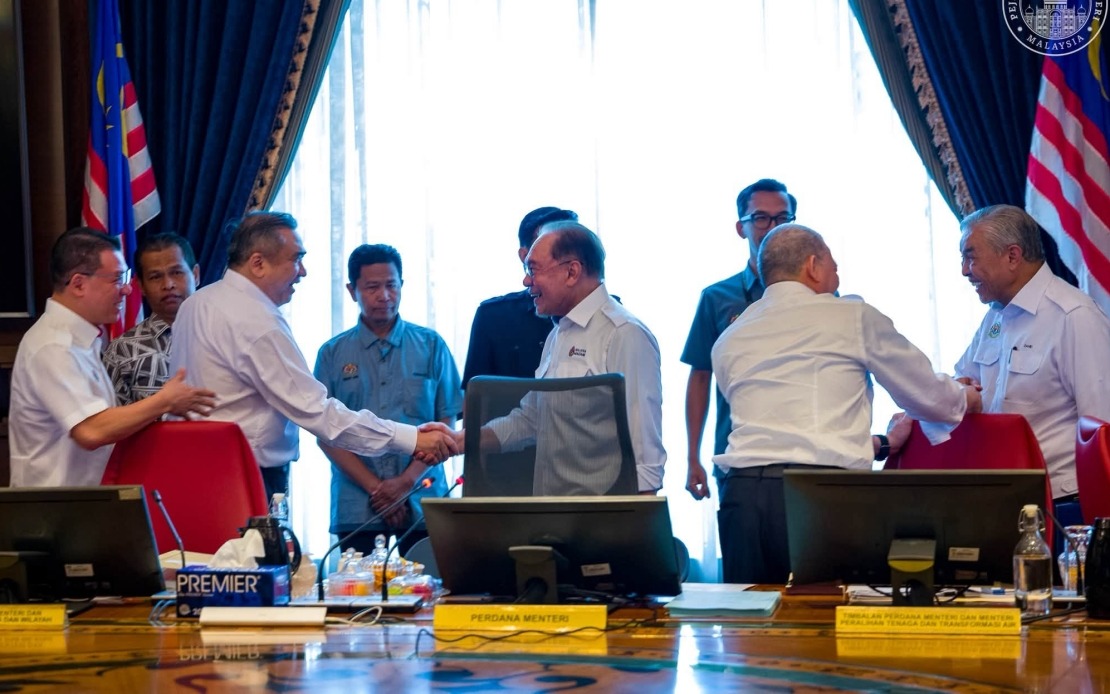
Prime Minister Datuk Seri Anwar Ibrahim has taken to social media with a carefully crafted message on unity and friendship, offering what observers interpret as a symbolic reminder of governmental cohesion during an intensely competitive period. The post, shared on his official Facebook page, featured a traditional four-line Malay pantun that celebrated the virtues of collective harmony, discipline and the strength found in shared purpose. Accompanying the verse was imagery from a Cabinet gathering that conveyed an atmosphere of camaraderie, suggesting a leadership team operating in concert despite the pressures of ongoing electoral competition.
The timing of Anwar's message proves particularly significant given the current political landscape in Malaysia. The Negeri Sembilan state election, called following the dissolution of the State Assembly on June 5, represents an unusual test of the Federal Unity Government's resilience. The Election Commission has scheduled polling day for August 1, with early voting set for July 28, creating a compressed campaign period that has kept political tensions elevated. Unlike typical state contests where the ruling coalition presents a unified front, this election has seen Pakatan Harapan and Barisan Nasional—the two pillars of the federal power-sharing arrangement—directly competing against one another across all contested seats.
The composition of the Negeri Sembilan contest underscores the complexity of Malaysia's current political configuration. Anwar's Pakatan Harapan is fielding candidates in all 36 state seats, while Barisan Nasional, led by Deputy Prime Minister Datuk Seri Dr Ahmad Zahid Hamidi, is contesting 25 constituencies. Adding another layer of complication, Barisan Nasional has forged an electoral alliance with Perikatan Nasional in several seats, creating a three-way contest that challenges traditional voting patterns. This arrangement reflects broader negotiations within Malaysia's fractured political system, where coalitions must balance national-level cooperation with regional electoral ambitions.
Anwar's poetic intervention appears designed to address underlying tensions that such direct competition can generate. Maintaining the Federal Unity Government requires constant reinforcement of the principle that coalition partners can contest elections vigorously while preserving fundamental governmental stability. The Cabinet photographs included in the post—particularly showing Deputy Prime Minister Ahmad Zahid and Transport Minister Anthony Loke in relaxed, convivial settings—transmitted a visual message that ministerial relationships remain intact despite campaign season pressures. This theatrical element served an important function in reassuring both coalition partners and the broader public that the government would not fracture over state-level electoral outcomes.
The online response to Anwar's message demonstrated substantial public interest in questions of political unity and governmental coherence. Within two hours of publication, the post had accumulated more than 11,500 likes, indicating engagement well beyond typical political communication. The comments section generated over 1,700 responses, with some users creatively replying in pantun form, suggesting that Anwar's choice of traditional poetic expression had resonated with audiences. Many commentators explicitly praised the Prime Minister's evident commitment to a conciliatory, statesmanlike approach, interpreting the message as a deliberate contrast to the fractious rhetoric that sometimes accompanies electoral contests.
The Malaysian political context makes such messaging especially valuable. The country has experienced periods of governmental instability, coalition collapses, and defections that have undermined public confidence in institutional continuity. The Federal Unity Government itself represents a deliberate effort to move beyond the zero-sum competition that characterized earlier years, establishing instead a framework where different political forces could share executive power. Each test of this arrangement—whether internal party manoeuvres, budgetary negotiations, or electoral contests—carries potential implications for the broader stability of the system. Anwar's emphasis on unity and consensus therefore transcended mere campaign rhetoric to address fundamental questions about the sustainability of Malaysia's current governing structure.
The Negeri Sembilan election itself will provide important data on how Malaysian voters respond to this unusual arrangement. Historically, state elections have served as referendums on national government performance, with governing coalitions either consolidating support or facing electoral punishment. However, this contest presents voters with an atypical scenario: they are being asked to choose between competing coalitions that jointly govern at the federal level. Whether voters treat this as permission to express support for one coalition over another, or whether they view defections to opposition Perikatan Nasional as the more meaningful choice, will shape how future electoral contests unfold within the Unity Government framework.
The presence of Perikatan Nasional as a competitor in Negeri Sembilan adds strategic dimension to the PH-BN rivalry. Rather than a simple two-way contest where all seats ultimately benefit one or both ruling coalition partners, the presence of PN candidates creates scenarios where opposition votes could be split or concentrated, affecting final outcomes. This triangular competition reflects the broader fragmentation of Malaysian politics, where no single coalition commands overwhelming dominance and electoral calculations must account for multiple contingencies. The Negeri Sembilan result may therefore offer insights into how the opposition bloc is recovering from its previous setbacks and whether it can exploit divisions within the Unity Government.
For regional observers, Anwar's communication strategy illustrates how contemporary Southeast Asian political leaders navigate the challenge of maintaining coalition discipline while preserving electoral legitimacy. The deliberate use of cultural symbolism—the pantun form carries deep resonance in Malay culture—combined with visual messaging through Cabinet photographs, demonstrates sophisticated political communication. This approach contrasts with confrontational rhetoric that might characterise other political systems, instead emphasising continuity, respect, and shared cultural identity. Whether such messaging proves sufficient to contain tensions within the Unity Government beyond the Negeri Sembilan election remains to be seen, but it signals Anwar's determination to preserve the delicate balance between cooperation and competition that defines Malaysia's current political dispensation.
The implications of this electoral period extend beyond Negeri Sembilan's immediate governance. The way the Federal Unity Government navigates this test will influence how future state elections are conducted and how the coalition manages internal tensions. If the partnership demonstrates resilience despite vigorous campaign competition, it may establish a precedent for stable power-sharing arrangements that transcend electoral cycles. Conversely, if significant fractures emerge or if one coalition partner emerges significantly weakened, it could prompt recalibrations in the broader governing arrangement. Anwar's poetic message, while seemingly modest in scope, therefore represents an important assertion of commitment to the framework that has sustained Malaysian governance stability since 2022.

