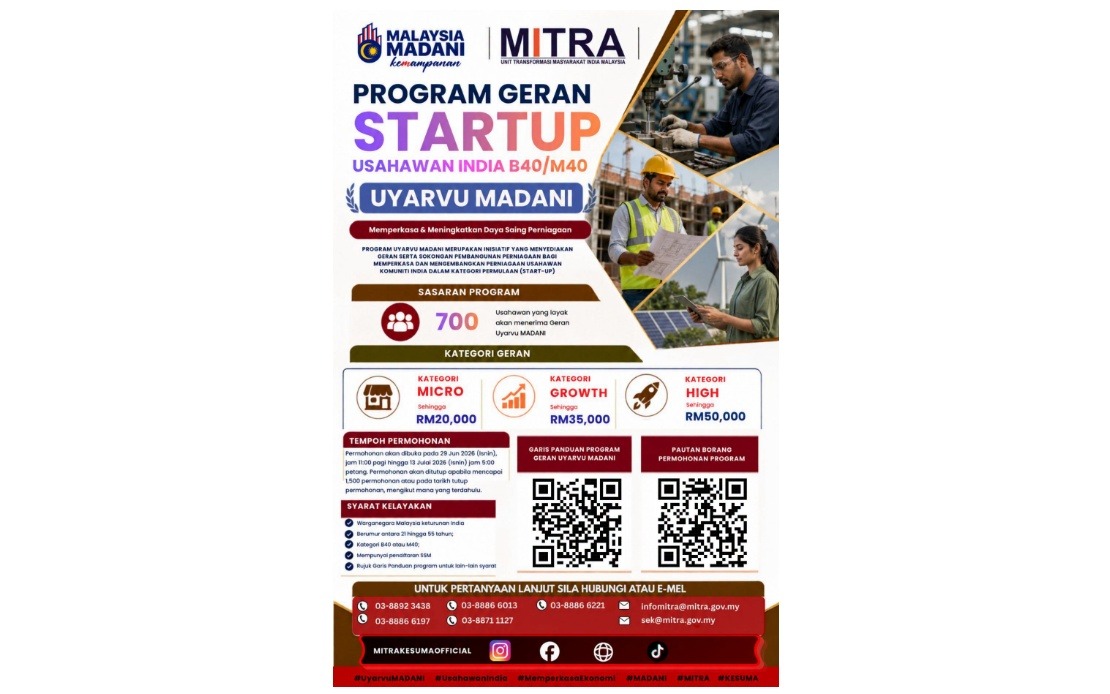
The Malaysian Indian Transformation Unit (MITRA) has opened the application window for the Uyarvu MADANI Startup Accelerator Grant Assistance Programme, beginning immediately and running through to 5 pm on July 13. The initiative represents a targeted effort to provide financial support and business development assistance to emerging entrepreneurs within the Indian community who fall within the B40 and M40 household income classifications.
The financial scope of the programme is substantial, with individual grants ranging between RM20,000 and RM50,000 available to successful applicants. MITRA has set an ambitious target to distribute these grants to approximately 700 entrepreneurs, reflecting a commitment to broadening business ownership and economic participation within the Indian Malaysian demographic. The support extends beyond capital injection, encompassing business development guidance designed to strengthen competitiveness and facilitate enterprise expansion.
The application process operates on a dual closure mechanism. Submissions will automatically cease if the programme receives 1,500 applications before the July 13 deadline, or at 5 pm on that final date, whichever condition is met first. This structure suggests MITRA anticipates strong demand for the funding opportunity and has established an overflow threshold to manage administrative capacity while ensuring equitable assessment of all submissions.
Uyarvu MADANI occupies a significant position within MITRA's broader 2026 developmental agenda, forming one of six newly introduced initiatives announced for the current year. The programme sits within a substantially larger financial commitment, as these six initiatives collectively command RM65.5 million in allocated resources. This budgetary allocation underscores governmental recognition of the need for targeted economic interventions supporting specific community segments.
The targeting of B40 and M40 income households reflects a deliberate policy approach to economic inclusion. These income classifications represent Malaysia's lower and lower-middle income groups, populations that historically face greater barriers to accessing startup capital and business financing through conventional channels. By directing grants specifically toward these segments, MITRA addresses a recognized gap in the entrepreneurial ecosystem where potential business founders lack sufficient collateral or established credit histories to secure traditional bank financing.
For Malaysian entrepreneurs of Indian origin seeking to establish or grow their ventures, the programme timing merits attention. The application window, though spanning nearly two weeks, may witness rapid uptake given the apparent supply constraints suggested by the 1,500-application threshold. Interested parties should prepare documentation promptly, as delays risk exclusion if applications reach the ceiling before the deadline.
The programme's emphasis on business development support alongside capital allocation distinguishes it from simple grant distribution models. Access to mentoring, training, and strategic guidance can substantially enhance survival rates and growth trajectories for startup enterprises, particularly among first-time entrepreneurs who may lack foundational business management experience. This comprehensive approach reflects contemporary understanding that capital alone insufficient for sustained entrepreneurial success without accompanying skill development and strategic counseling.
Within the broader context of Malaysian economic policy, targeted community-specific initiatives like Uyarvu MADANI represent government attempts to address persistent wealth disparities and create more inclusive growth pathways. Such programmes acknowledge that generalized business support frameworks may not adequately serve communities facing structural disadvantages in accessing networks, mentorship, and capital pools that more established business communities take for granted.
For entrepreneurs in other Southeast Asian countries examining Malaysia's approach, the Uyarvu MADANI model offers a case study in how governments can structure targeted economic interventions. The combination of direct capital support, beneficiary targeting based on income thresholds, and integrated business development assistance suggests a more sophisticated approach than simple grants, potentially offering templates for regional peers designing similar programs.
The presence of RM65.5 million across six MITRA initiatives indicates sustained governmental attention to Indian community economic development. Whether Uyarvu MADANI represents the largest component within this allocation remains unclear from available information, but the quantum invested suggests meaningful commitment to translating policy intentions into material resource deployment.
Intending applicants should note that while the programme addresses a genuine market gap in accessible startup financing, success will ultimately depend on application quality, feasibility of proposed business models, and alignment with MITRA's evaluation criteria. Entrepreneurs should approach their applications strategically, emphasizing how their ventures address genuine market needs and demonstrating realistic implementation capacity.
The closure of applications on July 13 creates an immediate timeline for interested parties. Prospective applicants should gather required documentation promptly and understand MITRA's specific application requirements before submission to maximize their chances of successful approval and funding disbursement.

