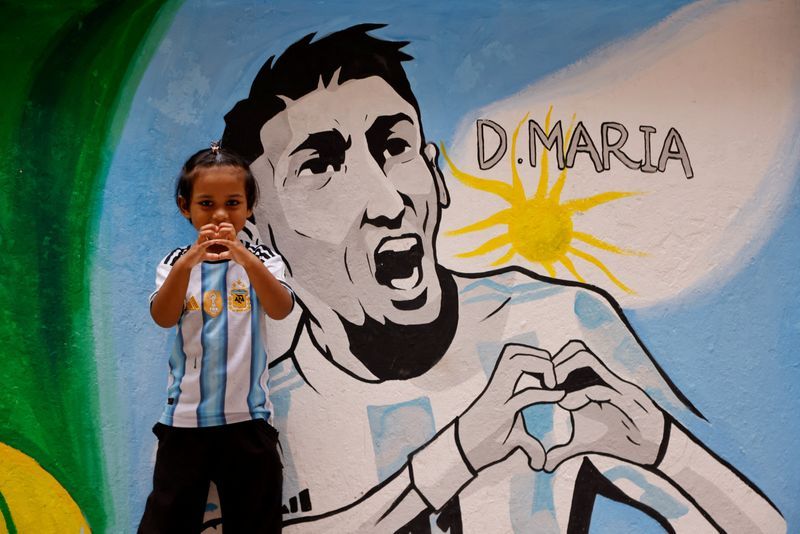
Argentina and Switzerland will renew their World Cup rivalry on Saturday in Kansas City, Missouri, with the quarterfinal stage serving as the setting for what promises to be a compelling encounter between a team steeped in recent tournament success and one experiencing a historic moment. The fixture carries particular weight given the history between these nations: exactly 12 years ago in Brazil, Argentina prevailed in a tense round-of-16 match when Angel Di Maria's extra-time strike broke Swiss resistance and propelled Lionel Messi's side toward the final. The passage of time has transformed both teams fundamentally, though their meeting point remains equally significant for each federation's aspirations.
When these sides last crossed paths at the 2010 World Cup in South Africa, Argentina operated under a different burden and with different expectations. Back then, Messi was approaching his peak years as a footballer, a virtuoso talent still searching for his first major tournament triumph with the national team. Argentina itself laboured under the weight of a 24-year drought without a World Cup victory, a gap that felt impossibly wide in a nation where the tournament occupies an almost spiritual place in the national consciousness. Switzerland, by contrast, had established themselves as consistent tournament participants with an impressive defensive reputation, yet remained paradoxically unable to transcend the group stage in any meaningful fashion, having last reached the quarterfinals in 1954.
The transformation in Argentina's status over the intervening years has been nothing short of remarkable. As defending world champions following their triumphant campaign in Qatar 2022, the Albiceleste arrive in the latter stages of this tournament carrying expectations befitting a team that has also finished as runners-up in 2014. Messi himself, now 39 years old, brings an almost mythical presence to the competition despite advancing age visibly affecting his physical capabilities. Yet his influence on Argentina's campaign remains disproportionately large, as evidenced by his pivotal role in orchestrating a stunning 3-2 comeback victory over Egypt in the previous round, a match in which his team recovered from being two goals down with merely eleven minutes of regulation time remaining.
Messi's perspective on these repeated moments of adversity and recovery offers insight into both Argentina's psychological resilience and the captain's enduring importance to his team's mission. Speaking after the Egypt result, the veteran midfielder acknowledged the emotional toll of such sequences while simultaneously emphasising the collective commitment to persevere regardless of circumstances. This characteristic refusal to surrender has become a defining feature of Scaloni's squad, a mentality that will be tested again against opponents who themselves have demonstrated growing tactical sophistication and competitive ambition.
Switzerland's presence in the quarterfinals constitutes a watershed moment for the confederation, representing the first time in 72 years that a Swiss side has advanced beyond the second round. Manager Murat Yakin's team achieved this milestone through a particularly demanding route, holding Colombia goalless across a full 120 minutes before prevailing in a penalty shootout. This achievement signals that Switzerland has evolved beyond their traditional archetype of defensive solidity and organised pragmatism. The Swiss believe they possess sufficient quality and cohesion to mount a genuine challenge against the tournament favourites, an optimism grounded in careful analysis of Argentina's recent performances.
Comparatively few direct connections bind these two teams across the dozen years separating their previous meeting. Only three players who featured in the 2010 encounter remain involved: Messi for Argentina, alongside Swiss captain Granit Xhaka and defender Ricardo Rodriguez. The presence of these continuities across such an extended period adds an intangible dimension to the narrative, particularly for Xhaka and Rodriguez, who carry the memory of previous disappointment against this opponent. Xhaka, at 33 years old, spoke with appropriate respect about facing Messi once more, acknowledging the gap between the Argentine's individual brilliance and the collective quality Argentina has developed over successive tournaments.
Rodriguez's assessment similarly recognised the multifaceted challenge posed by Scaloni's squad, emphasising not merely Messi's presence but the supporting cast that surrounds him and the tactical framework through which they operate. The Swiss captain understands that Argentina's strength extends beyond any individual, a reality that became apparent when the Albiceleste recovered from two-goal deficits against Egypt despite Messi's fluctuating contribution. This distributed attacking threat suggests that Switzerland must defend collectively with discipline rather than seeking to neutralise one player through tactical concentration.
Yakin's preparation has evidently included detailed analysis of vulnerabilities exposed during Argentina's group-stage proceedings, particularly matches against Cape Verde and Egypt that revealed defensive fragilities despite the team's ultimate success. The Swiss manager believes his side's patient, technically assured approach can exploit these weaknesses, though he appropriately cautioned against assuming Argentina has become vulnerable following two matches in close succession. His comments about the tactical dimensions of the forthcoming encounter suggest Switzerland will not approach this quarterfinal merely as underdogs hoping to survive, but rather as a team confident in their ability to impose their own playing style and create genuine difficulties.
Argentina's coaching staff, meanwhile, have evidently identified Switzerland as a formidable opponent despite the Swiss side's relative lack of recent tournament experience at this level. Scaloni indicated that Argentina will likely preserve the fundamental structure that secured victory over Egypt, suggesting consistency and continuity rather than wholesale tactical reorganisation. His assessment of Switzerland as a team with exceptional World Cup tradition and outstanding individual players reflects appropriate respect for an opponent with historical pedigree and current form.
The potential absence of Johan Manzambi through knee injury represents a complicating factor for Switzerland, as his creative contributions from midfield were notably missed during the Colombia encounter. The midfielder's availability could significantly influence whether Switzerland can maintain attacking balance against Argentina's relatively aggressive defensive approach. Conversely, Argentina must manage Messi's physical state carefully across a compressed fixture schedule, balancing his immense tournament experience and creative output against the reality that at 39, he cannot sustain elite performance for consecutive matches without adequate recovery.
Historically, this confrontation represents something different for each participant. For Argentina, a straightforward progression toward defending their title remains the overwhelming expectation, though Switzerland has demonstrated sufficient tactical organisation and collective commitment to avoid becoming mere ceremonial opposition. For Switzerland, reaching a quarterfinal for the first time in more than seven decades constitutes an achievement that transcends this particular fixture, yet advancement would transform the achievement into something genuinely historic. The narrative weight of their previous encounter, combined with their contrasting trajectories across 12 years, promises an encounter of considerable intensity and tactical interest, with implications extending beyond simple quarterfinal progression.

