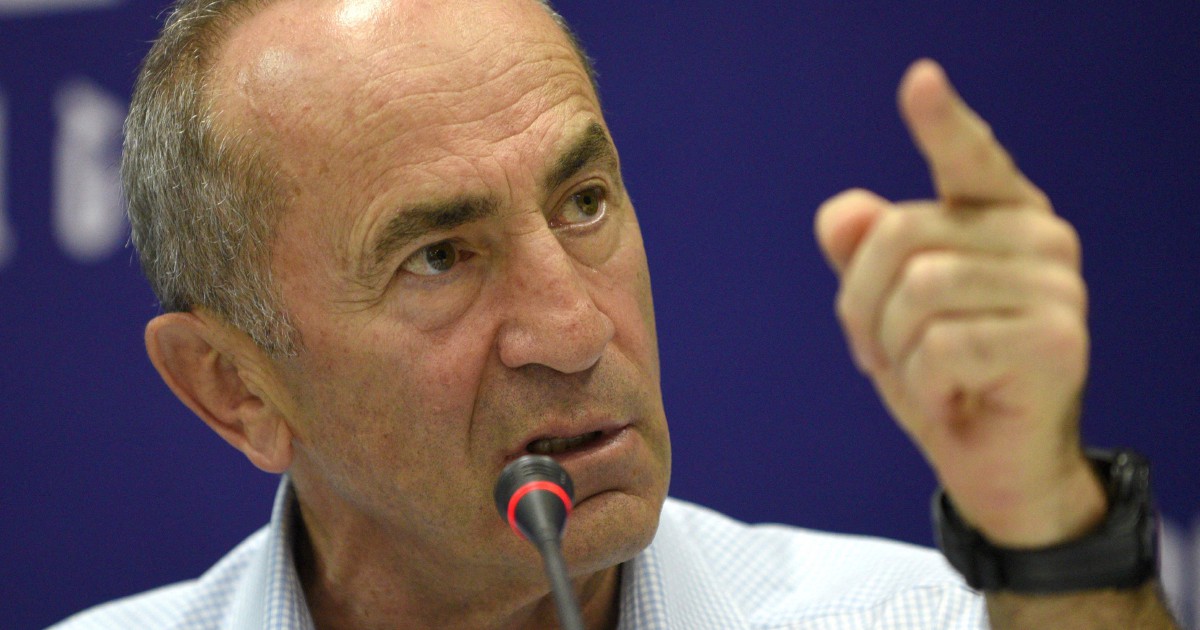
Armenia's prosecution service moved decisively on Tuesday to detain Robert Kocharyan, the former president who now leads opposition forces in the country, on an array of corruption allegations connected to his decade-long tenure. The detention marks an escalation in the government's scrutiny of Kocharyan's administration and reflects deepening political tensions within the ex-Soviet nation as it navigates complex governance challenges in the volatile South Caucasus region.
Kocharyan, who served as Armenia's president from 1998 until 2008, has emerged as a significant political force since stepping down from the top job more than fifteen years ago. His detention underscores the difficulties former leaders face across the broader post-Soviet space, where transitions of power frequently trigger investigations into the activities of previous administrations. The prosecution's action brings into focus broader questions about accountability and political continuity in nations still establishing robust democratic institutions.
The corruption charges levelled against Kocharyan encompass multiple domains of alleged misconduct spanning his period in power. Prosecutors have indicated that investigations have uncovered evidence suggesting illicit financial dealings and abuse of office during his presidency. The specific nature and scope of these allegations remain significant given Armenia's ongoing efforts to strengthen governance standards and combat endemic corruption that has historically plagued many post-communist states.
For Malaysian and Southeast Asian observers, Kocharyan's detention illustrates patterns familiar across diverse political systems—the vulnerability of former leaders to prosecution once they leave office. This phenomenon raises important questions about political stability and the rule of law, concerns that resonate particularly in the region given similar experiences in countries like Malaysia, where former prime ministers have faced legal proceedings following their departure from office. The tension between holding leaders accountable for wrongdoing and maintaining political stability remains a central challenge for democracies worldwide.
Kocharyan's position as an opposition leader adds complexity to his legal predicament. His detention by prosecution authorities raises concerns among some observers about the intersection of criminal justice and partisan politics. Such concerns are not unique to Armenia; they emerge regularly in contexts where political opposition and legal accountability become intertwined, potentially undermining public confidence in judicial impartiality. The optics of prosecuting opposition figures, whether justified or not, can generate perceptions of politically motivated investigations that damage institutional credibility.
Armenia's internal dynamics have been particularly strained since the 2020 military conflict with Azerbaijan over the disputed Nagorno-Karabakh territory. That devastating war reshaped the country's political landscape and has influenced how domestic accountability matters are perceived. Against this backdrop, investigations into past administrative misconduct operate within a heightened atmosphere of nationalist sentiment and questions about national security, complicating efforts to pursue conventional corruption cases.
The post-Soviet space has witnessed numerous instances of former leaders facing legal troubles following their exit from power. Russia, Georgia, Ukraine, and other former Soviet republics have all experienced high-profile prosecutions of former presidents and senior officials. These patterns reflect both genuine efforts to establish the rule of law and, in some cases, questionable motivations tied to score-settling and political consolidation. Armenia's handling of the Kocharyan matter will thus be scrutinised both domestically and internationally as indicative of the country's commitment to equitable application of justice.
For Armenia's democratic development and its international standing, the Kocharyan prosecution carries significant implications. The European Union and other Western observers monitor such cases as bellwethers of institutional maturity and respect for legal norms. Armenia's prosecution service must navigate the challenging terrain of pursuing legitimate accountability investigations while maintaining public perception of impartiality and fairness. Failure to do so risks deepening political polarisation at a moment when national unity and institutional stability are paramount.
The detention also reflects broader regional dynamics in the South Caucasus. Armenia faces complex relationships with neighbouring Azerbaijan and Turkey, alongside managing its historically close but increasingly complicated partnership with Russia. Internal political stability and the perceived legitimacy of governance institutions directly affect Armenia's capacity to navigate these delicate external relationships. Kocharyan's detention will likely intensify domestic political debate and could mobilise opposition constituencies, potentially complicating the government's efforts to project unity on security matters.
Moving forward, the trajectory of Kocharyan's case will significantly influence perceptions of Armenian governance. How prosecutors conduct investigations, whether due process protections are observed, and whether the legal system applies standards consistently across political actors will determine whether this represents justice system maturation or partisan score-settling. These outcomes matter not only for Armenia's internal politics but also for how international actors assess the country's institutional reliability and democratic credentials as it seeks to strengthen its position in an increasingly complex regional environment.

