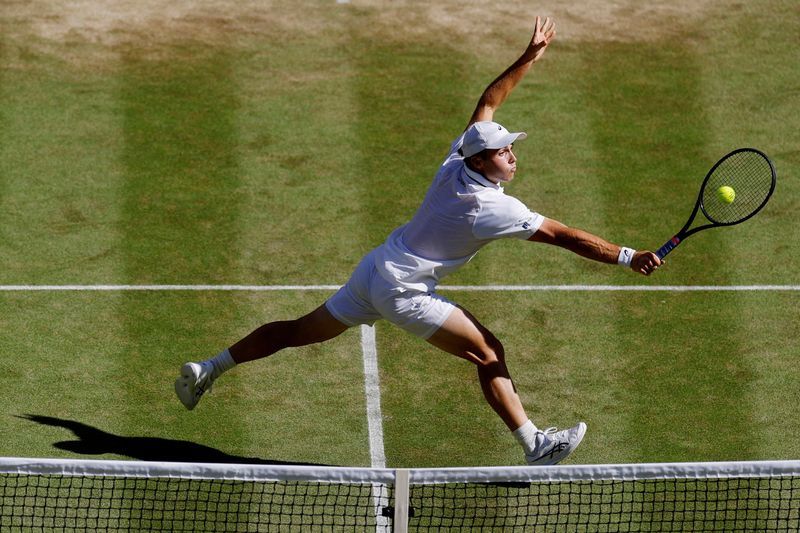
Arthur Fery arrives at Wimbledon's Centre Court on Sunday facing a narrative almost too perfect to script: the France-born Londoner will celebrate his 24th birthday on the same day as the men's singles final, and has engineered a genuine possibility of spending that milestone playing for the title. This remarkable convergence of personal and sporting milestones encapsulates the unlikely trajectory of a player who entered the Championships ranked 114th in the world and has since captivated audiences with a tournament run that defies conventional expectation.
Fery's maiden appearance on Centre Court delivered immediate drama. Making his debut on the sport's most hallowed stage on Monday, the Stanford-educated player engineered a gripping 7-5 3-6 4-6 6-4 7-6(7) victory over fellow wildcard Grigor Dimitrov, a former world number three now aged 35. The contest unfolded with Dimitrov orchestrating a commanding performance through the middle sets, at one stage commanding a 4-3 lead with a break of serve in the fourth set. Yet Fery summoned reserves of resilience and tactical acuity to force a deciding tie-break, ultimately prevailing in an encounter that sent the crowd into raptures. The Royal Box hosted Roger Federer as a spectator, adding another layer of occasion to Fery's breakthrough performance.
This victory represents his second consecutive five-set marathon at the Championships. His third-round triumph over Belgium's Zizou Bergs on Saturday demonstrated remarkable mental fortitude, with Fery fighting back from a two-sets-to-one deficit and a double break down in the fourth set to claim the tournament's longest match to date. The physical and emotional toll of that encounter, compounded by recurring nosebleeds that plagued him throughout, makes his continued progression all the more remarkable. These successive come-from-behind victories have established Fery as a player capable of elevating his game precisely when circumstances appear most desperate.
The atmosphere surrounding Fery's Monday victory carried extraordinary electricity that transcended typical tennis decorum. The crowd's exuberance drew considerable fuel from England's World Cup last-16 victory over Mexico, contested mere hours earlier in Mexico City's Azteca Stadium. British sporting enthusiasm, still resonating from that football triumph, channelled into rapturous support for the nation's tennis representative. When Fery clinched match point, the roar that erupted from the stands reached a volume that veteran observers suggested had rarely, if ever, been matched at Wimbledon. This intersection of concurrent British sporting success created a unique emotional environment that seemed to propel Fery's performance.
Fery's journey to the quarter-finals stands in stark contrast to the broader performance of British representatives at the Championships. Of the 19 British singles players entered into the competition, a sobering 15 departed in the opening round, leaving Fery as an almost solitary standard-bearer for home prospects. This statistical reality underscores the exceptional nature of his achievement and the weight of national expectation that has accumulated upon his shoulders. His progression represents British tennis' most significant contribution to the tournament narrative, a distinction that carries both honour and pressure for a player still establishing himself within the professional ranks.
Next opposing Fery stands world number 10 Flavio Cobolli of Italy, an opponent against whom he holds a recent competitive advantage. Fery defeated the Italian earlier this year at the Australian Open, providing tangible evidence that he possesses the capacity to compete effectively against top-ranked opposition. This previous encounter furnishes Fery with crucial tactical intelligence and psychological confidence heading into a fixture that represents another significant elevation in difficulty. Cobolli's ranking reflects genuine world-class credentials, yet Fery's recent form suggests he enters this quarter-final encounter as something more than a fodder for the seeded Italian.
The player himself has demonstrated considerable emotional maturity and perspective regarding his unexpected trajectory. When acknowledging the extraordinary circumstances surrounding his fortnight, Fery expressed genuine gratitude for experiences that he recognises may never recur. His comments reflected both humility and a consciousness that his current positioning represents an exceptional, potentially unrepeatable chapter in his career. This psychological grounding—neither dismissing his accomplishment nor allowing it to become consuming—suggests a mentality equipped to handle the intensifying pressure that accompanies deeper tournament progression.
Fery's ascent has not emerged entirely from obscurity within professional circles. Taylor Fritz, the American sixth seed, offered compelling testimony to the English player's technical capabilities and competitive intensity. Fritz recounted practising sessions with Fery prior to the 2024 World Tour Finals, during which the Londoner demonstrated such consistent dominance across baseline exchanges and service delivery that Fritz himself felt compelled to reassess his opponent's ability level. Such endorsements from established players carry particular significance in professional tennis, where high-level training partners offer unfiltered assessment of capacity and potential. Fritz's willingness to credit Fery's superiority during those practice sessions suggests the player possesses attributes that penetrate beyond Wimbledon's particular surface characteristics.
The velocity of Fery's rankings progression further illuminates his accelerating trajectory. Entering the Championships ranked 114th globally, he has since ascended into the top 70 and continues climbing. This ascent reflects not merely his Wimbledon performance but rather the accumulation of ranking points across recent months that collectively indicate sustained competitive improvement. For a player transitioning from college tennis at Stanford into the professional circuit, such progression across a six-month window represents genuine arrival at a higher competitive tier. The rankings movement validates what his on-court performances at Wimbledon have visually demonstrated: a player whose technical foundations and mental resilience position him within the upper echelon of tennis talent.
Fery's story carries particular resonance for Malaysian and Southeast Asian tennis audiences observing the sport's global landscape. His journey exemplifies how talent emerging from unconventional pathways—a French-born player raised in London, developing his game through American college tennis—can suddenly crystallise into championship-level performance on sport's biggest stages. This internationalisation of tennis talent pool mirrors broader trends in regional sport, where training systems increasingly transcend national boundaries and players develop capabilities through cross-continental development programmes. Fery's progression suggests that traditional hierarchies of tennis nations and established pathways to elite competition remain subject to disruption through exceptional individual performances and psychological resilience.

