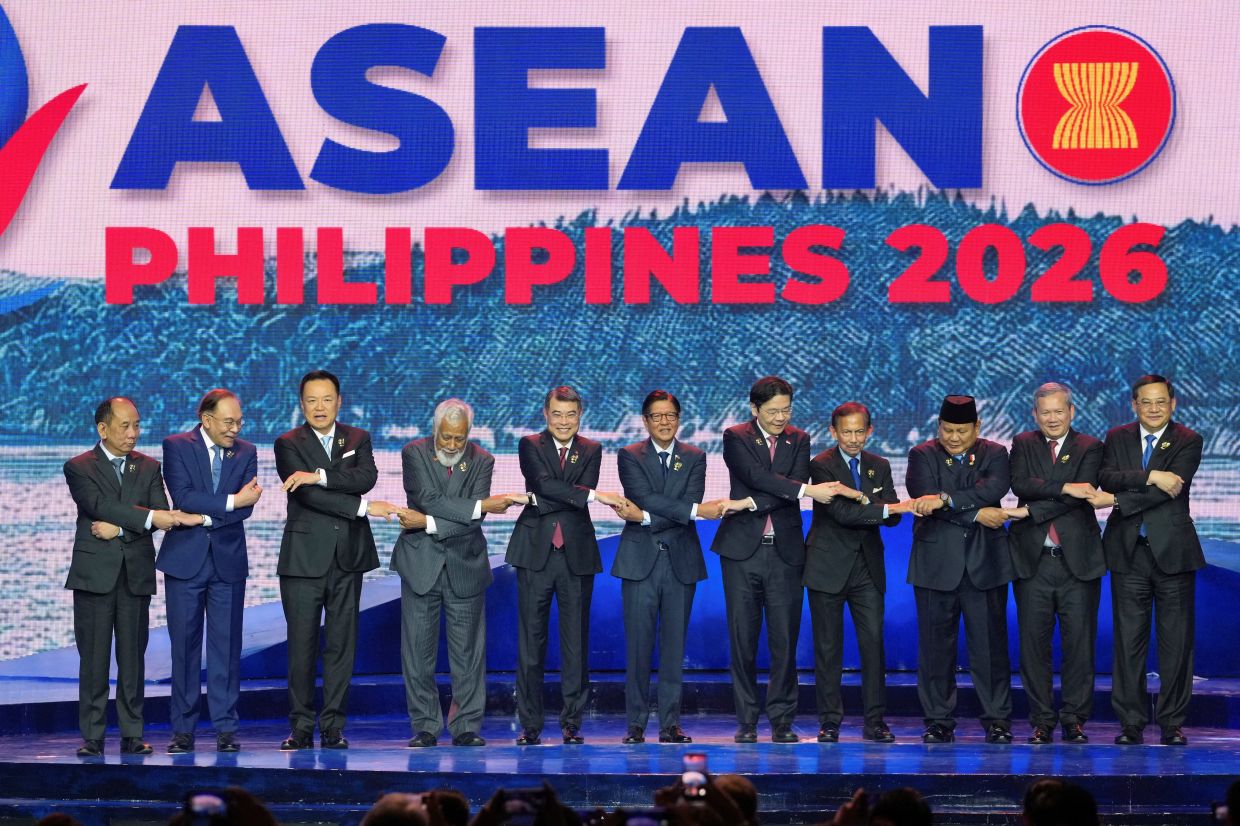
Senior diplomats from Southeast Asia's 11-nation bloc will gather in Manila this week to navigate a deteriorating geopolitical landscape that threatens regional stability and prosperity. The gathering, anchored by ASEAN foreign ministers meeting among themselves on Tuesday, represents an attempt by the Philippines—holder of this year's ASEAN chairmanship—to forge consensus on issues ranging from renewed hostilities in the Middle East to China's assertive posture in disputed maritime zones. The three-day ministerial conference will draw major power representatives including U.S. Secretary of State Marco Rubio, Chinese Foreign Minister Wang Yi, and Russian Foreign Minister Sergey Lavrov, reflecting the bloc's efforts to maintain dialogue amid rising international tensions.
The immediate catalyst for concern stems from escalating conflict between the United States and Iran, which has reverberated across the Middle East and triggered reverberations felt acutely in Southeast Asia. The two Southeast Asian diplomats briefed on the agenda indicated that ASEAN ministers intend to release a collective statement voicing deep anxiety about the hostilities and appealing to both protagonists to reinvigorate diplomatic channels. This renewed fighting carries particular weight for the region because it directly threatens the Strait of Hormuz, the critical waterway through which approximately one-fifth of the world's petroleum supply transits annually. For Southeast Asia—a densely populated region exceeding 680 million inhabitants—the implications prove especially severe, as economies across the bloc depend substantially on Middle Eastern energy resources to sustain their industrial bases and power generation.
The consequences of Middle Eastern instability have already proven tangible for Southeast Asian societies. Philippine President Ferdinand Marcos Jr. felt compelled to declare a national energy emergency in March, a stark measure designed to guarantee adequate supplies of fuel and essential commodities whilst preventing speculative hoarding and price gouging. This intervention underscores how Middle Eastern upheaval directly translates into hardship for ordinary Filipinos and citizens throughout the region. Beyond the Philippines, other ASEAN members have similarly grappled with inflationary pressures and energy supply uncertainties stemming from these distant conflicts, raising questions about whether the region's growth trajectory can remain resilient amid global commodity shocks.
Simultaneously, ASEAN policymakers harbour mounting frustrations regarding American strategic attention. Washington's military resources and diplomatic bandwidth have become considerably absorbed by Middle Eastern theatres, a reality that has prompted regional anxieties about Washington's capacity to sustain robust engagement with Asia-Pacific concerns. This concern carries particular urgency when considered against China's increasingly assertive behaviour in the South China Sea and the wider challenge posed by Beijing's military modernisation and strategic ambitions regarding Taiwan. The Trump administration has reaffirmed commitments to deter actions against Taiwan, yet the credibility of these assurances depends materially upon demonstrated American focus on the region—something the current Middle Eastern preoccupations have appeared to diminish.
Rubio's attendance in Manila fundamentally aims to reaffirm Washington's strategic commitment to maintaining what the United States frames as a free and open Indo-Pacific. In remarks preceding his departure, Rubio emphasised that whilst American and Chinese interests naturally generate points of friction and disagreement, the two powers bear reciprocal obligations to maintain communication channels and cultivate workable relationships. He indicated openness to meeting Wang, though no formal arrangements had been confirmed at the time of his statement. Notably, Rubio refrained from committing to raising Trump's unsubstantiated assertions regarding alleged Chinese interference in the 2020 American presidential election, instead projecting a tone emphasising pragmatic engagement. Additionally, he suggested that expectations persist for a proposed September visit to the United States by Chinese leader Xi Jinping, signalling that Washington is not entirely closed to high-level dialogue despite the administration's harder rhetorical line toward Beijing.
Beyond bilateral U.S.-China engagements, Rubio will participate in meetings with fellow Quad members—India, Japan, and Australia—an arrangement that underscores Washington's broader design to orchestrate coordinated counter-balancing to Chinese influence throughout the Indo-Pacific. The Quad grouping has become an increasingly central feature of American regional strategy, though Beijing consistently denounces it as a transparent containment apparatus designed to obstruct China's legitimate rise. The group's presence at these talks demonstrates how ASEAN has become a crucial arena where major power competition plays out, with the Philippines serving as both a sympathetic venue and a potential arbitrator of competing visions for Asian order.
The ASEAN meetings must also grapple with Myanmar's ongoing civil catastrophe, a conflict consuming the bloc from within yet resistant to consensus solutions. Since the military coup of 2021 that displaced Aung San Suu Kyi's democratically elected government, the fighting has claimed over 8,100 lives and rendered nearly 22,500 individuals in detention camps, according to the Assistance Association for Political Prisoners, an independent monitoring organisation. A five-point peace consensus adopted by ASEAN leaders in 2021 has manifestly failed to arrest the violence, primarily because Myanmar's military-dominated administration has refused meaningful compliance with its provisions. Consequently, ASEAN took the unusual step of excluding Myanmar's senior officials from its highest-level forums, including this week's Manila session.
Yet this position has begun to fracture as several ministers, led by Philippine Foreign Secretary Theresa Lazaro, engaged directly with Myanmar's Foreign Minister Tin Maung Swe during a Bangkok meeting earlier this month—the first such high-level contact in five years. This diplomatic manoeuvre prompted vociferous criticism from international human rights organisations, who characterised the engagement as a de facto abandonment of ASEAN's principled stance and a capitulation to military leaders lacking incentive for genuine compromise. Lazaro responded by insisting the meetings did not represent repudiation of the five-point consensus but rather embodied a conviction that durable peace requires sustained diplomatic engagement across all warring parties, however compromised such engagement might appear to external observers. Following the Myanmar government meeting, Lazaro and Thai Foreign Minister Sihasak Phuangketkeow subsequently consulted with representatives of ethnic armed groups in Pattaya, attempting to maintain some semblance of balanced engagement.
The South China Sea tensions command perhaps equal attention at these deliberations, particularly given the escalation of confrontations between Chinese government vessels and Philippine coast guard forces in recent years. The territorial disputes involve multiple claimants—China, Taiwan, and ASEAN members Brunei, Malaysia, the Philippines, and Vietnam—creating an intricate web of competing sovereignty assertions that remain fundamentally unresolved. ASEAN and China have been negotiating a proposed code of conduct framework intended to establish guardrails preventing disputes from catalysing into open conflict. Wang's participation in these Manila talks will include substantive discussions concerning the negotiation status and prospects for achieving a binding accord that all parties might accept. Given the Philippines' current ASEAN leadership and its frontline position in South China Sea confrontations, Manila has particular motivation to advance these negotiations toward concrete outcomes that might restore predictability to the region's most strategically sensitive waters.

