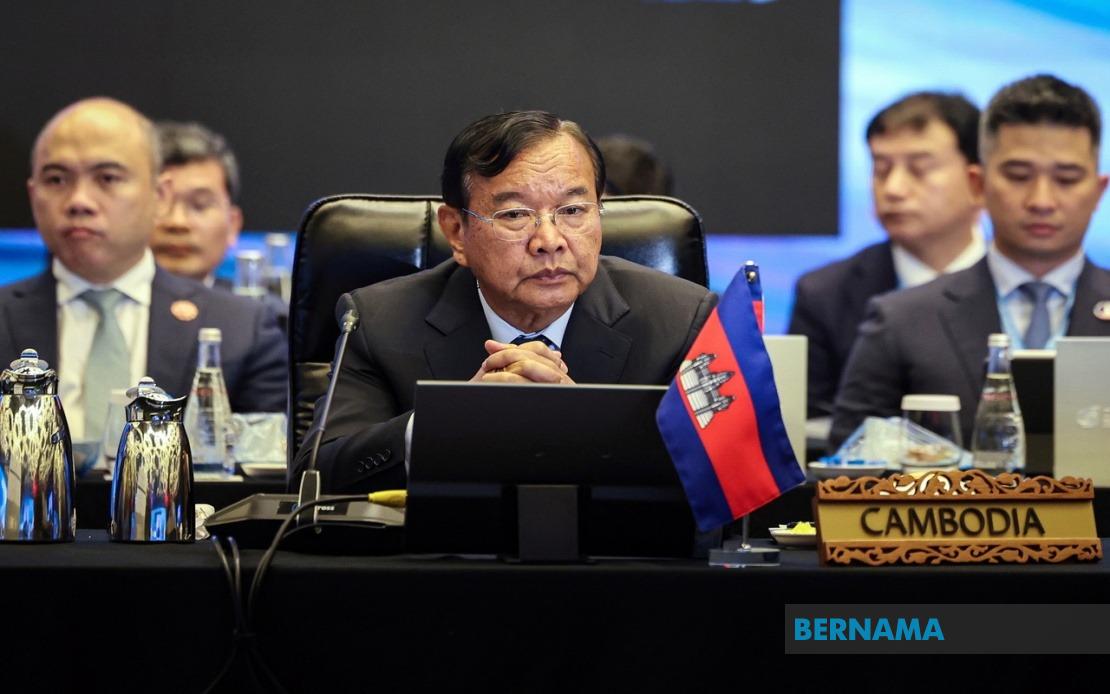
Cambodian Foreign Affairs and International Cooperation Minister Prak Sokhonn has reinforced ASEAN's centrality to Southeast Asian stability, cautioning that the 11-nation bloc faces unprecedented geopolitical pressures and must take proactive measures to safeguard regional interests. Speaking during the organization's 59th anniversary commemoration, the Cambodian minister—who also serves as deputy prime minister—outlined the evolving challenges confronting ASEAN as it navigates an increasingly fractious global environment marked by resurgent conflicts, sharpening great-power competition, and erosion of international legal frameworks.
Sokhonn's intervention underscores growing anxiety among regional capitals about ASEAN's capacity to maintain consensus and coherence as external actors intensify their engagement in Southeast Asia. The minister characterized the past six decades as a transformative period in which ASEAN converted a region historically fragmented by ideological differences, territorial disputes, and colonial legacies into a space defined by constructive dialogue and institutionalized cooperation. This narrative of regional success through multilateral engagement carries particular resonance given contemporary friction between major powers seeking influence in the Indo-Pacific.
The Cambodian official grounded his argument in ASEAN's foundational instruments, specifically the organization's Charter and the Treaty of Amity and Cooperation, both of which encode principles of non-interference, respect for sovereignty, and peaceful dispute resolution. For Malaysian and other Southeast Asian policymakers, this emphasis on institutional legitimacy and rule-based architecture reflects persistent efforts to insulate ASEAN from external pressures and domestic instability. Yet Sokhonn's acknowledgement that the region confronts a "volatile global climate" with "resurging armed conflicts" and "intensifying geopolitical tensions" suggests that these traditional mechanisms may face mounting strain.
Cambodia's positioning within ASEAN carries nuanced significance for regional dynamics. As a nation with deep historical and strategic ties to China, and one that has occasionally aligned with Beijing on contentious issues within ASEAN, Sokhonn's call for strengthened unity carries dual meaning. His assertion that ASEAN "cannot afford to be passive" and must "help shape" regional outcomes rather than merely react to external developments can be read as a plea for collective agency—a reminder that member states must prioritize ASEAN consensus over bilateral great-power relationships.
Sokhonn highlighted Cambodia's two-decade membership since 1999 as evidence of the nation's institutional commitment, though Cambodia's role remains subject to scrutiny given periodic allegations of diluting ASEAN positions on sensitive issues favored by Beijing. The minister's reaffirmation of strict adherence to the ASEAN Charter and Treaty of Amity and Cooperation appears designed to address such concerns, signaling that Phnom Penh remains bound by collective obligations even when bilateral interests diverge.
The composition of ASEAN—encompassing Brunei, Cambodia, Indonesia, Laos, Malaysia, Myanmar, the Philippines, Singapore, Thailand, Vietnam, and Timor-Leste—reflects both the organization's inclusivity and its vulnerability to internal divisions. Myanmar's ongoing political and humanitarian crisis, the South China Sea disputes involving multiple claimants, and varying economic development levels create fissures that geopolitical rivals can exploit. Sokhonn's emphasis on unity addresses these fault lines implicitly, suggesting that only collective resolve can prevent external powers from fracturing ASEAN consensus.
For Malaysian observers, Sokhonn's message carries immediate relevance given Malaysia's substantial interests in ASEAN cohesion and maritime security. As a claimant in South China Sea disputes and a nation with significant economic stakes in regional stability, Malaysia has long championed ASEAN unity as a counterweight to bilateral power imbalances. The Cambodian minister's call for ASEAN to remain "indispensable" echoes Malaysian diplomatic positions emphasizing the bloc's irreplaceability in regional architecture.
The broader Southeast Asian context adds weight to Sokhonn's concerns. Escalating tensions between major powers, the U.S.-China strategic competition, and shifting security alignments create incentives for individual ASEAN members to pursue hedging strategies that potentially compromise collective positions. The Myanmar crisis exemplifies this dynamic, with ASEAN's inability to achieve consensus on intervention or isolation reflecting member-state divisions and external pressures. Similarly, ongoing South China Sea tensions pit claimant states' immediate security concerns against ASEAN's commitment to peaceful negotiation and non-confrontational approaches.
Sokhonn's framing of ASEAN as a platform for "dialogue, cooperation, and shared prosperity" reflects the bloc's post-Cold War identity centered on economic integration, people-to-people exchange, and confidence-building rather than military alliance formation. Yet mounting geopolitical tensions increasingly test this model, as member states face pressure to align with competing strategic visions. The minister's insistence that ASEAN must be proactive rather than reactive suggests recognition that passive adherence to consensus-based diplomacy may prove insufficient in an era of sharpening great-power rivalry.
The institutional health of ASEAN hinges substantially on whether member states maintain commitment to collective principles despite bilateral temptations. Sokhonn's message, while diplomatically calibrated, carries implicit warnings about the consequences of allowing parochial interests to override regional solidarity. For Southeast Asia broadly, and Malaysia particularly, sustaining ASEAN's relevance requires sustained investment in multilateral mechanisms and demonstrated willingness to prioritize bloc positions over individual great-power relationships—a challenge that will intensify as geopolitical competition for regional influence deepens.

