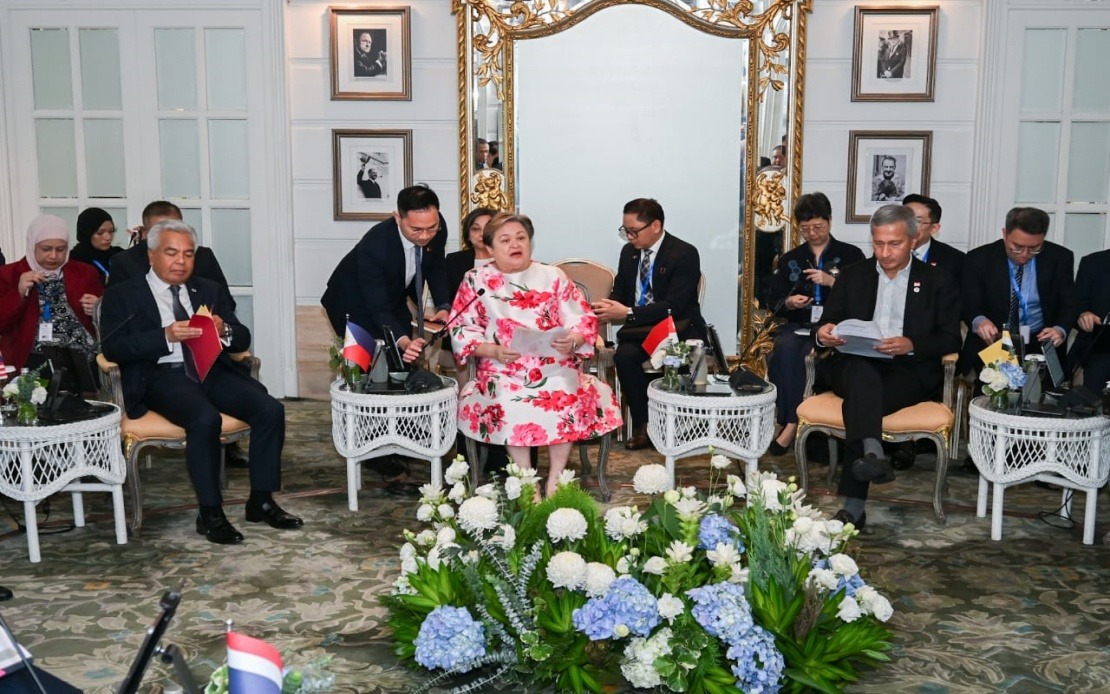
ASEAN has reasserted its commitment to the Five-Point Consensus as the bedrock of its approach to Myanmar's political crisis, signalling that the regional bloc will not abandon its preferred diplomatic framework despite Naypyidaw's recent parliamentary rejection. Speaking at a joint press conference in Bangkok following an Informal Meeting of ASEAN Foreign Ministers that included Myanmar's Foreign Minister, Philippine Secretary for Foreign Affairs Maria Theresa Lazaro, who serves as the ASEAN Chair's Special Envoy on Myanmar, underscored that the consensus remains non-negotiable for the association's engagement strategy across all stakeholder groups.
The Five-Point Consensus, adopted in April 2021 in the immediate aftermath of Myanmar's military coup, establishes five core pillars for resolving the country's turmoil: an immediate cessation of violence, inclusive dialogue involving all political factions, provision of humanitarian assistance to affected populations, engagement through an ASEAN-appointed Special Envoy, and mediation efforts involving all relevant parties. Though Myanmar's parliament passed a motion last week formally rejecting this peace architecture, ASEAN's stance remains unequivocal. Lazaro articulated this position with particular clarity, stating that regardless of Myanmar's official position, ASEAN intends to stand firmly behind the consensus as the legitimate framework for addressing the crisis.
The significance of this Bangkok meeting extends beyond diplomatic rhetoric. It marked the first in-person gathering between ASEAN foreign ministers and Myanmar's foreign minister since the coup erupted in February 2021, representing a rare moment of direct engagement at the ministerial level. The meeting was chaired by the Philippines in its capacity as ASEAN Chair, with representation from all member states except Cambodia. Malaysia participated through its Foreign Ministry Secretary-General, Tan Sri Amran Mohamed Zin, reflecting Kuala Lumpur's continued investment in finding a resolution to a crisis that affects regional stability and ASEAN's collective credibility.
During the discussions, ASEAN conveyed three concrete expectations to Myanmar's government. The first centres on expanding humanitarian assistance to Myanmar's civilian population, which continues to suffer acute shortages of essential services and medical care following years of conflict. The ASEAN Chair has already begun planning a dedicated humanitarian mission intended to map out enhanced pathways for aid delivery, recognising that the current crisis has created immense suffering that transcends political divisions. This initiative reflects ASEAN's pragmatic understanding that humanitarian concerns cannot be bracketed indefinitely while political negotiations proceed.
The second expectation demands a demonstrable reduction in violence, particularly targeting civilians caught in the crossfire between military forces and armed resistance groups. Reports documenting civilian casualties, displacement, and destruction have mounted steadily since 2021, creating a humanitarian catastrophe that ASEAN can no longer treat as peripheral to its diplomatic efforts. By explicitly raising this issue, ASEAN is signalling that violence reduction is not merely a desirable outcome but a prerequisite for meaningful progress on the broader agenda.
Third, ASEAN has pressed for more inclusive political dialogue that would facilitate genuine national reconciliation. This encompasses fostering a political environment conducive to negotiations, securing the release of political prisoners held by the military regime, and creating pathways for previously marginalised groups to participate in conversations about Myanmar's political future. This dimension acknowledges that sustainable stability cannot be built on military dominance alone but requires some degree of political inclusion that commands legitimacy among Myanmar's diverse populations.
Thailand's Foreign Minister Sihasak Phuangketkeow, whose country hosted the meeting, articulated a nuanced position regarding ASEAN's engagement strategy. He characterised the bloc's approach as one of "calibrated engagement," emphasising that this methodology functions as a reciprocal undertaking. ASEAN, through this framework, maintains diplomatic channels and extends conditional cooperation, but expects corresponding movement from Myanmar's junta towards addressing the concerns raised by the association and the international community. This formulation acknowledges that ASEAN's leverage is limited, requiring tangible gestures from Naypyidaw to sustain the credibility of engagement efforts.
The question of implementation timelines emerged as particularly critical during the discussions. When pressed on whether Myanmar had received specific deadlines to address ASEAN's concerns, Sihasak indicated that the regional bloc would undertake a comprehensive assessment of progress when ASEAN leaders convene for the formal summit scheduled later in 2023. This approach preserves diplomatic flexibility while establishing implicit benchmarks by which Myanmar's performance can be measured. It suggests that ASEAN is preparing for the possibility that continued intransigence may necessitate recalibration of the engagement strategy.
Myanmar's parliamentary rejection of the Five-Point Consensus last week represented a deliberate rebuff to ASEAN's preferred framework, yet the regional bloc's response has been to reaffirm rather than retreat from this position. This apparent contradiction reflects ASEAN's strategic calculus that abandoning the consensus would signal weakness and potentially encourage further defiance from Naypyidaw. By maintaining consistent public backing for the framework, ASEAN preserves the possibility of future dialogue even as the immediate prospects for Myanmar's acceptance remain dim.
For Malaysia and other ASEAN members, sustaining this consensus on Myanmar serves multiple functions. It demonstrates ASEAN's capacity to maintain internal unity on consequential regional issues, reinforces the association's role as a mediator in intra-regional disputes, and prevents the Myanmar crisis from becoming weaponised in broader geopolitical competitions. The participation of Malaysia's Foreign Ministry Secretary-General underscores Kuala Lumpur's commitment to supporting whatever consensus ASEAN reaches, even where individual members might harbour different preferences regarding engagement approaches.
The broader implications for Southeast Asia are substantial. Myanmar's political instability threatens regional security, generates refugee flows affecting neighbouring states, and disrupts economic connectivity across the Mekong subregion. ASEAN's determination to persist with the Five-Point Consensus, despite Myanmar's rejection, reflects recognition that abandoning mediation efforts entirely would leave the crisis entirely to military-dominated trajectories or regional power competition. By maintaining diplomatic channels, however strained, ASEAN preserves institutional credibility and keeps alive the possibility of future breakthroughs.
Moving forward, the credibility of ASEAN's approach will depend substantially on whether the humanitarian mission achieves tangible results in expanding aid delivery and whether Myanmar demonstrates incremental progress on violence reduction or political dialogue. The forthcoming ASEAN summit will provide an important checkpoint for assessing whether calibrated engagement is yielding movement or merely postponing more difficult decisions about the association's Myanmar strategy. Until then, ASEAN's reaffirmation of the Five-Point Consensus signals determination to maintain multilateral engagement as the framework for addressing one of the region's most intractable contemporary crises.

