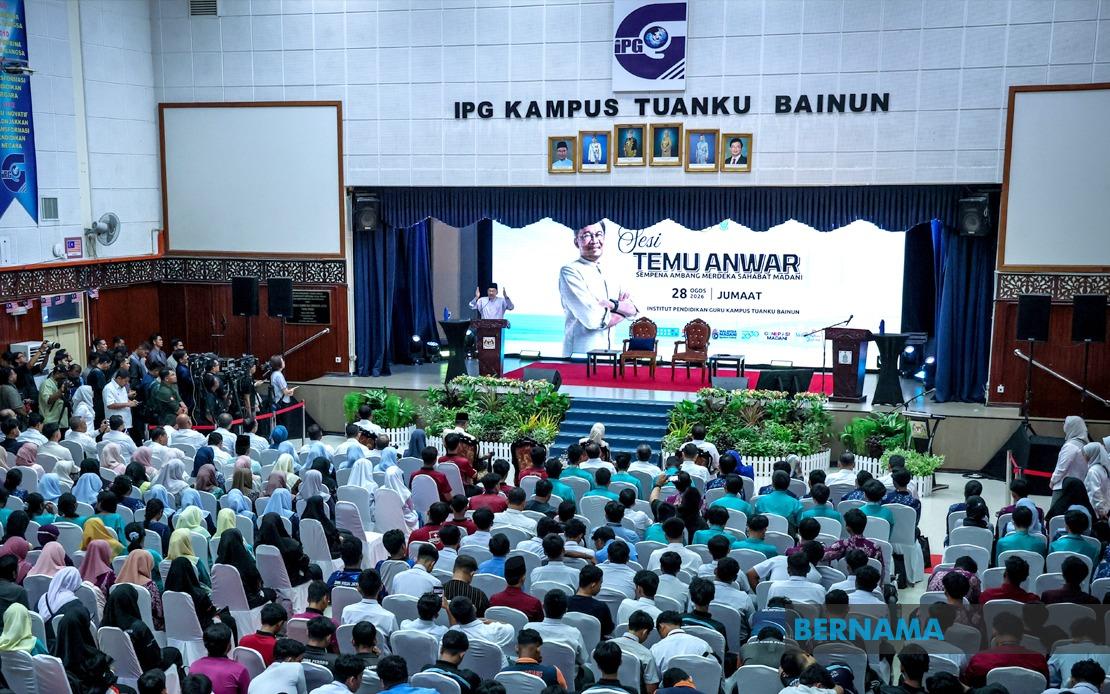
Prime Minister Datuk Seri Anwar Ibrahim has positioned the abolition of the Universities and University Colleges Act 1971 (AUKU) as a decisive break from half-century-old restrictions that stifled youth engagement, arguing the legislative repeal represents a philosophical shift toward trusting young Malaysians to participate meaningfully in national discourse. Speaking at a Temu Anwar session in Bukit Mertajam on August 28, Anwar framed the removal of constraints on student speech not merely as a legal reform but as an investment in developing the intellectual capabilities of the country's next generation of leaders and citizens.
The Prime Minister drew a stark contrast between the regulatory environment of 1971, when the AUKU was enacted, and contemporary Malaysian society, emphasizing that the original restrictions reflected an outdated approach to youth governance. By highlighting that students at 18 years of age already possess voting rights, Anwar constructed a logical framework questioning why legislative boundaries should prevent the same demographic from articulating political views or engaging in public debate. This reasoning challenges the implicit assumption embedded in the five-decade-old law that university students require state-imposed limitations on their right to assembly and expression.
Anwar's decision to pursue complete abolition rather than merely amending the AUKU signals a wider ideological commitment to liberalizing Malaysia's approach to academic freedoms and student activism. The articulation of his reasoning during the public session underscores government efforts to communicate that dismantling restrictions on campus speech is not a permissive retreat but rather a calculated strategy to cultivate intellectual maturity. The Prime Minister explicitly connected freedom of expression to the development of judgment and analytical capacity, framing the repeal as instrumental to fostering an ecosystem where creativity can flourish within university environments.
The emphasis on encouraging students to voice perspectives while acknowledging that their opinions may contain errors reflects a nuanced understanding of intellectual development. Rather than presenting unfettered speech as an end in itself, Anwar positioned open discourse as a pedagogical tool through which young people learn to refine their thinking through exposure to counter-arguments and evidence-based critique. This framing potentially addresses concerns from more conservative constituencies that dismantling AUKU might unleash chaotic or unmonitored activism by instead positioning debate and expression as mechanisms for developing more sophisticated political consciousness.
Education Minister Datuk Seri Fadhlina Sidek's presence at the session alongside the Prime Minister signaled institutional alignment between the highest political office and the education portfolio on the question of student freedoms. This coordination suggests the government is approaching the AUKU repeal not as an isolated legal change but as part of a coordinated effort across multiple government departments to reshape the regulatory and cultural landscape governing universities. The visible support from the education ministry indicates that implementation strategies likely extend beyond legislative amendment to include institutional reforms within tertiary education.
The timing of Anwar's remarks, delivered during an interactive forum specifically designed for direct engagement with students, represents a strategic communication approach. By explaining the rationale for AUKU repeal in a setting where students could respond and pose questions, the government attempted to frame the policy within a narrative of listening to youth concerns and responding with substantive reforms. The student who posed the question about entering politics provided an ideal context for the Prime Minister to link the repeal directly to enabling political participation among the young.
For Malaysian universities, the AUKU repeal carries substantial implications for campus governance and student organizing. Decades of restrictions had created institutional cultures where certain forms of student activism remained technically prohibited or subject to administrative discretion. The legislative removal of these constraints requires universities to develop new frameworks for managing student political engagement, ensuring that increased freedoms operate within clearly defined parameters that protect institutional integrity while genuinely permitting the exercise of rights. This transition period will test whether Malaysian tertiary institutions can effectively balance expanded student freedoms with maintaining academic standards and institutional stability.
The broader Southeast Asian context provides useful perspective on Malaysia's decision. Several regional neighbors have grappled with similar questions about student activism and academic freedom, with outcomes ranging from continued restrictions to gradual liberalization. Malaysia's choice to pursue complete abolition rather than incremental reform positions the country within a progressive trajectory on this issue, potentially influencing how other governments in the region evaluate their own policies governing university students. The decision also reflects confidence that Malaysian society has matured sufficiently to accommodate robust student political engagement without descending into institutional chaos or violent extremism.
Opposition voices and institutional stakeholders will likely scrutinize how the AUKU repeal functions in practice during the coming months and years. Concerns about maintaining order on campuses, preventing external manipulation of student movements, and ensuring that intellectual freedom does not become merely partisan activism will require careful navigation by university administrators and government officials. The success of the reform will ultimately depend on whether Malaysian universities can cultivate campus cultures where diverse viewpoints genuinely flourish and where debate genuinely sharpens critical thinking rather than reinforcing existing ideological positions.
Anwar's articulation of the reform's purpose also carries implications for how Malaysia positions itself internationally regarding human rights and democratic values. In an era where academic freedom and student rights have become markers of democratic health, the decision to repeal the AUKU contributes to Malaysia's standing within global conversations about governance and civil liberties. The explicit framing of the repeal as enabling critical thinking and creativity suggests the government is making a calculated choice to prioritize intellectual development and youth engagement over maintaining mechanisms of state control over campus expression, a shift with potentially far-reaching consequences for Malaysian civil society in the decades ahead.

