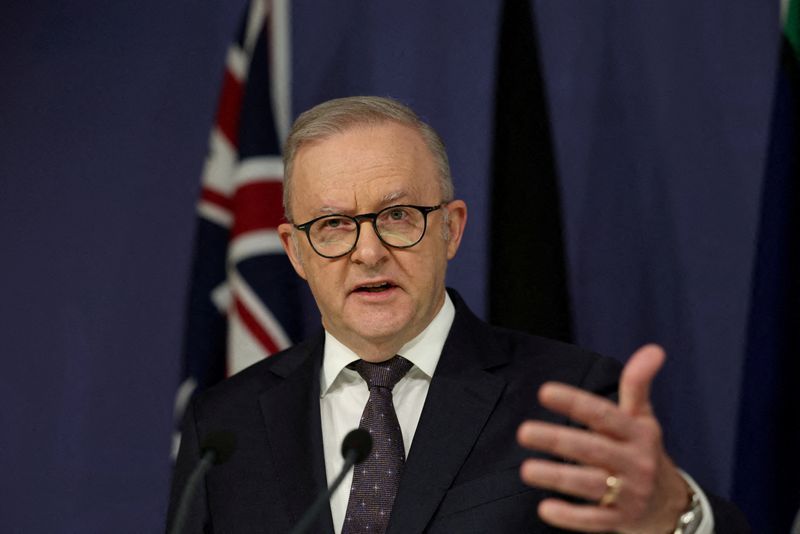
Australia is moving to create a dedicated governmental body tasked with managing artificial intelligence development and establishing consistent standards across the nation, marking an attempt to position the country as both a responsible regulator and an attractive destination for technology investment. The new Office of AI, to be housed within the Department of the Prime Minister and Cabinet, represents a significant shift in how the government approaches the complex challenges posed by rapid advances in artificial intelligence technologies.
Prime Minister Anthony Albanese unveiled this initiative through a major policy address in Sydney, framing the move as a necessary evolution in governmental response to transformative technologies. His remarks highlighted a critical observation about Australia's previous approach: rather than developing coherent, overarching strategies, the government had dealt with artificial intelligence through disparate, reactive measures addressed on a case-by-case basis or within individual industry sectors. This fragmented approach, Albanese suggested, has left gaps in oversight and created uncertainty for businesses and investors operating in the space.
The creation of this centralised office mirrors historical precedents in how Australian governments have tackled other paradigm-shifting technologies. Civil aviation regulation, which emerged in the 1920s as aircraft transformed transportation and commerce, and the genetic technology frameworks developed during the 1990s biotechnology boom, both demonstrate the government's capacity to develop comprehensive approaches when facing genuinely novel challenges. Albanese drew explicit parallels to these examples, suggesting that artificial intelligence warrants similarly integrated governance structures that cut across multiple ministries and policy domains.
Government officials argue that establishing this office will streamline how businesses navigate regulatory approval processes and compliance requirements. By providing clearer pathways for companies to understand and meet regulatory expectations, the office aims to reduce friction in investment decisions. This approach reflects a broader calculation that excessive regulatory uncertainty can deter capital flows, potentially causing Australia to lag behind other nations in developing domestic artificial intelligence capabilities and infrastructure.
The initiative arrives at a pivotal moment in Australia's technology ambitions. The nation has articulated aspirations to become a regional hub for artificial intelligence research and development, and simultaneously to attract substantial data centre investment from global technology companies. These objectives require demonstrating both innovation-friendly policies and credible, sophisticated governance frameworks that address legitimate public concerns.
Yet the announcement also reflects mounting anxiety across Australian society about artificial intelligence's societal implications. Labour displacement represents perhaps the most visceral concern, with economists and workers' advocates increasingly warning that widespread adoption could render significant portions of the workforce redundant without adequate transition support. The energy demands of artificial intelligence infrastructure have generated environmental anxieties as well, particularly regarding water consumption at data centres in a nation where water scarcity poses genuine constraints.
Beyond employment and environmental questions, stakeholders have raised alarms about artificial intelligence systems infringing upon fundamental rights and values. Data security vulnerabilities, potential breaches of intellectual property protections, and risks to personal privacy figure prominently in these discussions. Additionally, safety and security concerns extend to potential misuse of artificial intelligence for surveillance, autonomous weapons systems, and generation of convincing disinformation.
Currently, Australia lacks dedicated artificial intelligence legislation. Instead, the regulatory framework relies upon a patchwork of existing privacy statutes and consumer protection laws designed for earlier technological contexts. Supplementing these are voluntary guidelines framed around artificial intelligence ethics principles. This approach, while flexible, leaves substantial areas ungoverned and creates inconsistency about what standards apply to different artificial intelligence applications across different sectors.
For Malaysian and Southeast Asian observers, Australia's experience offers important lessons. The region faces similar pressures to become competitive in artificial intelligence development while managing legitimate regulatory concerns. Malaysia, Singapore, Indonesia, and other neighbours are themselves grappling with how to attract technology investment without sacrificing environmental sustainability or allowing unchecked labour displacement. Australia's decision to establish dedicated governmental infrastructure for artificial intelligence coordination suggests a model worth studying as regional governments develop their own strategies.
The effectiveness of Australia's new Office of AI will ultimately depend upon its actual powers, funding, and political support. Establishing an office within the Prime Minister's department provides organisational proximity to political authority, potentially facilitating whole-of-government coordination that individual ministry-based approaches cannot achieve. However, coordinating diverse interests—technology companies seeking minimal constraints, labour advocates demanding protections, environmental groups concerned about resource consumption, and civil society organisations focused on rights—will require substantial diplomatic skill and genuinely balanced policymaking.
Australia's approach also reflects a growing international recognition that artificial intelligence cannot be regulated piecemeal. The European Union's AI Act, the United States' emerging sectoral framework, and various Asian governments' initiatives all represent different bets on how to achieve this balance. Australia's explicit attempt to create a unified governmental structure represents one response to the coordination challenge that artificial intelligence regulation presents in complex modern states.

