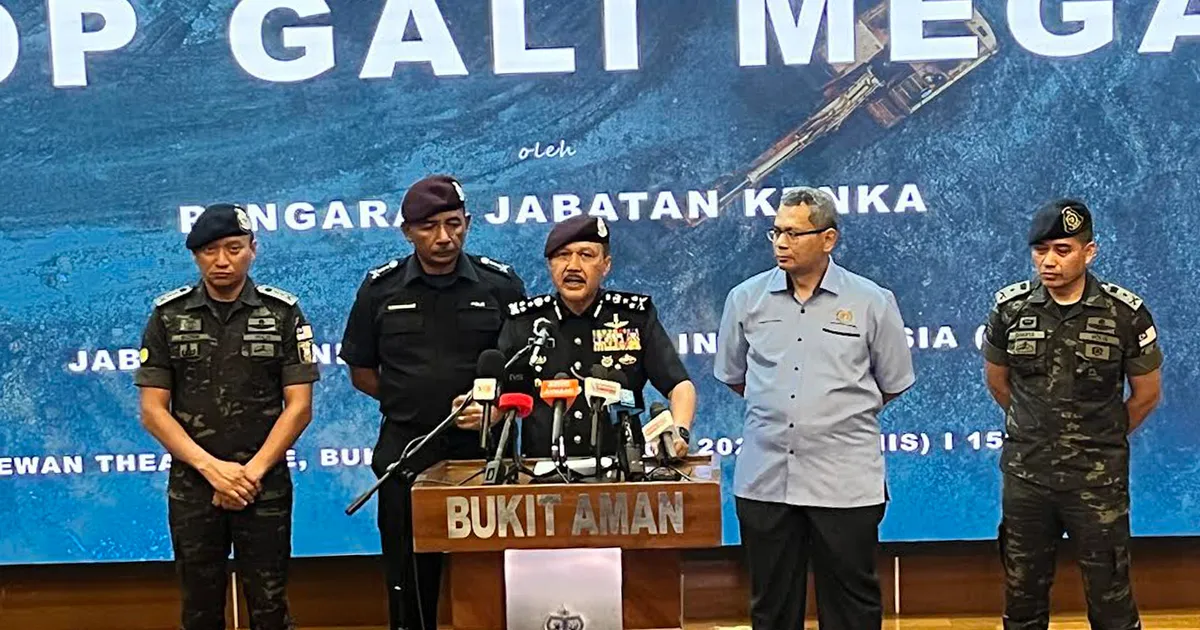
A coordinated enforcement operation spanning August 19-23 has resulted in the arrest of 99 suspects allegedly involved in illegal mining activities, with authorities securing approximately RM119 million in seized assets across Malaysia. The multi-agency crackdown represents a significant escalation in the government's ongoing battle against unlicensed extraction operations that have long plagued the nation's mining sector, undermining legitimate operators and depleting natural resources at an alarming pace.
During the five-day operation, authorities confiscated over 33,000 tonnes of extracted natural resources valued at RM21 million. The haul encompassed coal, quarry stone, earth, and sand—commodities that form the foundation of Malaysia's construction and industrial sectors. The sheer volume of materials recovered underscores the scale at which illegal mining syndicates have been operating, often with minimal regard for environmental regulations or land tenure laws. These underground networks frequently exploit remote locations and administrative gaps to extract resources without proper licensing or environmental impact assessments.
The broader seizure of assets totalling RM119 million extends considerably beyond the raw extracted materials and likely includes mining equipment, vehicles, machinery, and processing facilities used to facilitate operations. This comprehensive asset-seizure strategy effectively dismantles the operational infrastructure that enables illegal miners to function, making it substantially more difficult for criminal networks to resume activities even if some members evade prosecution. The approach reflects evolving enforcement tactics that recognize the importance of disrupting entire supply chains rather than merely apprehending individual operators.
Illegal mining represents a persistent challenge across Southeast Asia, with Malaysia experiencing particular vulnerability due to its abundant natural resources and porous border regions. The practice generates substantial revenue for criminal organisations while simultaneously causing environmental degradation, depleting irreplaceable mineral deposits, and distorting legitimate market competition. Many illegal operations employ undocumented workers, create hazardous working conditions, and operate outside tax collection mechanisms, further eroding state revenues and labour protections.
The timing and scale of this operation suggest coordination among multiple enforcement agencies, likely including the Ministry of Natural Resources and Environment, local authorities, police units, and customs agencies. Such inter-agency cooperation has become increasingly necessary given the sophisticated networks that organise illegal extraction activities. Effective enforcement requires real-time intelligence sharing, coordinated raid planning, and simultaneous action across multiple sites to prevent operators from relocating or concealing evidence when operations commence.
For Malaysia's legitimate mining sector, which remains important to the economy despite declining coal reliance, such enforcement actions provide critical market protection. Illegal operators undercut licensed producers by avoiding regulatory compliance costs, environmental remediation expenses, and tax obligations. This artificially depressed competition can force legitimate businesses to reduce operations, lay off workers, or relocate to jurisdictions with more robust enforcement. By removing illegal supply from markets, authorities help sustain the viability of properly regulated mining enterprises that contribute to government coffers and maintain employment standards.
The environmental implications of illegal mining extend far beyond simple resource depletion. Uncontrolled extraction destabilises landscapes, contaminates water sources, destroys habitats, and contributes to soil degradation. Unlike licensed operations that must implement mitigation measures and restoration plans, illegal mines typically leave behind scarred terrain with minimal effort toward rehabilitation. Communities adjacent to illegal mining sites frequently experience elevated pollution levels, compromised water quality, and health problems linked to unregulated extraction activities. These environmental costs are rarely quantified in official statistics but represent significant long-term economic burdens borne by affected regions.
The arrest of 99 individuals provides opportunities for law enforcement to gather intelligence about the organisational structures underpinning illegal mining networks. Interrogation of detainees may reveal supplier relationships, financial flows, distribution channels, and connections to other criminal activities. Such intelligence proves invaluable for disrupting larger networks that often operate across state boundaries or international borders, particularly given proximity to jurisdictions where enforcement capacity differs substantially. Understanding how illegal minerals enter legitimate supply chains—through intermediaries, false documentation, or commingling with legal stock—enables more sophisticated disruption strategies moving forward.
However, sustained effectiveness requires consistent enforcement commitment and adequate resourcing. Illegal mining operations frequently resume after initial crackdowns when enforcement attention shifts elsewhere, particularly if financial incentives for criminal operators remain attractive relative to punishment risks. Malaysia's experience mirrors patterns observed across Southeast Asia, where sporadic enforcement campaigns produce impressive short-term seizures but fail to generate lasting deterrence without sustained pressure. Building effective deterrence requires not only dramatic enforcement actions but also consistent prosecution, meaningful penalties, and robust monitoring of previously active sites.
Community engagement represents another underutilised dimension of enforcement strategy. In many regions where illegal mining flourishes, local populations tolerate or even participate in operations due to limited economic alternatives or insufficient awareness of environmental consequences. Developing alternative livelihood programmes, strengthening environmental education, and creating legitimate employment within the mining sector could address root causes driving participation in illegal activities. Without addressing underlying economic pressures that make illegal mining attractive, enforcement alone faces inherent limitations.
The RM119 million in seized assets sends a powerful signal about the financial stakes involved in illegal mining. These figures demonstrate that substantial wealth accumulation occurs within unregulated extraction networks, wealth that flows to organisers while contributing nothing to public coffers or legitimate economic development. Effective asset recovery—through proper prosecution and conviction—can fund future enforcement operations and support environmental remediation in affected areas. This model of enforcement-funded environmental restoration represents an emerging best practice in resource governance.
Moving forward, maintaining momentum against illegal mining requires sustained political will, inter-agency coordination, and integration of enforcement with broader strategies addressing resource governance. Malaysia's approach must balance rigorous enforcement against production of sufficient legal supply to meet domestic demand and export commitments. As legitimate mining operations face transition challenges—including global coal demand shifts and renewable energy transitions—preventing illegal alternatives from filling supply gaps becomes increasingly important for economic stability in mining-dependent regions.

