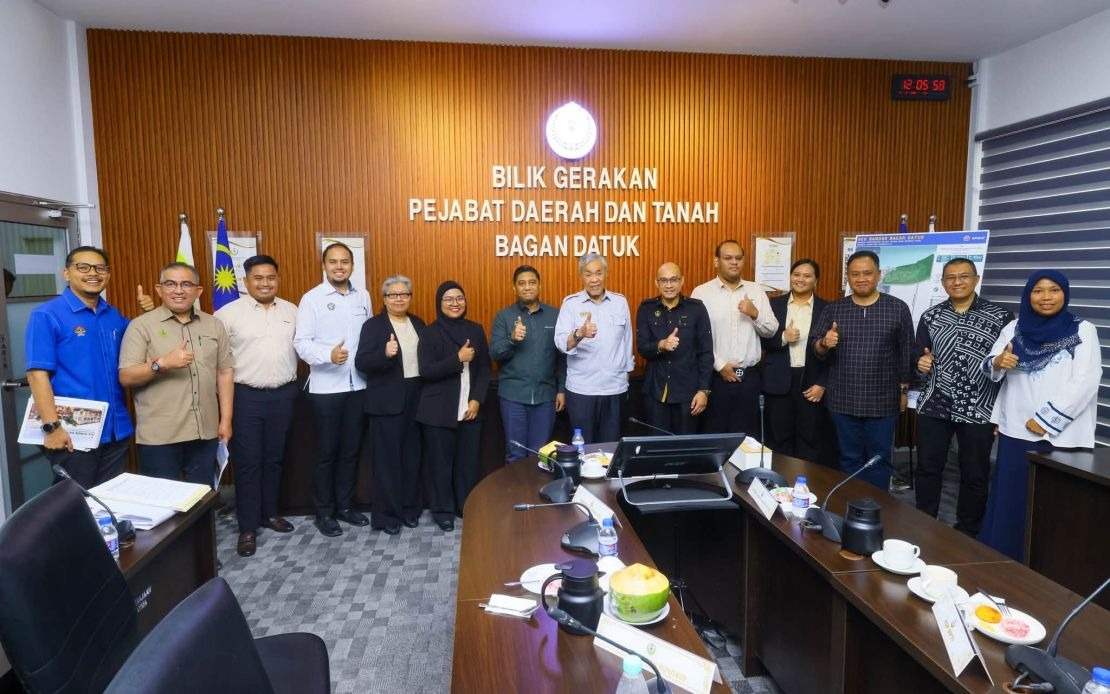
Deputy Prime Minister Datuk Seri Dr Ahmad Zahid Hamidi has articulated a comprehensive vision for transforming Bagan Datuk into a modern administrative centre that balances development with livability. Speaking in his capacity as Member of Parliament for the Perak constituency, Zahid emphasised the district's untapped potential and the importance of structured planning to realise its economic and social prospects.
Zahid's remarks came following a detailed briefing session in Ipoh where he reviewed the special area plan study for Bagan Datuk, a strategic document prepared in collaboration with the Teluk Intan Municipal Council, the Bagan Datuk District Office, and appointed consultants. The comprehensive planning exercise represents an effort to chart a deliberate course for the constituency's growth over coming years, moving beyond ad-hoc development towards a coherent framework.
The Deputy Prime Minister characterised the proposed development model as creating a distinctive administrative town within a park setting, a concept that integrates commercial and governance functions whilst maintaining environmental quality. This approach reflects growing international trends in urban planning that seek to combine economic productivity with enhanced quality of life, a model increasingly popular in Southeast Asia as cities grapple with balancing growth and sustainability.
Central to Zahid's vision is the expansion of Bagan Datuk's physical and social infrastructure. Adequate facilities and modern infrastructure form the foundation upon which communities can attract talent and investment, particularly as Malaysia competes with neighbouring countries to position regional administrative centres. Without these fundamentals, even constituencies with geographical or historical advantages struggle to retain residents and businesses seeking modern amenities.
Economic diversification constitutes another pillar of the development strategy. Bagan Datuk, historically dependent on traditional sectors, requires broader economic foundations to provide sustainable livelihoods and tax revenues. The special area plan presumably identifies opportunities across services, light manufacturing, tourism, and agriculture-related industries that could generate employment whilst complementing rather than displacing existing economic activity.
Zahid's personal connection to Bagan Datuk—he describes himself as a native of the district—lends credibility to his commitment, though it also raises expectations that development pledges will translate into tangible outcomes. Local constituents will likely measure the Deputy Prime Minister's sincerity against concrete project implementations, timelines, and resource allocations in coming budget cycles.
The reference to community needs within the planning process underscores an evolving approach in Malaysian governance that emphasises stakeholder consultation. By framing the special area plan as responsive to local priorities rather than imposed from above, Zahid signals awareness that sustainable development requires alignment between government vision and grassroots aspirations. However, the genuine extent of community input in finalising the plan remains unclear from available statements.
For Malaysian readers and observers across Southeast Asia, Bagan Datuk's trajectory carries broader significance. Perak has historically occupied an important position in Malaysia's economic and political landscape, yet many of its constituencies have experienced relative decline as development concentrates in the Klang Valley and Penang. Successful revitalisation of Bagan Datuk could provide a replicable model for addressing regional imbalances within Peninsular Malaysia, potentially offering lessons applicable to underperforming constituencies nationwide.
The emphasis on creating a distinctive administrative town reflects competition among Malaysian constituencies and states to establish identity and competitive advantage. As federal and state governments redirect resources toward priority development zones, districts must articulate clear value propositions. Bagan Datuk's positioning as an attractive administrative centre attempts to capture government functions and associated economic activity that might otherwise migrate elsewhere.
The involvement of the Teluk Intan Municipal Council in planning processes indicates coordination across administrative boundaries, a necessary approach for managing regional growth coherently. Effective implementation will require sustained cooperation between state and local authorities, a dimension not extensively detailed in available statements but crucial for translating plans into reality.
Timelines for implementing specific elements of the special area plan remain unspecified, creating uncertainty regarding when residents and businesses might expect visible transformation. Development of this scale typically requires phased implementation spanning multiple budget allocations and electoral cycles, necessitating political commitment that transcends individual tenures.
Zahid's invocation of Islamic terminology in committing to efforts for Bagan Datuk's advancement reflects conventional political communication in Malaysia, yet such language may signal the depth of conviction behind stated objectives. Whether rhetorical or substantive, the framing establishes a moral dimension to development commitments that resonates with local constituencies valuing both material progress and ethical governance.
Moving forward, stakeholders including residents, businesses, and civil society organisations in Bagan Datuk will scrutinise progress against articulated objectives. The success of the special area plan will ultimately determine whether the district achieves the transformation envisioned or whether it remains, as Zahid suggests it currently is, a constituency with unrealised potential awaiting purposeful development.

