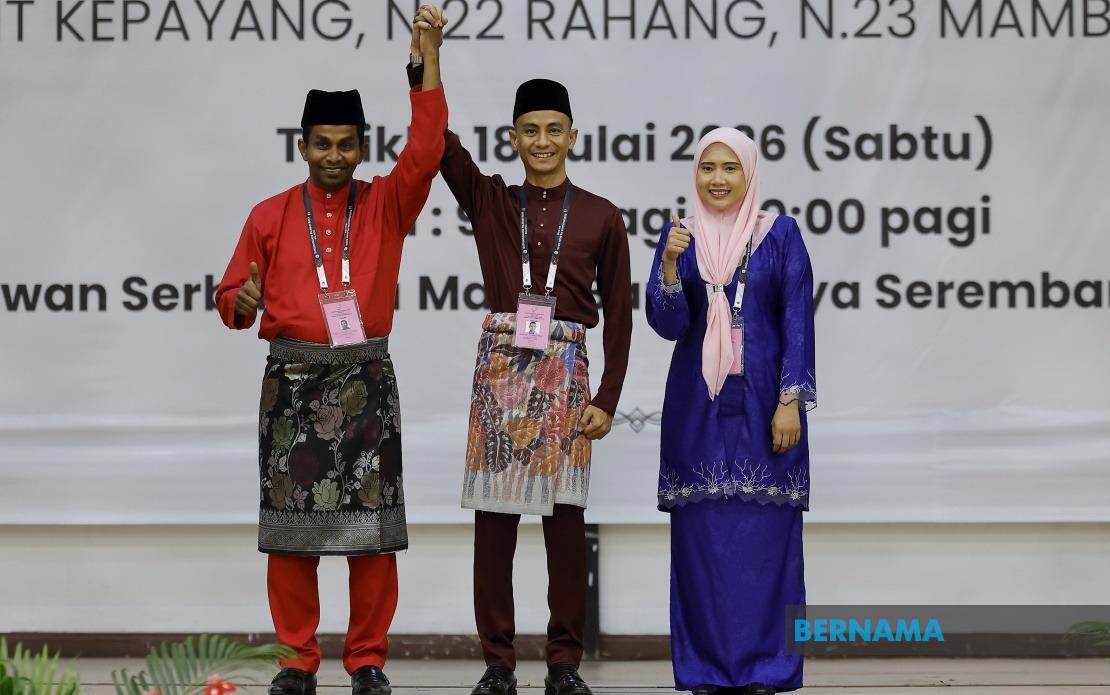
Datuk Ahmad Faez Abdul Razak, the Pakatan Harapan-PKR candidate contesting the Labu state seat in Negeri Sembilan's 16th state election, has staked his candidacy on a promise to manage development pressures whilst protecting the interests of local residents. Making his first attempt at electoral office, the property developer told reporters after nomination proceedings in Seremban that he brings both personal apprehension and genuine optimism to the contest, having invested nearly three years cultivating relationships with constituents across the constituency.
The 32,884 registered voters of Labu—comprising 32,869 ordinary voters plus 15 police personnel and spouses—will decide the seat's future when they cast ballots on August 1, with early voting scheduled for July 28. Ahmad Faez faces a three-cornered battle against the incumbent assemblyman, Mohamad Hanifah Abu Baker of Bersatu and Barisan Nasional, as well as BN's Siti Nur Umaira Hasim. Mohamad Hanifah secured victory in 2023 with a narrow 1,640-vote margin over the previous PH-PKR contestant Datuk Ismail Ahmad, who garnered 10,021 votes—a result suggesting the seat remains genuinely competitive.
Ahmad Faez's campaign narrative centres on leveraging his professional background to navigate the constituency's explosive growth trajectory. He emphasises that his years as a property developer equip him to comprehend both the opportunities and hazards inherent in large-scale infrastructure projects. This technical credibility proves significant given that Labu sits within the Malaysia Vision Valley corridor, a sprawling 11,000 to 12,000 hectare zone designated for industrial and residential expansion. Such large-scale projects invariably reshape communities, introducing traffic congestion, environmental pressures, and shifting demographics—challenges that require nuanced political management rather than blanket opposition or uncritical endorsement.
The Malaysia Vision Valley initiative represents a critical economic development initiative for Negeri Sembilan, promising substantial employment opportunities for local populations. However, Ahmad Faez recognises that industrial corridors frequently create externalities that burden existing communities: noise pollution from manufacturing, influxes of migrant workers straining local services, and property value fluctuations that disadvantage long-term residents. His campaign positioning attempts to address this tension head-on, framing himself as someone who comprehends development mechanics whilst remaining committed to protecting community cohesion and quality of life.
Worth noting is Ahmad Faez's assessment that public confidence in the current state administration has strengthened, partly attributable to alignment between Negeri Sembilan's initiatives and federal government policy directions. This signals that PH hopes to capitalise on governance continuity and policy coherence messaging—a particularly relevant advantage given the fragmentation evident in the three-cornered contest. The presence of Mohamad Hanifah, who defected from Bersatu, complicates the opposition narrative and may split votes among constituents dissatisfied with PH's prior tenure.
Central to Ahmad Faez's manifesto is the establishment of a community centre and youth recreational facility, addressing what he identifies as a conspicuous gap in Labu's social infrastructure. Youth engagement facilities represent a tangible, localised promise that contrasts with the macro-level development narrative, suggesting his campaign balances grand economic vision with attention to immediate quality-of-life concerns. For young voters, whose concerns often centre on employment prospects, social spaces, and community identity, such targeted pledges carry electoral significance. The absence of existing facilities may reflect historical underinvestment in Labu, providing room for Ahmad Faez to position himself as correcting previous neglect.
Ahmad Faez's emotional candour—acknowledging nervousness alongside optimism—presents an interesting counterpoint to the typical confident bravado of established politicians. For an electoral debut, such vulnerability may resonate with voters fatigued by performative political rhetoric. His assertion that nearly three years of grassroots engagement has generated measurable public support momentum suggests that PH has invested substantially in groundwork rather than parachuting in a last-minute candidate. This investment in relationship-building, whether genuine or performative, signals serious intent to reclaim the seat.
The demographic profile of Labu's electorate—32,884 voters in a constituency identified as among Negeri Sembilan's fastest-growing—indicates a constituency experiencing rapid change. Population growth often correlates with younger, more mobile demographics and voters with recent experience of multiple communities, making them potentially more receptive to development-focused messaging but also more attuned to livability concerns. Ahmad Faez's profile as a relatively new political figure without entrenched baggage may appeal to such voters seeking alternatives to long-standing political rivalries.
Competitively, the split opposition posed by Mohamad Hanifah's candidacy under Bersatu colours creates uncertainty. Voters opposed to PH's governance during its previous spell in Putrajaya may now distribute opposition votes across two non-PH options, inadvertently benefiting Ahmad Faez. Conversely, some voters may interpret Mohamad Hanifah's retention of the seat as validation of local representation, making the incumbent's incumbency advantage difficult to overcome. The 1,640-vote margin separating Mohamad Hanifah from Ismail Ahmad in 2023 suggests that Labu has remained exceptionally close, with small voter movements capable of determining the outcome.
For Malaysian political watchers, Labu exemplifies the recurrent tension between economic modernisation and community preservation that defines contemporary Southeast Asian politics. The Malaysia Vision Valley corridor, whilst economically justified, generates genuine anxiety among residents regarding environmental quality, cultural preservation, and equitable benefit distribution. Ahmad Faez's challenge lies in convincing voters that his dual expertise in property development and political representation positions him uniquely to maximise benefits whilst minimising harms—a genuinely difficult balancing act that will likely dominate the campaign's final weeks as polling approaches.

