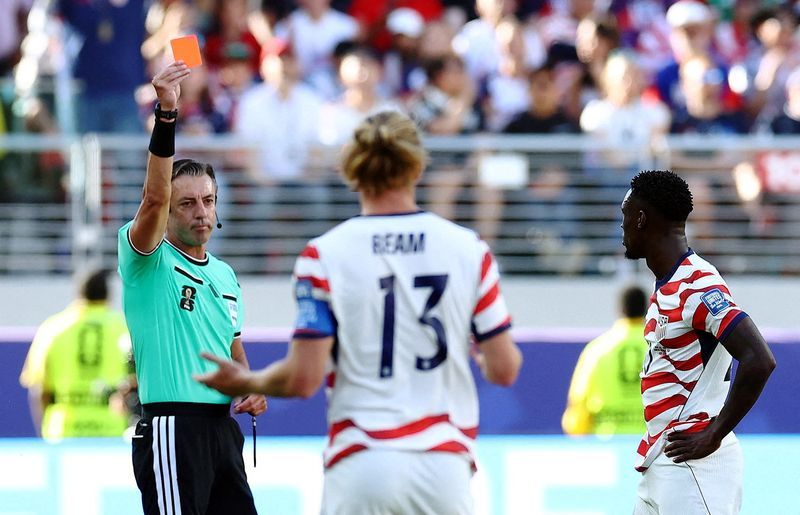
The Premier League's top officiating and executive leadership has raised alarm that the fallout from FIFA's contentious decision to overturn Folarin Balogun's World Cup suspension threatens to erode public confidence in football's integrity, at a moment when the English domestic season prepares to commence with heightened scrutiny on refereeing decisions.
Balogun, the American forward, received a red card during World Cup play in what became one of the tournament's most controversial moments. The situation intensified dramatically when U.S. President Donald Trump publicly intervened, following which FIFA proceeded to lift the suspension through a disciplinary procedure that many observers criticised for lacking transparency and established precedent. The sequence of events—political pressure, followed by an apparent reversal of protocol—has left officials and administrators grappling with the reputational damage to football's governance structures.
Howard Webb, who heads Pro Ref and previously officiated the 2010 World Cup final, expressed particular disturbance not primarily about disagreement with the original dismissal itself but rather about the corrosive message sent by how the situation unfolded. Webb explained that the visibility of political influence on FIFA's disciplinary decisions, combined with the improvised nature of the reversal process, has created a template for questioning the impartiality of officiating at all levels. The precedent set is especially troubling because it suggests that external pressure can circumvent established regulatory frameworks.
A parallel concern animates Webb's warnings about the contemporary digital landscape surrounding football. In an era where controversial decisions instantly generate millions of social media posts, the Balogun episode provides convenient ammunition for those predisposed to view refereeing as corrupt. Webb emphasised that while factual debate about match decisions remains healthy, the injection of unfounded corruption narratives—divorced from evidence—creates an environment where reasonable people begin to suspect systemic malfeasance. This psychological shift, Webb warned, fundamentally damages the legitimacy of officiating regardless of actual conduct.
The timing compounds the concern considerably. As the Premier League season commences on Friday, every controversial decision will face intense microscopic examination. Webb acknowledged candidly that the Balogun affair does not help the domestic competition's efforts to maintain public trust in refereeing. The World Cup fallout carries forward into English football not as historical footnote but as active corrosive force, providing interpretive frameworks through which supporters and analysts will view decisions they disagree with.
Richard Masters, the Premier League's chief executive, approached the issue from a different angle, lamenting that discourse surrounding the World Cup has become overwhelmingly dominated by off-field administrative controversies rather than celebration of on-field excellence. Masters pointed out that the tournament should be remembered for Spain's dominant performances and England's heartbreaking semi-final elimination, yet instead the conversation centres on governance failures. This displacement of focus represents not merely a public relations problem but a substantive shift in how football is discussed and understood.
Masters further identified a structural deficiency in FIFA's regulatory architecture. Unlike many domestic competitions and tournaments that permit review and potential overturn of red card decisions, FIFA's disciplinary framework contains no such mechanism. This inflexibility creates situations where controversial dismissals become locked in place, generating pressure for workarounds that ultimately compromise procedural integrity. The Balogun case exemplified how this regulatory gap, when combined with external political pressure, produces ad hoc solutions that appear to bend rules rather than apply them consistently.
The implications for Malaysian and Southeast Asian football governance merit consideration. As regional competitions increasingly aspire to international standards and attract global investment and attention, the question of how disciplinary decisions are made and defended becomes increasingly important. The Balogun controversy serves as a cautionary example of how insufficient transparency and flexibility in regulatory frameworks can create openings for improper influence and subsequent public scepticism. Regional football associations observing FIFA's handling of this episode will need to ensure their own disciplinary processes maintain both flexibility to address genuine injustices and transparency sufficient to sustain public confidence.
Webb outlined that the new Premier League season will introduce numerous refereeing law changes designed to reduce time-wasting and accelerate match tempo. Notably, referees will issue fewer warnings and penalise more offences proactively. This stricter enforcement approach creates additional complexity for maintaining public trust. When referees begin penalising actions that previously received warnings, confusion and accusations of inconsistency inevitably follow. Against the backdrop of the Balogun controversy, this transition period becomes especially fraught, as supporters already primed to question officiating decisions will interpret the increased penalty rate through a lens of potential bias rather than consistent rule application.
Webb expressed confidence that by next season's equivalent briefing, the refereeing community could demonstrate that increased penalty enforcement has actually reduced the incidence of problematic play by forcing tactical adjustments among players. This educational narrative—that stricter initial enforcement produces long-term behavioural change—requires consistent messaging and public understanding. Yet the Balogun affair has damaged the credibility necessary to advance such arguments persuasively. Officials must now rebuild trust simultaneously with implementing operational changes, a considerably more challenging proposition.
The deeper concern articulated by Webb and Masters reflects a fundamental reality about modern football administration: legitimacy depends not merely on making correct decisions but on maintaining processes that credibly demonstrate impartiality. FIFA's handling of the Balogun case failed on both counts. The original red card decision, however defensible on technical grounds, became inseparable from the subsequent political intervention and procedural irregularity. For Webb, this represents not an isolated administrative stumble but a symptom of systemic vulnerability to external pressure that corrodes football's foundational principle: that outcomes on the pitch are determined by athletic ability and tactical acumen rather than external influence.
As the Premier League enters a season of heightened refereeing changes and inevitable controversial decisions, the Balogun controversy casts a long shadow. Webb and Masters have essentially signalled that they face an uphill battle to maintain public confidence in officiating during a period when rule changes will naturally generate dispute and adjustment. The World Cup's handling of Balogun has provided those inclined toward cynicism about football with precisely the narrative they require to interpret every subsequent contentious decision as evidence of systemic corruption. Rebuilding trust will require not merely correct decisions going forward but explicit demonstration that the governance structures correcting the Balogun precedent are functioning as intended.

