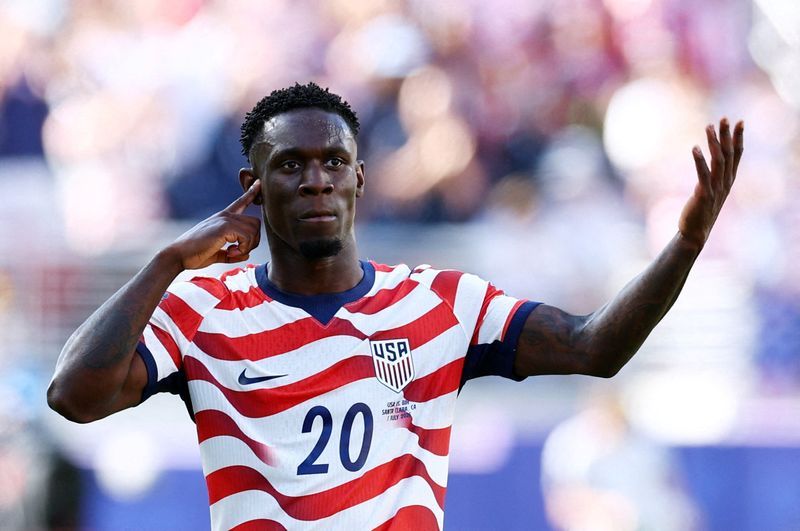
Folarin Balogun arrived at a defining moment in his football career carrying far more than athletic pressure when he took the pitch for the United States against Belgium on Monday. The 25-year-old striker embodied a collision of competing interests—soccer performance, national identity, and American immigration policy—that few athletes have navigated so publicly. His presence in the match itself became possible only after an extraordinary series of events that revealed how deeply sports and politics intertwine, even at the world's most prominent sporting competition.
Balogun's trajectory to this point had already captured imaginations. After representing England at youth levels, he switched to the United States Soccer programme in 2023, becoming the breakout star of the tournament with three goals that inspired genuine hopes of a deep run. Yet the dream fractured when he received a red card during the match against Bosnia and Herzegovina after a Video Assistant Referee review deemed his contact with defender Tarik Muharemovic worthy of dismissal. The challenge appeared inadvertent, and the decision sparked immediate controversy about whether the punishment fit the infraction.
Under normal circumstances, the red card would have meant automatic suspension from the crucial round of 16 encounter with Belgium. FIFA's decision on Sunday to suspend that ban represented a stunning reversal that defied established protocol. The agency provided little explanation for this extraordinary intervention, creating space for speculation about what prompted such an unusual course correction. The decision satisfied immediate sporting concerns but introduced an entirely different layer of complexity—one rooted in Washington rather than football.
President Donald Trump had directly contacted FIFA President Gianni Infantino, publicly urging the football governing body to review Balogun's case. This intervention carried profound irony given Trump's well-documented opposition to birthright citizenship—a cornerstone of American law since an 1898 Supreme Court ruling affirmed that the 14th Amendment grants citizenship to all persons born on American soil. Balogun himself embodied the very mechanism Trump has repeatedly sought to dismantle. His mother, a Nigerian national, became pregnant during a trip to New York but was medically unable to return home due to her advanced pregnancy. She delivered Balogun in the United States, giving him citizenship by birth, before returning to Britain when her son was one month old. He grew up in London and developed through Arsenal's academy before eventually choosing American representation.
The emergence of this origin story transformed Balogun's World Cup performance into something far larger than sport. Immigration advocates seized upon his narrative as evidence that birthright citizenship serves national interests. The American Immigration Council characterised his case as demonstrating how such policies create opportunities that benefit the entire country. A Miami Herald editorial declared that "Balogun prove(s) birthright citizenship isn't a loophole—it's America," using his athletic success to argue for the policy's continued relevance. For supporters of inclusive citizenship rules, his emergence as the team's most exciting player during a tournament with global viewership offered powerful testimony.
Balogun's rise also signified a broader transformation within American football. For decades, the sport carried a reputation as predominantly white and peripheral to American sporting culture. Christian Pulisic had served as the rare mainstream celebrity from the men's game, offering the charisma and commercial appeal that sponsors coveted. Yet Balogun's performances and celebratory style—mimicking NBA star LeBron James's "Silencer" gesture—resonated with audiences in ways that suggested shifting demographics and interests within the American sporting landscape. His success challenged longstanding narratives about the sport's place in the national consciousness.
The timing of Trump's FIFA intervention proved particularly striking given recent Supreme Court developments. Just days earlier, the high court had rejected Trump's central policy goal of ending birthright citizenship through constitutional reinterpretation. A Reuters/Ipsos poll indicated that most Americans opposed eliminating this mechanism, suggesting popular opinion ran contrary to Trump's position. Nevertheless, the president mobilised his influence to assist a player whose very existence as an American citizen depended upon the rule he opposed.
Infantino subsequently denied that Trump's intervention influenced FIFA's decision to suspend the red card, though confirmation that the president had indeed contacted the football federation ensured speculation would continue. The simultaneous operation of these political and sporting narratives created an unusual convergence where sports journalism intertwined with immigration policy analysis. Southeast Asian observers witnessed how American politics permeates even the supposedly neutral realm of international competition, offering insights into how political leaders globally leverage sporting events for broader messaging.
Balogun's own explanation for choosing the United States over other national options revealed a more personal calculus beneath the political symbolism. During a vacation to Orlando, he experienced the intensity of American football supporters in ways that moved him. He described feeling "at home" despite spending his formative years in Britain, suggesting that his decision reflected genuine connection rather than merely technical eligibility. His family supported the choice, and the athlete consistently characterised it as an authentic expression of belonging rather than a citizenship technicality.
The suspension reversal, regardless of its true causation, allowed Balogun to compete at a moment when his performances carried meaning extending beyond the 90 minutes of play. For Malaysian and Southeast Asian observers accustomed to seeing their own nations navigate complex identity politics through football, Balogun's situation offered a recognisable template. Countries across the region grapple with questions about national representation, including whether foreign-born players constitute legitimate national assets or represent some form of sporting opportunism. The philosophical questions embedded in Balogun's participation resonate across borders where football frequently intersects with nationalism and state identity.
The extraordinary nature of these circumstances—a player banned for a challenge, then unbanned through intervention that defied normal procedure, all while his very citizenship status became a political football in American immigration debates—created a genuinely unprecedented situation in modern World Cup history. Balogun carried expectations not merely to perform athletically but to vindicate particular policy positions about immigration and belonging. Few athletes have found themselves positioned so explicitly as symbolic ambassadors for competing visions of national identity. Whether this external pressure enhanced or compromised his performance remained an open question, but his presence in the tournament guaranteed that football's supposed political neutrality would remain thoroughly tested.

