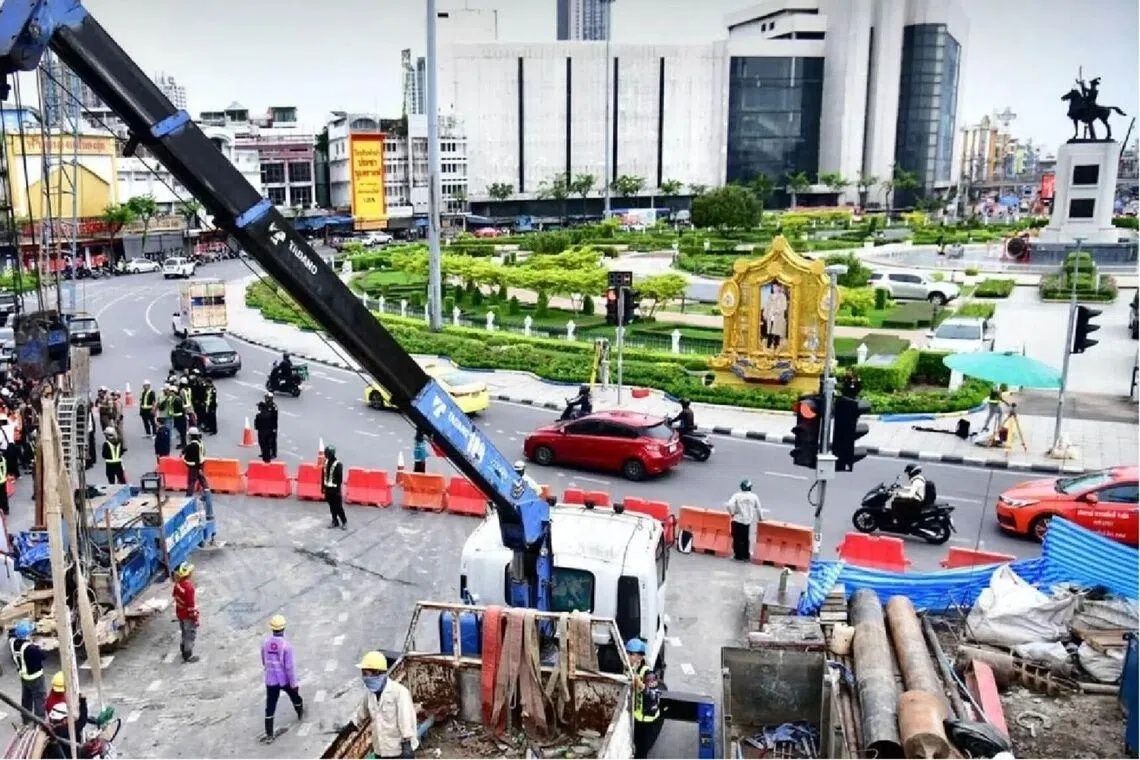
The Bangkok Metropolitan Administration has initiated a major emergency response after water infiltration at an underground tunnel construction site triggered ground subsidence near Wongwian Yai, forcing the evacuation of around 60 residents from nearby commercial buildings and the closure of a significant traffic artery in the city's central-south corridor.
The incident stems from water seepage that developed inside a drainage sump at the lowest section of the southern Purple Line mass rapid transit tunnel currently under construction. This infiltration created a pathway for surrounding soil to migrate into the underground structure, destabilising the ground layer and producing visible cracks across the overlying road surface. The subsidence raised immediate concerns about the structural integrity of buildings situated within proximity to the affected area, particularly those standing directly above or adjacent to the compromised zone.
Three commercial buildings located within 30 metres of the subsidence point were identified as presenting potential risk. Authorities, working jointly with the Mass Rapid Transit Authority of Thailand's project contractor, relocated approximately 60 residents to temporary accommodation arrangements, primarily hotel facilities, where they are expected to remain for approximately one week pending structural assessments. The contractor has assumed financial responsibility for accommodation costs, compensation payments, and other associated expenses related to the evacuation.
In response to the emergency, Bangkok's infrastructure monitoring capabilities were rapidly deployed. The Department of Disaster Prevention and Mitigation installed two Rescue Guardian monitoring units on buildings closest to the affected zone. These sophisticated sensors continuously measure structural tilting and movement in real time, transmitting data to a central monitoring system programmed to issue immediate alerts if abnormal displacement is detected. The placement of sensors within 30 metres of surface cracks provides early warning capability against further deterioration. Bangkok Governor Chadchart Sittipunt visited the site on July 9 alongside deputy governor Wisanu Subsompon and deputy permanent secretary Kanokwan Iamlim to assess conditions firsthand and review response measures.
The road closure encompasses approximately 200 metres of Prajadhipok Road extending between Ban Khaek intersection and Wongwian Yai, with all outbound traffic lanes suspended as a precautionary measure. This restriction serves a dual purpose: reducing vibration from passing vehicles that could potentially trigger further soil destabilisation, and preventing increased loading on an already compromised roadbed. Traffic management authorities have implemented a temporary counter-flow arrangement, converting two inbound lanes to accommodate outbound vehicles. Motorists have been directed toward alternative routes utilising Itsaraphap, Lat Ya, and Somdet Chao Phraya roads, with specific advisory for vehicles arriving from Memorial Bridge or Phra Pok Klao Bridge to divert at Ban Khaek intersection.
The longer-term traffic ramifications present considerable challenges given that the affected corridor serves as a major transportation bottleneck in proximity to major educational institutions including Suankularb Wittayalai School and Suksanari School. Governor Chadchart has signalled that Bangkok may implement supplementary traffic mitigation strategies previously deployed following a comparable subsidence incident near Vajira Hospital, potentially encompassing additional shuttle bus services for schoolchildren to reduce parental vehicle traffic entering the congested zone. Final determination of traffic arrangements remains pending completion of engineering assessments regarding closure duration.
Engineers from Thailand's national Urban Search and Rescue team have joined the inspection effort to evaluate structural conditions across the broader surrounding area and validate that all response protocols meet established engineering and public safety standards. A forward command centre has been established near the subsidence point to coordinate operations among multiple agencies including the Bangkok Metropolitan Administration, the Mass Rapid Transit Authority, the construction contractor, district-level authorities, police forces, and emergency response teams. The Department of Disaster Prevention and Mitigation provided generators, specialisation machinery, and lighting equipment to support continuous overnight monitoring operations.
Authorities have reported that water levels within the affected sump and the rate of ground movement have begun stabilising, though round-the-clock monitoring will continue until conditions are deemed safe for resident return and road reopening. The immediate operational focus concentrates on sealing the water infiltration source and preventing additional soil migration into the tunnel structure. Continuous instrumental monitoring tracks multiple parameters including road surface movement, subsurface soil displacement, water leakage rates, and the structural condition of proximate buildings. Rescue foundations and volunteer organisations have been positioned on standby to provide emergency medical assistance or patient evacuation if required.
The incident occurs along the same southern Purple Line alignment as a previous collapse near Vajira Hospital, though distinct contractors manage each project segment. That earlier incident established procedures and response templates now being applied to the current emergency. Officials have clarified that restrictions will remain in place only until engineers formally certify that buildings, roads, and surrounding infrastructure meet safety standards. The Department of Disaster Prevention and Mitigation and the Bangkok Metropolitan Administration will coordinate the staged easing of restrictions only after comprehensive structural clearance has been completed.
For Malaysian observers, this incident illustrates the complex engineering challenges inherent in major urban transit expansion, particularly in dense metropolitan areas built atop varying soil compositions and with extensive underground infrastructure networks. The comprehensive, multi-agency response demonstrates coordination mechanisms available to larger Thai municipalities, though it simultaneously highlights vulnerability points in underground construction processes. Southeast Asian cities undertaking similar rapid mass transit development programmes should note both the technical risks—particularly water management in underground works—and the administrative frameworks required for coordinated emergency response across construction, traffic, disaster management, and governance agencies.

