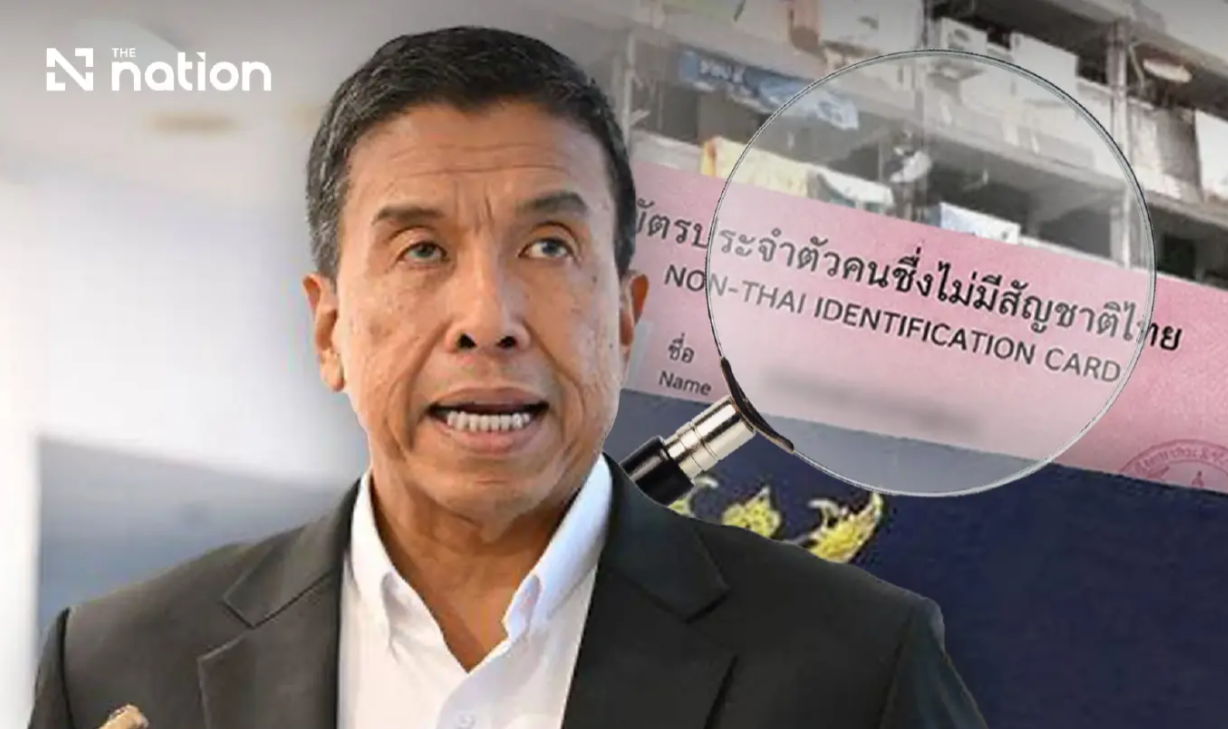
Bangkok Governor Chadchart Sittipunt has initiated a sweeping forensic examination of household-registration records dating back to 2017 across all 50 district offices in the Thai capital, triggered by mounting evidence of systematic manipulation in the issuance of pink cards—identity documents issued to non-Thai nationals. The audit represents one of the most extensive civil-registry investigations undertaken by Bangkok's Metropolitan Administration in recent years, reflecting serious concerns about institutional weaknesses that may have facilitated organised fraud on a substantial scale.
The suspected schemes exploited gaps in Thailand's household-registration framework by improperly enrolling foreign nationals into official registries under false or misappropriated identities, thereby creating documentation that could then support applications for pink-card identification. District offices have been instructed to submit preliminary findings by August 21, signalling the urgency with which authorities are treating the matter. The investigation stems from initial discoveries in Din Daeng district, where investigators uncovered evidence suggesting a property covering just 40 square metres contained between 40 and 45 registered residents—a statistical impossibility that triggered broader scrutiny across the metropolitan area.
One common fraudulent method identified involved birth certificates of children born in Thailand to foreign parents who subsequently returned to their home countries. The certificates remained within Thai registries and were allegedly repurposed to transfer unrelated individuals into household records under the children's assumed identities. Investigators have also documented cases where names were fraudulently moved from the central household register into ordinary registries, and instances of fabricated familial relationships—colloquially referred to as "phantom child" and "phantom father" arrangements—used to legitimise registrations that should never have been approved. These schemes suggest a level of coordination and institutional knowledge that points toward potential involvement by insiders within the registration system itself.
Initial screening of Din Daeng district's 2024 records alone uncovered more than 2,000 apparently irregular address transfers, prompting Governor Chadchart to estimate that approximately 3,000 questionable registrations may exist across Bangkok. However, he emphasised that this figure remains unconfirmed and cautioned that fraudulent registrations may be distributed across multiple properties rather than concentrated at single locations, potentially complicating the audit process. The Bangkok Metropolitan Administration has established a threshold of at least 15 registered residents per property as a starting point for closer examination, with the possibility of lowering this benchmark to capture additional anomalies through wider random sampling.
The administrative response has already resulted in the temporary removal of four BMA employees linked to the irregularities, pending formal disciplinary inquiries. The measure explicitly does not constitute a finding of guilt but reflects the administration's commitment to separating potentially compromised personnel from sensitive positions during the investigation. A separate police investigation is proceeding in parallel, highlighting the criminal dimensions of the suspected fraud beyond administrative failures. Governor Chadchart has indicated that the inquiry will pursue evidence wherever it leads, including toward senior officials and retired executives, though any formal action will depend upon investigative findings and applicable legal provisions.
A critical aspect of the investigation involves tracing financial connections between suspected brokers and government employees, as organised fraud of this scale typically involves corrupt officials who benefit financially from facilitating false registrations. The BMA cannot independently access financial records or compel private citizens to provide transaction documentation, requiring cooperation from Thailand's police force to map money flows and establish payment relationships. An investigation committee will be formally established to analyse registry records and evaluate the conduct of individuals implicated in the scheme, with particular focus on identifying whether corruption was concentrated among lower-level administrative staff or extended to supervisory levels.
Beyond the immediate investigation, Governor Chadchart has outlined structural reforms designed to prevent recurrence of similar frauds. The Bangkok Metropolitan Administration plans to distribute approval authority across multiple officials—requiring district directors and section heads to share responsibility for registration decisions rather than concentrating power in individual employees. This structural change addresses a systemic vulnerability that investigations have revealed: excessive authority vested in single officers creates opportunities for corruption and reduces institutional oversight. The BMA is also considering periodic rotation of staff working in sensitive registration positions to disrupt entrenched relationships and reduce the risk of officials developing corrupt arrangements with external brokers.
The implications of this fraud extend beyond administrative embarrassment for Bangkok's authorities. Pink cards are foundational documents within Thailand's civil-identification system, and widespread irregularities in their issuance raise questions about the integrity of the broader household-registration database. If thousands of fraudulent registrations have been incorporated into official records, the accuracy of migration statistics, census data, and social-policy administration may be compromised. Additionally, the involvement of apparent institutional corruption underscores vulnerabilities in Thailand's governance that resonate across Southeast Asia, where similar household-registration systems in neighbouring countries face comparable risks of manipulation.
For Malaysia and other Southeast Asian nations, Bangkok's situation serves as a cautionary case study. The region's developing economies rely heavily on household registration systems for population management, social service delivery, and internal migration tracking. The Thai experience demonstrates how inadequate oversight of registration processes, insufficient separation of duties among approving officials, and insufficient financial transparency mechanisms can create environments conducive to organised fraud. Malaysian authorities managing the MyKAS civil registration system and other identity-documentation frameworks should note that periodic audits, staff rotation, distributed approval authority, and robust financial-transaction monitoring represent essential safeguards rather than optional administrative refinements.
Governor Chadchart has committed to expanding the Bangkok Metropolitan Administration's existing anti-corruption policies to emphasise civil-registration affairs more prominently, recognising that identity documents represent both critical public resources and valuable commodities within criminal marketplaces. The revised working procedures will be designed to enhance transparency while ensuring that legitimate applicants—including foreign residents genuinely entitled to pink cards through proper legal channels—are not unfairly disadvantaged by enhanced scrutiny. This balancing act reflects the practical challenge that robust anti-fraud measures, if implemented carelessly, can also create obstacles for compliant citizens and legal residents seeking legitimate documentation.
The 10-year audit will likely extend well into 2025 and may ultimately touch tens of thousands of household registrations across Bangkok. Beyond confirming the scale of the fraud, the investigation will establish whether the irregularities represent isolated instances of individual corruption or reveal systemic design failures within Thailand's household-registration framework that require legislative attention. The scope of findings may ultimately inform policy discussions across the Association of Southeast Asian Nations regarding civil-registration security, particularly as the region increasingly digitises identity systems and interconnects registration databases across borders for labour mobility and trade purposes.

