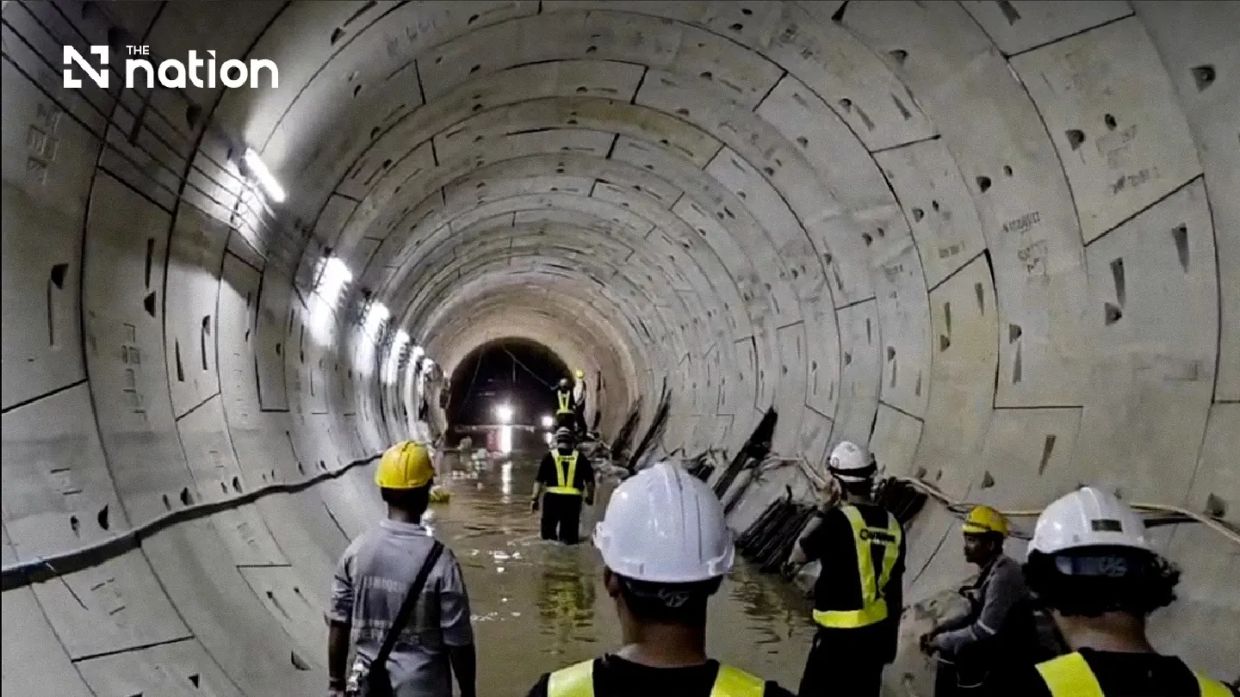
Thailand's infrastructure sector faced another test of its crisis management capabilities when heavy rainfall on July 8 caused water to penetrate the underground construction tunnel of the Purple Line southern extension near Wongwian Yai in Bangkok. The incident prompted an unusual late-night visit by Prime Minister Anutin Charnvirakul, who arrived at the affected site around midnight, reflecting the heightened sensitivity surrounding major infrastructure projects following previous tunnel-related disasters in the capital.
The water intrusion occurred within a construction shaft situated beneath the tunnel section of the Tao Poon–Rat Burana, or Kanchanaphisek Ring Road section, as part of the Purple Line's southern extension development. The problem emerged as Bangkok experienced significant rainfall during the day, with water levels gradually rising inside the active worksite. Unlike catastrophic tunnel failures that strike without warning, this incident presented officials with a compressed timeframe to assess, contain and remedy the situation while the source remained observable and potentially controllable.
The response demonstrated the Thai government's heightened alertness to infrastructure vulnerabilities. Deputy Prime Minister and Transport Minister Phiphat Ratchakitprakarn, along with Deputy Transport Ministers Siripong Angsakulkiat, Phattharaphong Phatraprasit and Sanphet Boonyamanee, plus Deputy Interior Minister Worasit Liangprasit, all mobilised to the location. Supporting them were Gardphajon Udomdhammabhakdi, governor of the Mass Rapid Transit Authority of Thailand, and Prasong Suviwattanachai, executive chairman of Unique Engineering and Construction Public Company Limited, the contractor executing the work.
The affected construction area forms part of Contract 4 of the broader southern Purple Line project, specifically the Saphan Phut–Dao Khanong section. This particular contract, valued at 14.982 billion baht (approximately US$447.3 million), involves extensive tunnel excavation and the construction of retaining wall systems. The scale of investment and the complexity of deep underground work in an urban environment underscore the technical challenges faced by the project, particularly in managing water ingress during Bangkok's rainy season.
Initial assessments confirmed that the situation remained manageable, though Deputy Transport Minister Phattharaphong stressed the need for comprehensive technical investigation. Officials issued strict directives requiring the MRTA and contractor to conduct full structural monitoring, pinpoint the exact source of water entry, and implement corrective measures immediately. The focus extended beyond immediate damage control to encompassing broader project considerations, including maintaining the construction schedule and ensuring no spillover effects on adjacent infrastructure or public safety.
Prime Minister Anutin characterised the situation as fundamentally different from a previous major incident near Vajira Hospital in late September 2025, when tunnel structure collapse had caused dramatic ground subsidence and surface failures. In the Wongwian Yai case, he observed, officials had detected the water ingress early and possessed the capacity to monitor and respond to it in real time. Beginning from morning hours, teams had successfully maintained water levels without evidence of escalating conditions, a material distinction from scenarios involving structural failure.
The government activated monitoring equipment to track any movement in nearby buildings and structures, reflecting lessons learned from past incidents. Anutin confirmed that no abnormal ground movement had been detected as of his nighttime inspection, though he ordered continued close surveillance of the area. The prime minister's reassurance that water levels remained stable and contained—"At this stage, we can control the water level"—aimed to prevent public alarm while acknowledging the seriousness of the situation to engineers and officials.
The intensity of the governmental response, with multiple cabinet-level officials and the prime minister personally present at midnight, reflected institutional memory of infrastructure failures that had undermined public confidence. Anutin framed the visit as ensuring proper handling of the crisis and accelerating remedial work, emphasising that public safety remained the paramount consideration. The unusual convergence of senior officials at the site demonstrated how sensitive tunnel-related incidents had become within Thailand's political and administrative circles following previous disasters.
From a broader Southeast Asian perspective, the Purple Line incident illustrates the technical complexities facing major urban transit projects in tropical climates with pronounced seasonal rainfall patterns. Bangkok's rapid underground expansion, mirrored to varying degrees in other regional megacities, necessarily confronts challenges of water management, structural integrity in saturated soils, and the convergence of multiple subsurface utilities. The response mechanics evident in this case—rapid official coordination, engineering-based problem-solving, and emphasis on transparent communication—offer insights into how developing nations approach infrastructure crisis management.
The incident also underscores pressures facing transit authorities attempting to maintain ambitious construction timelines while managing unforeseen technical obstacles. The explicit instruction to avoid delays to the overall project schedule while simultaneously conducting thorough inspections reflects the difficult balancing act between safety and delivery commitments. For Malaysian observers, comparable challenges exist with major urban rail projects, where geological conditions, seasonal weather patterns, and the necessity of maintaining traffic and commerce in developed urban cores create competing demands on project management.
Official coordination between the MRTA and Unique Engineering and Construction appeared functional, though the need for prime ministerial intervention at midnight hinted at systemic concerns about crisis escalation thresholds. The government's determination to accelerate repairs and prevent recurrence of the Vajira Hospital scenario dominated the narrative, with Anutin and his team essentially telegraphing zero tolerance for similar failures. This stance carries implications for contractor performance standards and the willingness to impose financial penalties or project restructuring if safety protocols are breached.
The emphasis on engineering-based response and technical standards, rather than ad hoc crisis management, represented an attempt to institutionalise lessons learned from previous collapses. Anutin's statement that officials had observed the leak "from the beginning" and worked to seal it while monitoring water levels suggested that early detection systems and real-time monitoring capabilities had improved since earlier incidents. Whether these measures prove sufficient to prevent future occurrences remains a substantial test for Bangkok's expanding underground infrastructure network.
Looking forward, the Purple Line incident serves as a reminder that tropical urban transit development, while essential for regional economic competitiveness and livability, demands sustained investment in geotechnical expertise, water management systems, and contingency protocols. The full technical assessment ordered by transport officials will likely yield insights applicable across Southeast Asia's growing class of major underground transit projects, particularly in cities with high water tables and intense monsoon precipitation patterns.

