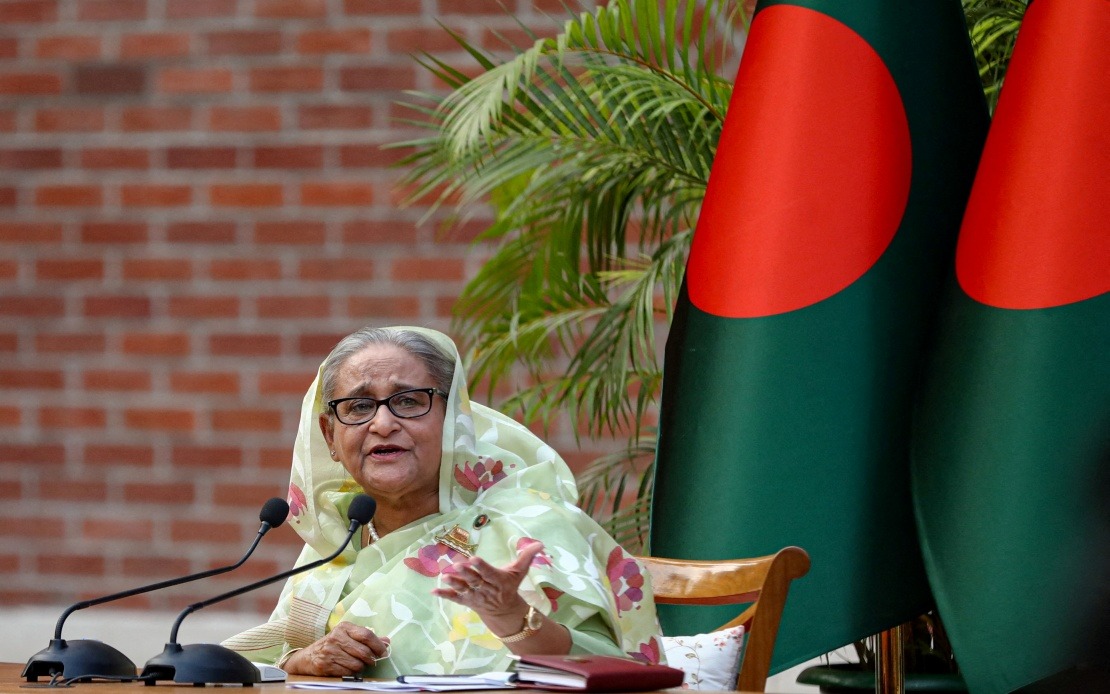
Sheikh Hasina, the 78-year-old ousted Prime Minister of Bangladesh, has made an audacious declaration that she will return to her homeland and submit to judicial proceedings, regardless of the prospect of imprisonment or capital punishment. Speaking through a written interview with Kyodo News, Hasina expressed her determination to face the courts, fully acknowledging the severe personal consequences she may encounter. Her assertion comes as Bangladesh's government under newly elected Prime Minister Tarique Rahman actively pursues her extradition from India, where she has resided since fleeing the country in August 2024.
Hasina's conviction in November 2025 represents a watershed moment in Bangladesh's recent history. The war crimes tribunal, conducting proceedings in her absence, found her guilty of crimes against humanity in connection with a violent crackdown on student-led demonstrations that erupted following a court decision to reinstate a 30 percent job quota for descendants of the 1971 independence war veterans. The death sentence underscores the polarisation within Bangladesh's political establishment and raises significant questions about the rule of law in the country, particularly given that the trial occurred without the defendant's physical presence.
The unrest that precipitated Hasina's downfall proved catastrophic in human terms. According to United Nations estimates, approximately 1,400 individuals lost their lives during the upheaval, with the majority falling to gunfire from security forces. Hasina has consistently maintained that she did not authorise these killings and has characterised the movement as an orchestrated campaign manipulated by political adversaries. Her willingness to submit to forensic examination by international experts demonstrates an attempt to rehabilitate her position, though such gestures carry limited weight given the current political climate in Dhaka.
The trajectory of events following Hasina's departure illustrates the dramatic reshaping of Bangladesh's political landscape. An interim administration led by Nobel Peace Prize laureate Muhammad Yunus stepped in to govern the country before February 2026 elections resulted in victory for the Bangladesh Nationalist Party. Tarique Rahman's subsequent assumption of the premiership marked the consolidation of power among Hasina's political opponents. Meanwhile, her Awami League party, which dominated Bangladesh politics for much of the period between 2009 and 2024, has been subjected to a comprehensive ban since May 2025, effectively marginalising her political base.
India's position in this diplomatic standoff holds critical importance for Hasina's immediate future. New Delhi has received Bangladesh's extradition request and is currently evaluating it against the backdrop of existing legal frameworks and judicial considerations. As a regional power with historically complex relations with Bangladesh, India's handling of Hasina's asylum status carries implications beyond bilateral ties. For Malaysia and other Southeast Asian nations, India's decision will serve as a precedent for how major regional powers balance diplomatic relations with adherence to international legal norms.
Hasina's invocation of foreign forensic expertise reflects a broader strategy to reframe the narrative surrounding the 2024 protests. By proposing that independent investigators examine the circumstances and mechanisms of each death, she attempts to shift discussion from questions of direct command responsibility to technical matters of ballistics and causation. This approach, whilst potentially appealing to international observers concerned about procedural fairness, finds little resonance in Bangladesh's current political environment, where public sentiment has largely turned against her administration.
The international community's response to these developments has been notably measured. Human Rights Watch, whilst acknowledging the tribunal's serious conclusions about abuses committed during Hasina's tenure, has expressed reservations about the legitimacy of a trial conducted in absentia. This qualified concern reflects a broader tension in human rights discourse between accountability for state violence and procedural justice. For regional observers in Malaysia and neighbouring countries, the episode illustrates how political transitions, particularly those emerging from mass mobilisation, often create competing imperatives between justice and reconciliation that prove difficult to navigate simultaneously.
Hasina's political biography provides essential context for understanding her current predicament. As the daughter of Bangladesh's founding father Sheikh Mujibur Rahman, she occupied a unique position in the country's political mythology. Her five separate terms as prime minister, spanning from 1996 to 2001 and again from 2009 to 2024, made her one of South Asia's longest-serving leaders. Yet longevity in office proved insufficient to protect her from the forces that ultimately unseated her, suggesting that even entrenched political figures remain vulnerable to rapid shifts in popular sentiment.
Hasina's tenure witnessed episodes that transcended domestic boundaries, most notably the 2016 Holey Artisan Bakery attack in Dhaka, which claimed 20 lives including Japanese nationals engaged in development work facilitated by the Japan International Cooperation Agency. This attack, and the subsequent prosecution of seven Islamist militants ultimately sentenced to life imprisonment rather than execution, illuminated Bangladesh's struggle with violent extremism. The incident also demonstrated the interconnected nature of South Asian security challenges and the international dimensions of domestic instability.
In her recent statements, Hasina has articulated a vision of Bangladesh's future that emphasises healing and accountability whilst warning against impunity. She has described regional stability as essential not merely for Bangladesh but for South Asia broadly, the Bay of Bengal littoral, and development partners including Japan. This framing attempts to position her as a statesperson concerned with regional prosperity rather than merely a politician defending her record. Whether such rhetoric can influence current decision-makers in Dhaka remains highly uncertain.
The question of extradition from India presents a complex legal and diplomatic puzzle. India has historically extended asylum to prominent political figures from neighbouring countries, and Hasina's presence in New Delhi reflects this pattern. However, contemporary pressures toward international accountability and India's own bilateral interests may complicate what might otherwise be a straightforward assertion of asylum rights. For Malaysian policymakers and regional analysts, the resolution of this standoff will offer crucial insights into how major Asian powers navigate the tension between providing sanctuary to political opponents of neighbouring regimes and maintaining productive diplomatic relations with those regimes.
Hasina's assertion that "the next decade can be a decade of recovery and renewal" provided conditions including democratic restoration and popular self-determination reveals a fundamental disagreement with Bangladesh's current leadership about both past events and future governance. Her framing presents the 2024 protests and subsequent transition as obstacles to national development rather than expressions of popular will. This competing narrative will likely persist in regional and international discourse as Bangladesh seeks to consolidate its new political order whilst managing relationships with influential external actors including India and Japan.
The broader implications for Southeast Asia and South Asia extend beyond Hasina's personal fate. The case illuminates how political upheaval in major regional democracies can generate lasting diplomatic complications, particularly when accountability mechanisms collide with traditional practices of political asylum. It demonstrates the limits of executive authority in the face of sustained popular mobilisation and raises enduring questions about the relationship between justice and reconciliation in post-conflict transitions. For Malaysia, observing Bangladesh's navigation of these challenges provides valuable perspective on democratic consolidation, civil society mobilisation, and the international dimensions of domestic political transformation.

