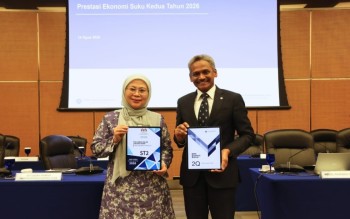
Bank Negara Malaysia has elected to retain its 2026 gross domestic product growth forecast at 5.0 per cent, signalling confidence in the economy's trajectory despite global headwinds and geopolitical uncertainties. Governor Datuk Seri Abdul Rasheed Ghaffour made the announcement following the release of Malaysia's second-quarter economic data, which revealed an expansion of 6.0 per cent—a performance that surpassed the Department of Statistics Malaysia's initial estimate of 5.8 per cent. The central bank's decision to maintain its outlook reflects a more optimistic assessment of the economy's resilience, though officials have cautioned that adjustments may prove necessary should external conditions deteriorate.
The decision to forgo any revision at present aligns with established central banking practice, as Datuk Seri Abdul Rasheed explained that comprehensive forecast reassessments typically occur in conjunction with the government's Budget announcement. This approach allows policymakers to incorporate a fuller suite of data and economic indicators before making formal adjustments to economic projections. The stance underscores Bank Negara's measured confidence in Malaysia's near-term prospects, even as the central bank acknowledges the need for vigilance regarding potential headwinds.
Malaysia's economic performance in the first half of 2026 has consistently exceeded Bank Negara's expectations, with three consecutive quarters of growth outpacing initial forecasts. This sustained outperformance reflects a diversified expansion across multiple sectors and demand components, rather than reliance on any single growth engine. The governor highlighted that the breadth of growth across consumption, investment, exports, and tourism provides a solid foundation for continued expansion into the second half of the year, suggesting that the momentum observed in recent quarters is likely to persist through the remainder of 2026.
Domestic demand has emerged as the primary catalyst for growth, providing a counterbalance to potential vulnerabilities in external markets. The external sector, meanwhile, continues to provide meaningful support, particularly through merchandise exports which have demonstrated surprising resilience amid global trade uncertainties. This combination of strong internal demand and steady external demand has created a favourable environment for sustained expansion, reducing the economy's vulnerability to any single external shock.
Within the export sector itself, growth has been notably diversified, with both traditional electrical and electronics products and non-E&E exports contributing to overall performance. This sectoral diversification reduces Malaysia's exposure to cyclical downturns in any particular industry, a structural advantage that has become increasingly important given the volatility in global technology demand. Additionally, the information and communications technology services sector has registered expansion, signalling Malaysia's successful transition toward higher-value services exports and reducing dependence on commodity and labour-intensive manufacturing.
Household consumption, a critical pillar of the economy, maintained its strength at 4.8 per cent growth during the second quarter, demonstrating the continued purchasing power of Malaysian consumers. Datuk Seri Abdul Rasheed identified income growth, accumulated savings, and government policy support as the primary drivers of this resilience, with household borrowing playing a comparatively minimal role. This composition is significant, as it suggests that consumption growth is underpinned by sustainable sources rather than an unsustainable build-up of household debt, which would pose medium-term risks to financial stability.
Government policy support has played an instrumental role in sustaining household income and spending capacity, reflecting the continued stimulus from fiscal measures implemented to support the economy. This support has been particularly important in offsetting potential headwinds from global conditions and in maintaining consumer confidence amid international uncertainties. The accumulation of savings by households also indicates that Malaysian consumers have maintained a cautious approach to spending despite improved economic conditions, suggesting room for consumption to accelerate further if confidence strengthens.
Bank Negara's acknowledgement of potential downside risks reveals a nuanced assessment of the economic landscape. The governor explicitly referenced global uncertainties and geopolitical conflicts as factors that could necessitate adjustment to growth drivers going forward. These concerns extend beyond traditional economic metrics and encompass supply chain disruptions, energy price volatility, and shifts in international trade patterns that could materialise with limited notice. The central bank's transparency on these risks demonstrates a balanced communication strategy that neither dismisses legitimate concerns nor allows pessimism to override evidence of underlying strength.
The governor also highlighted the potential macroeconomic implications of El Niño weather patterns, which have been linked to agricultural challenges in various regions. While acknowledging that any impact would likely be lagged and concentrated in the agricultural sector, Datuk Seri Abdul Rasheed urged businesses and households to begin preparing for potential adverse effects. This forward-looking guidance reflects central bank awareness that climate-related economic shocks are becoming more frequent and severe, warranting proactive adaptation strategies from both private and public sectors.
For Malaysian investors and policymakers, Bank Negara's continued confidence in 5.0 per cent growth provides a stable baseline for planning and decision-making, while the acknowledged uncertainties underscore the importance of flexibility in economic strategies. The central bank's assessment that growth drivers remain intact across multiple sectors and demand components suggests that Malaysia is well-positioned to navigate the remainder of 2026, provided that external conditions do not deteriorate markedly. The emphasis on broad-based growth and diversified income sources within consumption patterns indicates that the economy has developed sufficient resilience to absorb moderate external shocks without derailing expansion.
Looking forward, the trajectory of Malaysia's economy will hinge on the extent to which domestic momentum can insulate the country from global headwinds, the durability of government support measures, and the ability of exporters to maintain market share despite international competition. Bank Negara's maintenance of its 5.0 per cent forecast reflects confidence in these mechanisms, though the implicit caveat regarding potential revisions suggests that the central bank remains prepared to adjust its outlook as new information emerges. For regional observers, Malaysia's current economic performance and the central bank's measured optimism provide a case study in how a diversified, services-inclusive economy can achieve stability and growth even amid global uncertainty.

