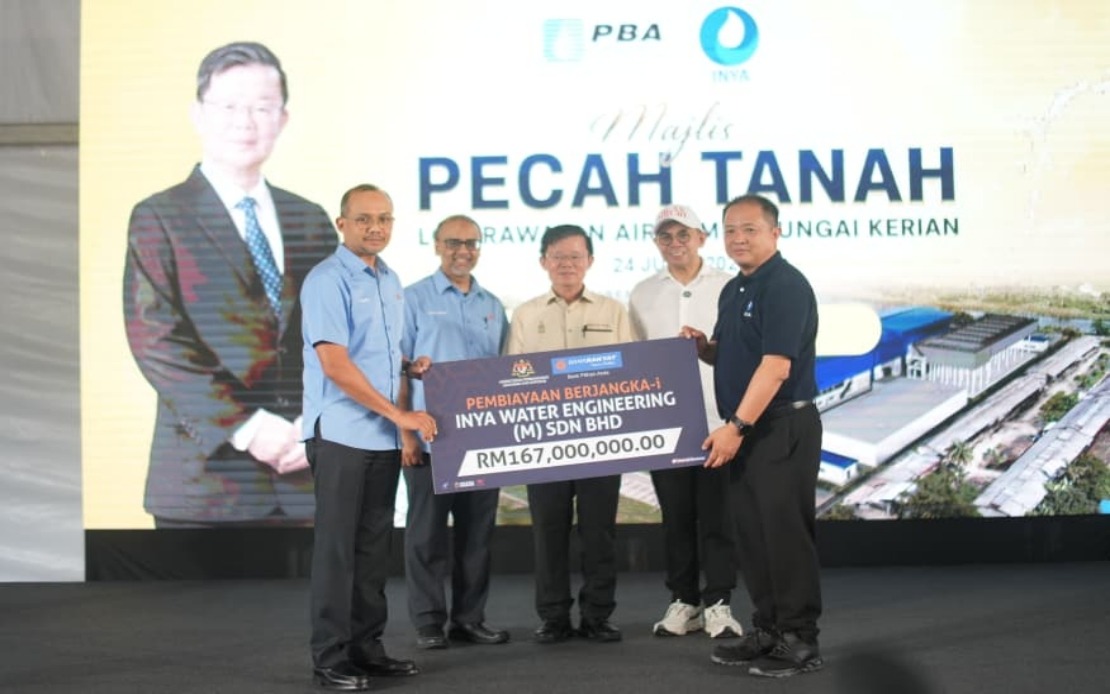
Bank Rakyat has committed RM167 million in financing for the Sungai Kerian Water Treatment Plant in Seberang Perai Selatan, with the loan covering four-fifths of the project's total construction expenditure. The development marks a significant expansion of the national development bank's role beyond traditional business lending into critical infrastructure that underpins regional economic growth and public welfare. Penang Chief Minister Chow Kon Yeow presided over the ground-breaking ceremony, underscoring the state government's emphasis on securing reliable water supplies for its growing population and industrial base.
Entrepreneur and Cooperatives Development Minister Steven Sim framed the financing decision as evidence of Bank Rakyat's evolving mandate to support not only entrepreneurial ventures but also foundational infrastructure projects with broad economic ramifications. The minister highlighted how this particular investment would stabilise water availability across Seberang Perai, a region increasingly vital to Penang's manufacturing and services sectors. By extending financing to water infrastructure, Bank Rakyat positions itself as an institution investing in long-term state development rather than solely short-term commercial returns.
The project itself represents an investment of more than RM209 million and will establish a water treatment facility with daily processing capacity of 80 million litres. Construction will proceed under a 30-year Build-Operate-Transfer arrangement, a structural approach that allows the private contractor, Inya Water Engineering (M) Sdn Bhd, to construct, operate and maintain the plant before handing ownership to the Penang Water Supply Corporation upon contract expiration. Bank Rakyat serves as the sole financial institution backing the venture with a 15-year loan period, complemented by a two-year grace period intended to provide breathing room during the plant's initial operational phase.
Chow noted that the facility represents Penang's first water supply project employing the BOT model, a departure from conventional public financing approaches. This innovative structure allows the state water authority to avoid capital expenditure on construction and operation while securing treated water at predetermined commercial rates. The Penang Water Supply Corporation will purchase water at an initial cost of RM0.98 per cubic metre from 2027, subject to price reviews every five years. This contractual flexibility protects the state authority from unexpected escalations while providing the private operator with revenue certainty.
Water demand across Seberang Perai has intensified as residential and industrial development accelerates, particularly in the southern and central districts. The new treatment plant will serve approximately 223,000 consumers once operations commence in mid-2027, delivering an additional 80 million litres of treated water daily to meet growing consumption patterns. This expansion of supply capacity addresses chronic shortages that have periodically affected industrial operations and domestic consumption during peak demand seasons, a recurring challenge in Malaysia's northern corridor.
The scale of this additional capacity, while substantial in absolute terms, represents only 6.6 per cent of the Penang Water Supply Corporation's total production of 1,208 million litres daily as of the previous year. This modest proportional increase reflects the incremental approach to infrastructure expansion, where multiple projects over time accumulate to meet rising demand. The staggered expansion strategy helps distribute financial burden and construction disruption across several years, reducing risk of simultaneous project failures.
Chow assured consumers that the project's implementation would not trigger water tariff increases during 2027 and 2028, a politically significant commitment that protects household budgets during an inflationary period. The water authority will absorb the cost of purchasing treated water from the private operator as part of operational expenses across the two-year period, effectively subsidising the transition to the new supply source. This subsidy arrangement reflects government willingness to manage transitional costs rather than immediately passing them to consumers, though long-term pricing mechanisms remain subject to contractual review clauses.
The BOT model employed here represents an evolution in Malaysian infrastructure financing, particularly relevant for water authorities facing capital constraints. Rather than raising funds through government bonds or budgetary allocations, this approach mobilises private capital and operational expertise while maintaining public ownership and control over final output. Bank Rakyat's participation signals confidence among government-linked financial institutions in water infrastructure as a stable, revenue-generating asset despite its essential public service character.
For the broader Malaysian context, this project demonstrates how development finance institutions can extend beyond microfinance and small business support to anchor larger infrastructure initiatives. Water security has emerged as a critical national concern, particularly in peninsular regions experiencing rapid urbanisation and industrial concentration. Projects like Sungai Kerian contribute to addressing supply constraints that could otherwise limit economic growth and quality of life improvements across the region.
The mid-2027 operational target provides a reasonable timeframe for construction completion in Malaysia's climate and regulatory environment, though execution risks remain inherent in large infrastructure projects. The involvement of Inya Water Engineering as the primary contractor and operator introduces an established operator into Penang's water supply network, diversifying the system beyond the singular reliance on the public utility. This diversification, while introducing contractual complexity, potentially enhances supply reliability through multiple operational entities and treatment methodologies.
Steven Sim's emphasis on maintaining safety standards, construction quality, environmental preservation and governance throughout the project's development underscores growing attention to sustainability and accountability in major public infrastructure. Water treatment plants require careful management of chemical inputs, sludge disposal and environmental discharge, considerations that extend beyond simple construction completion metrics. The minister's stated commitments reflect evolving expectations that infrastructure projects incorporate environmental and governance standards alongside technical delivery.
As Malaysia pursues its growth objectives, water infrastructure investments will likely accelerate across multiple regions, making models like Sungai Kerian increasingly relevant as templates for implementation. The project's success in securing Bank Rakyat financing and delivering additional supply capacity could encourage similar ventures elsewhere, particularly in states confronting supply-demand imbalances. Penang's pioneering adoption of the BOT model for water treatment may establish a framework that other regional authorities consider for their own expansion programmes, spreading both innovation and financial burden across multiple stakeholders.

