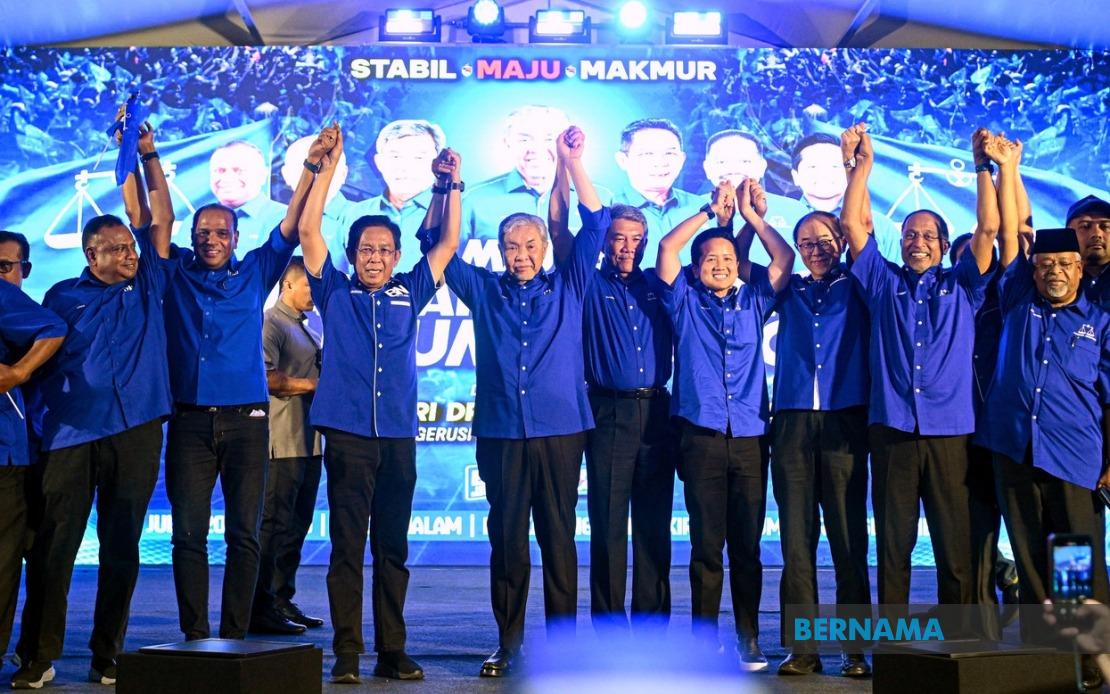
Barisan Nasional unveiled its slate of 25 candidates for the 16th Negeri Sembilan state election, signalling its strategy to blend proven incumbents with fresh political blood as it prepares for polling day in the central state. The coalition's announcement represents a carefully calibrated approach to seat allocation, with party leaders opting to retain several long-serving representatives whilst deferring final decisions on nearly half the state assembly's contested constituencies.
Negeri Sembilan BN chairman Datuk Seri Mohamad Hasan confirmed that he will contest the Rantau state seat for the seventh time, maintaining a parliamentary-style continuity in his representation of the constituency since 2004. His retention in this seat underscores the confidence placed in him by UMNO's central leadership, with Datuk Seri Dr Ahmad Zahid Hamidi personally endorsing his candidacy. Mohamad's dual role as BN deputy chairman amplifies his symbolic importance to the coalition's campaign machinery, positioning him as a bridge between federal party structures and state-level operations.
Jalaluddin Alias, who chairs the Negeri Sembilan UMNO Liaison Committee and holds the Jelebu parliamentary seat, will similarly defend the Pertang state assembly seat that he has occupied since 2013. This decision reflects a pattern within BN's Negeri Sembilan branch of rewarding stability and demonstrated electoral capacity. The retention of such figures provides the coalition with recognisable faces capable of mobilising grassroots support whilst managing institutional relationships developed over multiple electoral cycles.
Beyond these two high-profile retentions, Barisan Nasional maintained confidence in Datuk Mohd Faizal Ramli in the Linggi seat and Datuk Mustapha Nagoor in Palong. These incumbents represent a broader category of mid-tier representatives whose local machinery and community networks justify continued candidacy. The distribution of retained seats across different constituencies suggests BN is prioritising consolidation in areas where it has demonstrated sustained electoral performance rather than pursuing aggressive expansion in new territories.
The announcement comes at a pivotal moment for Negeri Sembilan politics. The state, long regarded as a Barisan Nasional stronghold, has experienced notable political shifts in recent years, with opposition coalitions increasingly competitive in certain constituencies. BN's deliberate retention of proven operators in strategic seats represents a defensive posture aimed at protecting traditional strongholds whilst testing new candidates in secondary contests. This approach allows the coalition to manage risk whilst maintaining flexibility should market conditions shift dramatically before polling day.
Yet the most striking aspect of BN's announcement is what remains unresolved. The coalition has deferred final decisions on eleven state seats: Klawang, Serting, Lobak, Sikamat, Ampangan, Bukit Kepayang, Mambau, Paroi, Lukut, Bagan Pinang, and Gemas. This incomplete candidate slate, whilst not unprecedented, raises questions about party mechanics and the speed of BN's preparations. The outstanding seats represent approximately forty-four percent of Negeri Sembilan's constituencies, a substantial proportion to leave undecided at the announcement stage.
The timing and scale of incomplete candidate selection may reflect internal deliberations over potential defections, boundary demarcation considerations, or ongoing negotiations within BN's component parties about seat allocation formulas. In multiparty coalition politics, particularly within Malaysia's federal-state nexus, seat distribution negotiations often extend to the final permissible moment as parties attempt to maximise their share of winnable contests. The eleven outstanding seats may represent territories where UMNO, MCA, and MIC have not yet reached consensus, or where party leadership wishes to retain strategic flexibility regarding candidate quality and acceptability.
For Malaysian political observers, Negeri Sembilan represents an important barometer of BN's current electoral health and operational efficiency. The state's relatively compact geography and concentrated population centres make it an accessible laboratory for testing campaign messages and organisational approaches. The mixed slate of retention and deferral suggests BN leadership recognises both its institutional strengths and emerging vulnerabilities in this region.
Mohamad Hasan's reaffirmation in Rantau carries particular significance beyond Negeri Sembilan's borders. As BN deputy chairman and a senior UMNO politician with substantial organisational influence, his successful retention at state level would constitute a personal political victory and provide testimonial value to BN's broader national campaign narrative. Conversely, an unexpected loss in a constituency he has represented for two decades would signal troubling shifts in voter sentiment that extrapolate to other states and federal territories.
The announcement itself was staged at Tuanku Abdul Rahman Stadium in Paroi, a venue choice that emphasises geographical reach and logistical capacity—indicators that BN has mobilised significant organisational resources for its Negeri Sembilan campaign. The launch of election machinery in parallel with candidate announcements suggests party leadership views these contests as sufficiently important to warrant coordinated, high-profile roll-out operations that traditionally foreshadow substantial campaign investment.
Beyond Negeri Sembilan's borders, this election holds implications for Malaysia's broader political configuration. A decisive BN performance would validate the coalition's revitalisation efforts since its controversial 2018 federal election loss. Conversely, significant opposition gains would suggest underlying voter sentiment remains volatile and that BN's recovery, whilst measurable, faces persistent headwinds. The state's results would likely influence campaign messaging and resource allocation in upcoming contests in other states and in calculations about federal government stability.
As the campaign period approaches, Barisan Nasional faces the challenge of translating its candidate announcements into effective ground mobilisation. The eleven outstanding seats require rapid finalisation to allow nominated candidates adequate preparation time. Party machinery in Negeri Sembilan must simultaneously maintain momentum around its confirmed candidates whilst managing uncertainty about final seat allocations. This balancing act will test both BN's administrative capabilities and its capacity to retain coalition unity under the pressures of competitive electoral campaigning.

