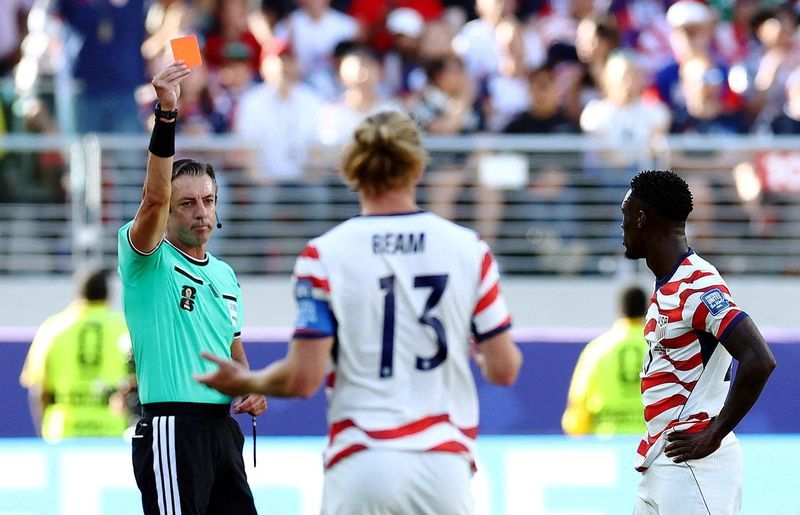
The Belgian government and public have erupted in protest over FIFA's controversial decision to lift a red-card suspension for a United States player following what officials describe as direct pressure from President Donald Trump on FIFA leadership. The dispute threatens to overshadow an already contentious World Cup knockout encounter between the two nations scheduled for Seattle, with Belgian authorities questioning the fundamental integrity of international football's disciplinary framework.
The controversy centres on FIFA's decision to overturn the suspension of striker Folarin Balogun, who had been barred from the Americans' upcoming fixture following a sending-off in an earlier match. Trump's personal appeal to FIFA President Gianni Infantino to reconsider the disciplinary action marked an extraordinary moment of political intervention in what has traditionally been regarded as sport's autonomous domain. The reversal has crystallised long-standing concerns among European football authorities about the vulnerability of FIFA's governance structures to external political pressure, particularly from powerful nations with significant sporting influence.
Thérese Kpoubié, a Brussels resident, articulated the bewilderment felt across Belgium's football community. She questioned the foundational logic of disciplinary enforcement, noting that a red card represents a referee's considered judgment that a player committed a serious breach of the sport's rules. The lifting of consequences attached to such an adjudication, she argued, effectively undermines the credibility of officials and renders the entire punishment system meaningless. Her frustration reflects a broader European perspective that views disciplinary consistency as essential to competitive fairness and the sport's legitimacy.
The incident has exposed what Belgian officials regard as a dangerous precedent whereby national governments can lobby international sporting bodies to overturn established penalties when their nations face disadvantage. Deputy Prime Minister Maxime Prevot characterised the situation as fundamentally incompatible with the foundational principles governing sport, issuing a formal statement expressing incredulity that such political interference could influence FIFA's decision-making processes. His intervention elevated the dispute from sporting commentary into the realm of formal governmental protest, signalling that Belgium views the matter as a breach of international sporting norms rather than merely a contentious rule application.
The United States has attempted to deflect accusations of improper interference through its diplomatic channels. Bill White, serving as Washington's ambassador to Belgium, issued a statement denying that Trump sought to manipulate FIFA's internal procedures, suggesting instead that the president merely acknowledged FIFA's decision after the matter had already been resolved. This characterisation, however, fails to address contemporaneous reports indicating that Trump's direct communication with FIFA leadership preceded the reversal, leaving significant questions about the sequence of events and the actual influence wielded by presidential pressure.
Bastien Noel, another Brusselian quoted in reaction to the controversy, offered a perspective focused on channelling grievance into competitive motivation rather than dwelling on perceived injustice. He suggested that Belgium's national team should regard the decision as additional incentive to demonstrate their superiority on the pitch, effectively arguing that sporting excellence represents the most legitimate form of protest against what many perceive as administrative manipulation. This approach reflects a pragmatic recognition that while the decision may be controversial, Belgium must now focus entirely on football performance rather than becoming distracted by diplomatic disputes.
The reversal represents an unprecedented moment in FIFA governance, with few historical precedents for direct presidential intervention in disciplinary matters. Most international sporting bodies maintain formal independence from government influence precisely to preserve the appearance and reality of impartial governance. FIFA's apparent willingness to entertain such pressure from a major sporting power raises broader questions about how the organisation applies its rules consistently and whether resources or political influence now determine outcomes traditionally based on objective disciplinary criteria.
Belgian football supporters expressed determination to channel their frustration into vocal support for their national team, with fans emphasising that the Red Devils' legitimacy derives from competitive performance rather than administrative favour. The passionate response from Brussels residents demonstrated that Belgian society views this incident as testing the sport's fundamental values, transcending typical match rivalry to touch on questions about the relationship between governmental authority and sporting institutions.
The controversy arrives at a particularly sensitive moment for FIFA, which has faced sustained criticism over governance transparency and the concentration of influence among powerful football-playing nations. Trump's intervention exemplifies precisely the kind of external pressure that independent sporting bodies theoretically exist to resist. Whether FIFA's capitulation represents an isolated incident or signals a broader willingness to accommodate political pressure from influential nations remains a pressing concern for smaller football-playing countries whose interests may not align with those of major powers.
For Southeast Asian observers, the incident carries additional significance given recurring debates within the region about governmental involvement in sporting governance and questions about how small nations can protect their competitive interests against pressure from larger powers. Malaysia and neighbouring countries with smaller international sporting influence may view Belgium's experience as illustrative of vulnerabilities facing any nation attempting to invoke established rules against strategically important opponents. The apparent ineffectiveness of Belgium's formal protests suggests that institutional rules provide limited protection when confronted with determined political pressure from nations with substantial leverage within international sporting structures.
Looking forward, the incident will likely prompt FIFA to face intensifying scrutiny regarding its decision-making processes and the potential influence of external actors on disciplinary matters. Whether this moment catalyses meaningful governance reform or represents merely a temporary controversy remains uncertain, but the episode has definitively established that international football's governance structures are vulnerable to political manipulation by determined state actors. For Belgium, focus has now shifted entirely to the pitch, where the Red Devils must attempt to translate public support and justified grievance into match success against an American team that benefits from an administrative decision many regard as fundamentally compromising football's competitive integrity.

