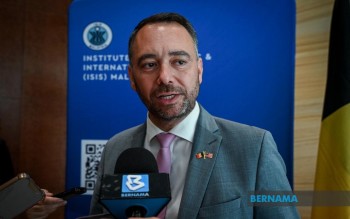
Belgium has extended a formal invitation to Malaysia to collaborate on offshore energy development, positioning the partnership as a cornerstone of both nations' renewable energy ambitions. Belgian Deputy Prime Minister and Foreign Affairs Minister Maxime Prévot made the overture during his inaugural visit to Malaysia since taking office in February 2025, framing offshore wind as a sector ripe for bilateral knowledge transfer and investment cooperation.
Despite its modest 60-kilometre coastline, Belgium has emerged as an unexpected powerhouse in offshore wind technology, a distinction that Prévot emphasized as directly relevant to Malaysia's own clean energy pathway. The European nation currently operates offshore wind farms with a combined capacity of two gigawatts, supplying substantial electricity to its population. More ambitiously, Belgium intends to expand this capacity to between six and seven gigawatts within the coming years—a scale equivalent to the output of five to seven nuclear power plants—underscoring the viability of offshore wind as a baseload renewable energy source.
This technical achievement carries particular significance for Malaysia, a tropical archipelago with extensive maritime zones and growing electricity demands. Unlike Belgium's constrained geography, Malaysia possesses vast offshore potential in the South China Sea, the Straits of Malacca, and surrounding waters. Prévot's pitch effectively offers Malaysia access to proven European engineering, project management methodologies, and regulatory frameworks developed over decades of offshore wind expansion, potentially accelerating Malaysia's own capacity-building in this domain.
Proévot indicated that offshore energy represents merely one avenue for expanded Malaysia-Belgium cooperation. His government has identified semiconductors, logistics infrastructure, clinical trial facilitation, biotechnology research, and pharmaceutical manufacturing as additional sectors warranting bilateral engagement. This diversified approach reflects Belgium's strategic positioning as a gateway to European markets and a nexus of advanced manufacturing and life sciences activity. For Malaysian policymakers, the breadth of potential partnerships suggests opportunities to strengthen ties across multiple high-value economic sectors simultaneously.
The Belgian minister's statements arrive alongside a more expansive European commitment to Southeast Asian energy transformation. During his address at the 39th Asia-Pacific Roundtable in Kuala Lumpur, Prévot announced that the European Union and its member states plan to mobilize €10 billion—equivalent to approximately RM46.5 billion—under the Global Gateway Strategy. This substantial financial commitment is earmarked specifically for advancing the ASEAN Power Grid initiative and supporting the region's wider transition away from fossil fuels toward cleaner energy sources.
The Global Gateway Strategy represents the EU's counterweight to competing infrastructure initiatives in the Indo-Pacific region, combining development finance with diplomatic influence to shape long-term economic and energy relationships. By channelling capital toward ASEAN's interconnected power infrastructure, Europe aims to position itself as a partner in the region's clean energy transition while simultaneously enhancing grid resilience and reducing energy security vulnerabilities that have historically constrained Southeast Asian development. For Malaysia, participation in this framework could unlock substantial funding for domestic renewable energy projects and regional transmission corridors.
Proévot stressed that European and ASEAN alignment on climate and energy policy would generate compounding benefits for sustainable economic growth and regional stability. As countries across Southeast Asia grapple with rising electricity demand driven by manufacturing expansion, digitalization, and growing living standards, coordinated investment in renewable capacity and grid modernization becomes strategically essential. Malaysia, as ASEAN's second-largest economy and a major energy consumer, stands to benefit substantially from both direct EU investment and knowledge spillovers from regional power grid harmonization efforts.
The bilateral relationship between Malaysia and Belgium reflects growing economic interdependence, though it remains underdeveloped relative to Malaysia's partnerships with larger European economies. In 2025, two-way trade totalled RM9.74 billion, with Malaysian exports comprising RM6.85 billion and Belgian imports contributing RM2.89 billion. This trade structure underscores Malaysia's role as a supplier of raw materials and intermediate goods to Belgium, a pattern typical of developing economy-developed economy relationships. However, the proposed energy and advanced manufacturing partnerships suggest movement toward more technology-intensive and capital-intensive collaboration patterns.
Belgium's investment footprint in Malaysia, while still modest, indicates growing confidence in the country's business environment and economic fundamentals. As of 2025, 67 investment projects involving Belgian participation had received Malaysian approval, representing collective commitments of RM5.1 billion and projected job creation of 4,605 positions. These figures, while substantially smaller than those generated by investors from China, Singapore, or Japan, demonstrate that Belgium views Malaysia as a viable manufacturing and operational hub within Southeast Asia.
Proévot's timing in pursuing deeper Malaysia-Belgium engagement reflects broader European strategic recalibration toward the Indo-Pacific region. With geopolitical competition intensifying and traditional European influence in Asia facing pressure from other powers, the EU is channelling resources into energy and infrastructure partnerships that generate long-term diplomatic leverage. For Malaysia, this competition among external partners creates opportunities to extract maximum concessions and technology transfer in exchange for access to markets and investment opportunities.
The offshore energy partnership holds particular relevance given Malaysia's stated climate commitments and energy security concerns. The nation has pledged to achieve carbon neutrality by 2050 and to increase renewable energy's share of the electricity generation mix substantially over coming decades. Offshore wind, which remains nascent in Malaysia despite significant potential, represents a frontier technology that could play a transformative role in meeting these targets. Belgian expertise could accelerate Malaysia's learning curve and reduce the risk profile of early-stage offshore wind development, making the partnership economically and strategically sensible.
Looking forward, the success of Malaysia-Belgium cooperation on offshore energy and other sectors will depend on translating high-level political commitments into concrete institutional frameworks, technology transfer agreements, and financial mechanisms. Both countries must establish working groups, identify priority projects, and align regulatory standards to enable rapid cooperation. The broader EU engagement with ASEAN through the Global Gateway Strategy provides a supportive ecosystem for such bilateral initiatives, potentially creating economies of scale and harmonized standards that benefit all participating countries.

