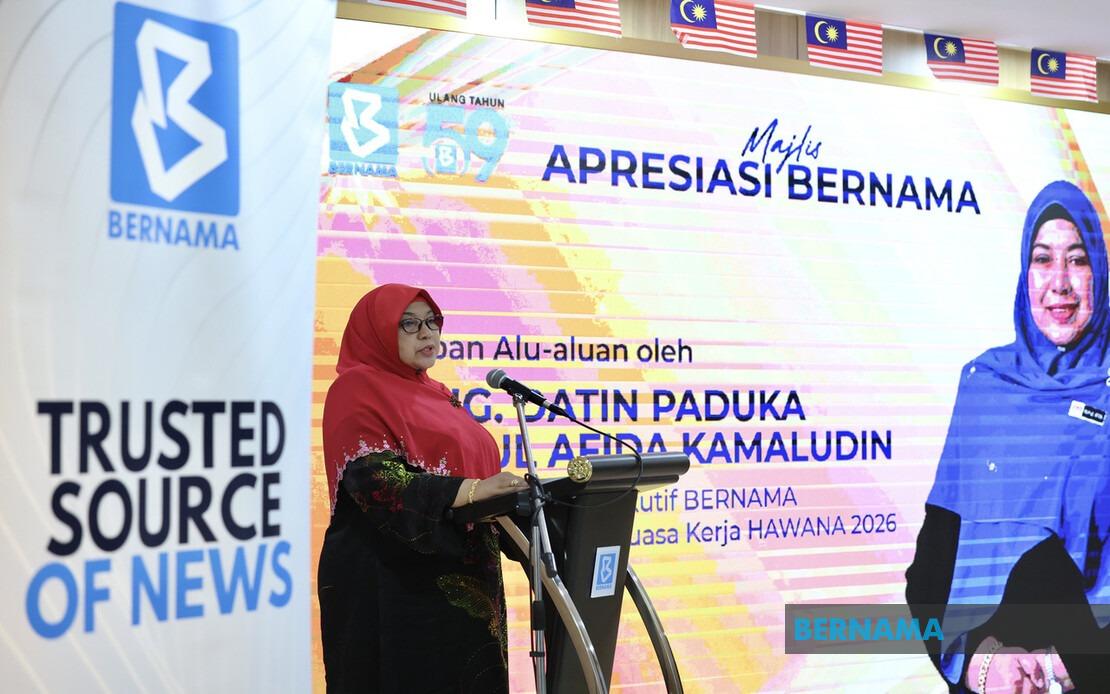
The Malaysian National News Agency, Bernama, has signalled its commitment to playing a stronger role in cultivating nationalist sentiment among Malaysians as the country prepares to mark its National Day. Operating under the Ministry of Communications, the agency views its remit as extending well beyond conventional news dissemination to encompass active participation in shaping the civic consciousness of the nation during significant national occasions. This expanded mandate reflects how state institutions are increasingly expected to contribute to broader social and patriotic objectives beyond their core functions.
Datin Paduka Nur-ul Afida Kamaludin, the chief executive officer of Bernama, articulated this institutional vision while addressing participants at an appreciation ceremony held at the agency's headquarters in Kuala Lumpur. She underscored that Bernama's positioning within the government communications framework places it at the intersection of information distribution and national agenda implementation. As such, the agency shoulders responsibility not only for reporting on Ministry of Communications initiatives but for actively promoting them through strategic messaging and public engagement. This dual role suggests an evolving understanding of how national agencies contribute to governmental objectives.
Central to Bernama's current National Month campaign is a grassroots flag-flying initiative designed to saturate the visual landscape with the Jalur Gemilang, Malaysia's iconic flag. The campaign, launched following Prime Minister's official initiation of National Month celebrations in Ipoh, encourages both institutional and residential display of the national flag. By decorating its own premises and mobilising employees to hang flags at their homes, Bernama aims to create a visual narrative of widespread patriotic participation. The campaign operates under the thematic banner "Satu Rumah, Satu Jalur Gemilang"—one house, one flag—a messaging framework that consciously links individual household participation with collective national identity.
The agency's strategy reflects a calculated approach to patriotic mobilisation that targets both institutional and domestic spaces. Rather than relying solely on mass media messaging, Bernama has opted for a multi-layered activation that involves its workforce as primary stakeholders and ambassadors. This employee-centric approach leverages the agency's internal structure to amplify patriotic messaging, effectively transforming staff members into vectors for spreading National Month sentiment throughout their communities. The recognition that institutional gatherings provide rare opportunities to align staff around shared national objectives underscores the practical challenges of maintaining collective participation in large bureaucratic organisations.
An integral component of Bernama's National Month programming involved a ceremonial presentation of flags to representatives from the agency's main departments. This symbolic gesture, conducted by Nur-ul Afida herself, served to formally inaugurate the flag-flying campaign while simultaneously creating a theatrical moment that reinforced hierarchical commitment to the initiative. By personalising the flag handover and creating a visible moment of institutional activation, Bernama sought to infuse the campaign with ceremonial weight and gravitas. The event also featured the unveiling of the official National Day theme song, composed by singer Faizal Tahir, thereby integrating musical and visual cultural elements into the broader patriotic activation.
The Bernama Appreciation Ceremony functioned as a compressed manifestation of the agency's broader strategic approach to National Month engagement. Rather than conducting separate departmental or thematic programmes, Bernama consolidated its initiatives into a single consolidated event. This consolidation reflected both practical necessity and strategic design: the CEO acknowledged that assembling all headquarters staff simultaneously presented logistical challenges, making a unified event approach both efficient and symbolically powerful. By concentrating patriotic messaging, flag distribution, and cultural programming into one occasion, the agency maximised the impact of its National Month activation while respecting operational constraints.
The approach undertaken by Bernama illuminates broader patterns within Malaysian state institutions regarding their engagement with national commemoration. As a news agency historically positioned as an information conduit, Bernama's expansion into active patriotic mobilisation represents a conscious repositioning of institutional purpose. Rather than maintaining a purely neutral informational stance, the agency has embraced a more explicitly nation-building role that aligns employee behaviour and public messaging around shared patriotic objectives. This evolution reflects governmental expectations that public institutions contribute actively to maintaining and reinforcing national identity narratives, particularly during significant commemorative periods.
For Malaysian employees within Bernama and similar state agencies, the intensified patriotic programming carries both practical and symbolic implications. The encouragement for staff to display flags at home represents an extension of institutional expectations into private domestic space, blurring conventional boundaries between professional obligation and personal choice. While framed as voluntary encouragement, the context of a formal agency initiative headed by senior leadership creates subtle normative pressures that transform the flag display from individual choice into expected institutional participation. This dynamic reflects how state agencies communicate implicit expectations regarding employee participation in national campaigns, even when ostensibly framed as voluntary initiatives.
The engagement with popular culture through Faizal Tahir's National Day theme song demonstrates Bernama's awareness of contemporary communication strategies and the importance of musical and entertainment elements in reaching broader audiences beyond traditional news consumers. By integrating creative cultural production into patriotic programming, the agency acknowledges that nationalist sentiment is sustained through emotional and aesthetic engagement, not merely informational messaging. The selection of a prominent contemporary artist to compose the National Day anthem reflects recognition that national identity construction increasingly depends on cultural and entertainment sectors, not exclusively on government institutions or traditional media.
Looking beyond the immediate National Month celebrations, Bernama's intensified patriotic programming raises broader questions about the proper role and boundaries of state news agencies in democratic systems. While fostering national pride represents a legitimate institutional objective, the extent to which news agencies should actively participate in patriotic mobilisation campaigns versus maintaining a more neutral informational posture remains contested terrain in media studies and journalism ethics. Bernama's approach suggests a model where state news agencies are understood as integral components of national identity maintenance rather than as neutral information distributors, a positioning that carries implications for how publics understand and engage with news content produced by such institutions.
For regional observers and analysts monitoring Malaysian governance patterns, Bernama's National Month campaign exemplifies how Southeast Asian governments increasingly mobilise state institutions toward explicit patriotic and nationalist objectives. This pattern extends across the region, with national news agencies, broadcasting corporations, and educational institutions frequently tasked with reinforcing national identity narratives during commemorative periods. Understanding these institutional dynamics proves important for comprehending how nationalist sentiment is actively constructed and maintained through state apparatus deployment, particularly in countries where professional boundaries between journalism and government communication remain comparatively permeable.

