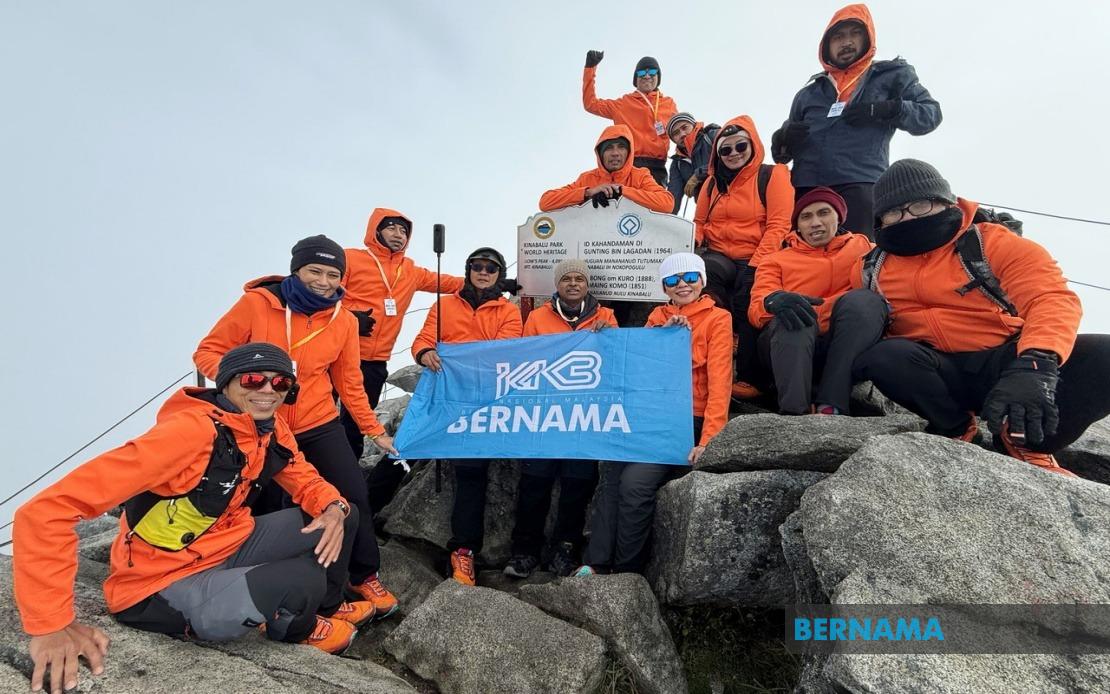
In a landmark demonstration of institutional pride and physical endurance, twenty-three journalists and support staff from Bernama, Malaysia's national news agency, summited Mount Kinabalu on July 1 as part of celebrations marking National Journalists' Day, known locally as HAWANA 2026. The successful expedition, spearheaded by Bernama Editor-in-Chief Arul Rajoo Durar Raj, represents more than a routine team-building exercise—it signals the agency's commitment to elevating the profile of Malaysian media practitioners while setting ambitious records for the industry.
The climbing party encompassed the full spectrum of newsroom operations, including reporting staff, visual journalists, editorial personnel, broadcast television crew members, and administrative teams. This cross-departmental composition underscores how the expedition functioned as an institution-wide endeavour rather than a selective athletic challenge. By drawing participants from throughout Bernama's organisational structure, the climb deliberately transcended the stereotypical image of journalism as desk-bound work, instead positioning news professionals as individuals capable of demanding physical achievement and mental fortitude.
The expedition pursued two distinct Malaysia Book of Records entries that would cement Bernama's place in the country's institutional annals. The first recognises the group as the largest contingent of media practitioners from a single organisation ever to successfully climb Southeast Asia's highest peak. The second, perhaps more creatively ambitious, targets recognition as the first media organisation to produce and file news reports simultaneously in four distinct languages directly from Mount Kinabalu's 4,095.2-metre summit. This multilingual dimension carries particular resonance in Malaysia's linguistically diverse context, reflecting the country's commitment to reporting across Malay, English, and other major regional languages.
The climb itself presented formidable natural obstacles that tested participants' resilience. The expedition commenced at Timpohon Gate at 10 am on June 30, with the team establishing their overnight base at Panalaban shelter before resuming their summit push at 2.30 am the following morning. The weather proved unpredictable and challenging throughout, with climbers contending with persistent rainfall, dense mist that obscured visibility, and gusting winds that threatened stability on exposed sections. Despite these conditions, the entire contingent reached the summit at approximately 7.20 am, completing what ranks among the most demanding single-day climbs on the mountain.
For Arul Rajoo himself, the achievement carried personal historical significance. His successful ascent made him the first Bernama Editor-in-Chief in the agency's history to reach Mount Kinabalu's summit, establishing a new precedent for institutional leadership engagement with the country's most iconic natural landmark. This personal milestone, achieved while leading an entire organisational team under adverse conditions, communicates symbolism about editorial commitment and shared responsibility that extends beyond conventional workplace dynamics.
Mount Kinabalu holds tremendous cultural and environmental significance well beyond its status as a climbing destination. Encompassed within the protected boundaries of Kinabalu Park, which spans 754 square kilometres of biodiverse terrain, the mountain forms a core component of the Kinabalu UNESCO Global Geopark (KUGGp). Its designation as a UNESCO World Heritage Site reflects its geological importance and ecological value, positioning it as a natural monument of international standing. The peak thus represents more than Malaysian geography—it embodies conservation principles and environmental stewardship that resonate throughout Southeast Asia's increasingly urgent climate discussions.
Bernama's expedition success depended substantially on organisational and commercial partnerships that mobilised resources across multiple sectors. International sportswear manufacturer BMAI provided specialist equipment and expertise essential for high-altitude mountaineering. Regional airline Batik Air facilitated participant transport to Sabah, while beverage company 100PLUS supported hydration strategies crucial for endurance climbing. Additional commercial partners including EHH Food Industry, Saloma Bistro, Malaysia Airports, Sabah Parks, and Marathon Baker contributed logistical and nutritional support that collectively transformed an ambitious but potentially chaotic endeavour into an efficiently managed expedition.
The expedition achieved several secondary objectives beyond record-seeking. Bernama intentionally framed the climb as a centrepiece of the broader HAWANA 2026 celebration, using the physical challenge to elevate the national recognition of journalists' contributions to Malaysian society. The institutional focus on teamwork development and mental resilience strengthening reflects contemporary understanding that modern journalism demands not merely intellectual capability but psychological robustness to withstand the pressures of perpetual digital connectivity and fractured information environments. The promotion of healthy living among Bernama personnel, meanwhile, addresses wellness concerns increasingly prevalent within news organisations globally where sedentary work patterns contribute to chronic health complications.
Organisation of the expedition by the Bernama Staff Club (KKB), rather than external management consultants, emphasises internal institutional capacity and staff-driven initiative. This structural choice signals that Malaysian journalism organisations are developing sophisticated capabilities in large-scale coordinated activities and experiential programming that build organisational culture from within rather than importing standardised external frameworks. Such self-organisation strengthens institutional autonomy and fosters organic professional community among staff members who share concrete achievement experiences.
The expedition carries implications extending beyond Bernama's immediate institutional interests. Malaysian news organisations increasingly face questions about professional identity, societal relevance, and staff retention in an era of digital disruption and declining traditional media revenue. Public demonstrations of journalistic community—through shared challenging experiences rather than merely professional credentials—may influence how broader society perceives news practitioners and how journalists themselves conceptualise their professional identity. By positioning journalists as capable of extraordinary physical feats on Malaysia's most recognisable mountain, Bernama offers counternarrative to stereotypes depicting media professionals as intellectually capable but physically unremarkable.
The Mount Kinabalu expedition also addresses workforce dynamics within Malaysian news organisations during a period of significant sector-wide challenge. International media companies continue reducing their Malaysian presence while local outlets struggle with advertising revenue pressures intensified by digital migration. By investing in dramatic team experiences that build camaraderie and institutional pride, Bernama demonstrates commitment to staff wellbeing and retention even amid broader industry pressures. The expedition suggests that national news organisations must increasingly compete not merely on journalistic quality metrics but on workplace culture and employee experience factors that influence career longevity.
Looking forward, the successful Mount Kinabalu expedition establishes a precedent that other Malaysian media organisations may attempt to replicate or surpass. Should Bernama successfully secure the two targeted Malaysia Book of Records entries, subsequent news organisations facing institutional challenges might similarly invest in dramatic collective achievements that simultaneously build internal cohesion and generate institutional publicity. This pattern could inaugurate a new competitive dimension in Malaysian journalism not centred on traditional editorial metrics but on organisational identity and professional community-building activities.

