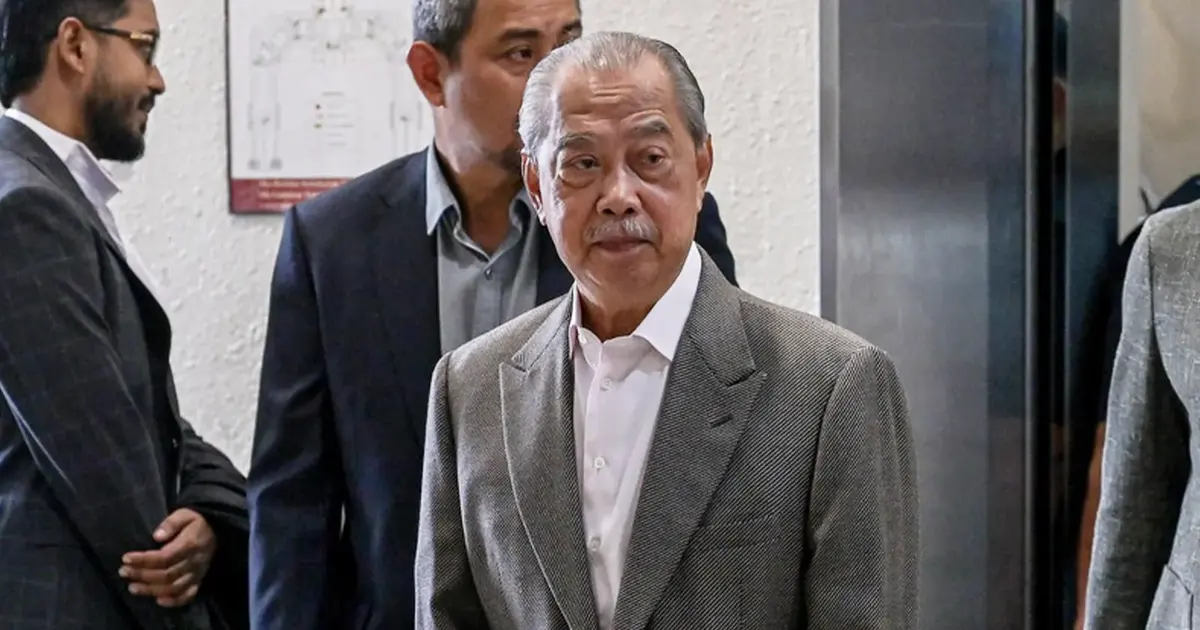
Testimony in the High Court this week has shed light on the internal financial governance structure of Bersatu, one of Malaysia's most volatile political coalitions, with fresh questions emerging about the extent of former party chairman Muhyiddin Yassin's control over day-to-day party operations. Zulhelmi Zaulkafly, who serves as the party's financial officer, provided sworn statements indicating that no individual wielded exclusive authority over Bersatu's financial dealings, a revelation that has prompted the Defence and Press Club (DPP) to probe whether Muhyiddin functioned merely as a ceremonial figurehead rather than an active decision-maker during his tenure.
The testimony represents a significant development in ongoing legal proceedings related to the party's governance and accountability. Zulhelmi's assertion that financial management operated through a collective or distributed system rather than concentrated in the hands of a single leader introduces complexity to the narrative surrounding Muhyiddin's leadership period. In Malaysian political practice, where factional infighting and power consolidation frequently dominate internal party dynamics, such a decentralised structure is noteworthy and potentially unusual for a party of Bersatu's prominence and political significance.
Bersatu itself has become emblematic of the fractious nature of contemporary Malaysian politics. The party emerged from a controversial split within the United Malays National Organisation (UMNO) and has since navigated multiple leadership transitions, coalition shifts, and internal power struggles. Its financial architecture, therefore, carries implications beyond mere administrative interest, reflecting broader questions about party institutionalisation, democratic accountability, and the concentration of power within Malaysia's political structures.
The DPP's questioning of whether Muhyiddin operated as a rubber stamp—effectively a leader in title only without substantive decision-making authority—touches on fundamental governance principles. If financial decisions were genuinely distributed among multiple parties rather than flowing through the party chairman's office, this would represent either a remarkably egalitarian party structure or, alternatively, a fragmented organisation where leadership authority was diluted or contested. Neither scenario presents an entirely flattering portrait of institutional health or coherent stewardship.
Muhyiddin's leadership tenure at Bersatu has been controversial and scrutinised from multiple angles. His earlier role as Prime Minister between 2020 and 2021, heading the short-lived Perikatan Nasional coalition, remains deeply contested politically. Questions about his decision-making capacity, his influence within Bersatu itself, and the degree to which he genuinely directed party strategy versus merely representing existing factional alignments have persistently surfaced in political commentary and analysis.
The High Court proceedings, while technical in their immediate focus on financial governance protocols, carry broader implications for understanding how Malaysian political parties operate behind closed doors. These institutions theoretically serve democratic functions—aggregating interests, developing policy platforms, fielding candidates—yet often function more as vehicles for individual ambition or factional power consolidation. Transparency regarding their internal structures remains limited, making court testimony a rare window into actual operational mechanics.
For Malaysian readers and political observers, the significance extends beyond Bersatu's internal arrangements. The state of governance within ruling and opposition parties directly affects political stability, policy coherence, and the quality of democratic representation. A party chairman who lacks financial oversight or decision-making authority presents concerning questions about whether such an office retains meaningful executive power. Conversely, the existence of distributed financial management might indicate institutional safeguards against unchecked personalised power, though equally it could suggest organisational dysfunction.
The DPP's intervention in this matter reflects broader civil society interest in political accountability. Their questioning direction—pursuing whether Muhyiddin functioned as a passive figurehead—indicates they suspect a gap between formal leadership position and actual influence. This distinction matters substantially. A ceremonial chairman effectively exercising little control differs fundamentally from one actively directing party affairs, with implications for both personal responsibility and institutional legitimacy.
Bersatu's current political position has evolved considerably since Muhyiddin's chairmanship. The party has recalibrated its coalition relationships multiple times, reflected changed policy positions, and undergone leadership transitions. These shifts might themselves indicate instability stemming from unclear internal authority structures or alternatively demonstrate pragmatic adaptation to Malaysia's fluid political landscape. Understanding the nature of financial governance during Muhyiddin's period provides context for evaluating these subsequent developments.
The testimony also invites examination of how Malaysian political parties document and justify financial decision-making. Strong governance typically involves clear audit trails, documented approval processes, and transparent accountability mechanisms. If Bersatu's finances operated through ill-defined collective management rather than documented procedures, this raises questions about financial compliance and internal democratic processes that extend beyond Muhyiddin's personal role.
For observers tracking Malaysian political development, these High Court proceedings exemplify how judicial processes occasionally illuminate aspects of political party functioning that might otherwise remain opaque. The court testimony regarding financial governance structures provides rare evidence about actual rather than theoretical internal arrangements, contributing to public understanding of how Malaysian political organisations truly operate.
As the proceedings continue, additional testimony may clarify whether the collective financial management Zulhelmi described functioned effectively as genuine institutional governance or merely masked underlying power concentrations within particular factions. The resolution of these questions carries consequences not only for understanding Muhyiddin's historical role but for broader assessment of institutional health within Malaysian political parties and the resilience of democratic processes they theoretically serve.

