The All England Club's manicured lawns and centuries-old customs have long defined Wimbledon as sport's most tradition-conscious institution. For nearly a century and a half, the oldest Grand Slam tournament has cloaked itself in pageantry—pristine white attire mandated for all players, spectators adorned in elaborate hats, strawberries and cream served in genuine silver bowls, and the ceremonial presence of the British royal family. The aesthetic carefully cultivated each summer presents Wimbledon as something fundamentally different from the raw spectacle of modern professional sports. Yet beneath this veneer of civility and refinement lies a sporting competition of extraordinary intensity, where the world's finest tennis players fight desperately for the sport's most coveted prize.
The 2024 edition of the tournament encompassed approximately 675 matches across all categories, drawing the globe's elite competitors to compete on grass courts that have hosted legendary encounters for generations. While the competition unfolded simultaneously with the FIFA World Cup—a spectacle of unbridled passion and national pride—Wimbledon maintained its outward composure and decorum. The surface-level contrast between these two sporting mega-events could hardly be more pronounced. Yet the underlying competitive fire burning within the All England Club proved equally intense, equally uncompromising, and equally consequential for the athletes staking their legacies on the outcome.
Photojournalists documenting the tournament captured what tournament organisers and broadcasters often overlook: the visceral emotional reality of elite sport. These images revealed Wimbledon's true competitive soul—visible not in the crowd's applause or the trophy presentations, but in the silent moments of tension before crucial serves, the physical agony of desperate attempts to retrieve seemingly lost balls, and the overwhelming cascade of emotions when victory arrived or defeat became inevitable. The photographs documented the tournament's hidden narrative, one told through grimaced expressions, exhausted bodies, and the psychological toll of competing at the highest level.
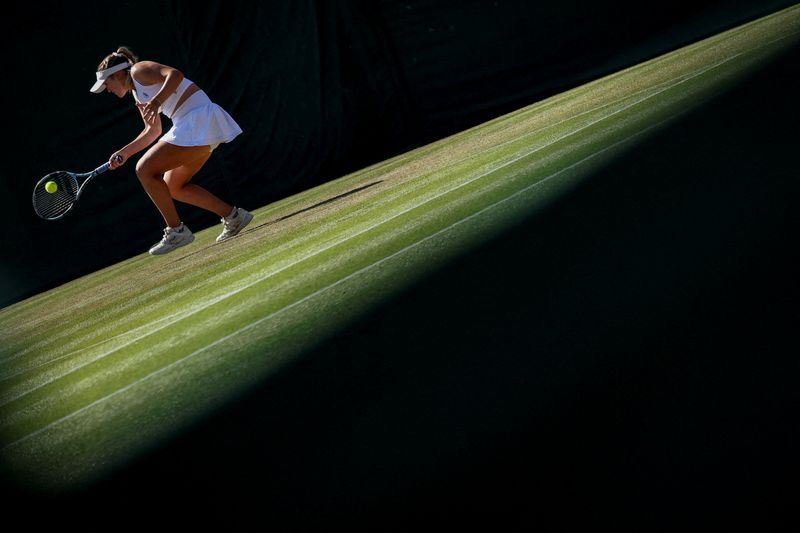
Alexandra Eala's struggle against third seed Iga Swiatek provided one such moment encapsulating this hidden dimension. The 21-year-old Filipino player, competing against a six-time major champion, found herself literally tumbling across the court while attempting a forehand return. The image captured her gritted teeth and contorted body mid-fall—a physical manifestation of her determination to combat an apparently insurmountable opponent. For Eala, this moment represented not mere defeat but the grinding effort required to challenge tennis's elite, the willingness to risk body and dignity in pursuit of a single point.
Photographer Toby Melville, positioned to capture Eala's celebratory moment, instead encountered something more profound. What he initially framed as a vertical composition—a player standing in triumph—transformed into a horizontal landscape of human struggle as Eala's fall unfolded unexpectedly. Melville's ability to adapt and capture this fleeting instant of competitive desperation produced an image transcending typical sports photography. Rather than celebrating athleticism, the photograph documented the vulnerability inherent in striving against superior opponents, revealing Wimbledon's darker, more human dimension.
Otto Virtanen's first-round encounter similarly illustrated the psychological demands of Grand Slam tennis. During a tightly contested match, the player approached the courtside barrier during a moment of obvious frustration, his body language suggesting an almost physical desire to escape the overwhelming pressure of competition. Rather than projecting confidence or composure, Virtanen's posture revealed the crushing weight of maintaining focus across potentially five-set matches, each demanding maximum physical and mental exertion. These moments—often cropped from official coverage or overlooked entirely—constitute the genuine substance of professional tennis.
Conversely, moments of accomplishment shone with equivalent clarity. Naomi Osaka's appearance on Centre Court, dressed in a striking kimono-inspired ensemble, conveyed both her confidence and her fearless approach to competition. The two-time major champion's body language and demeanor as she traversed the court communicated a player rediscovering her competitive edge and belief. Her subsequent progression to the quarter-finals—the furthest she had advanced at Wimbledon—validated this visual narrative of renewal, demonstrating how even the sport's elite must periodically resurrect their competitive resolve.
Yet even moments of victory proved shadowed and complex. When Jannik Sinner, ultimately crowned men's champion, stretched to his absolute physical limit during the final against Alexander Zverev, the resulting photograph captured more than mere athleticism. His extended form, his shadow seemingly magnified and distorted across the grass, conveyed the totality of effort required to ascend Wimbledon's pinnacle. This image reminded viewers that triumph at the All England Club demands not elegance or grace, but absolute commitment to reaching beyond perceived physical limitations.
The women's doubles final produced its own visually compelling moment when victorious players embraced at the net. The photograph's composition—where the shadow cast by the embracing players appeared to depict one athlete raising a fist in solitary triumph—captured an ambiguity inherent in competition. Victory, often celebrated collectively, fundamentally involves individual struggle and personal achievement. The shadow's visual trick suggested that beneath any moment of shared joy lies individual aspiration and personal triumph.
As the tournament concluded and maintenance crews dismantled temporary structures, the courts themselves bore testimony to the intensity of competition. The grass courts, traditionally representing Wimbledon's elegant permanence, displayed conspicuous wear—scuffed patches revealing where thousands of players' feet had driven them to their physical limits during two weeks of relentless competition. Andy Couldridge's time-lapse documentation of Centre Court's deterioration across the tournament visualised the cumulative toll extracted by elite-level tennis. The worn grass became a metaphor for the physical and psychological depletion that characterises professional sport at its highest level.
For Malaysian and Southeast Asian readers, Wimbledon's example carries particular relevance. While the region produces emerging tennis talent seeking to compete on the sport's grandest stages, the Wimbledon narrative underscores the extraordinary demands placed on athletes pursuing elite competition. Alexandra Eala's presence in the tournament represented Southeast Asian aspirations, her struggles against established champions illustrating both the region's growing competitive capacity and the formidable obstacles confronting players from developing tennis nations. Understanding Wimbledon's true competitive nature—stripped of its ceremonial pageantry—provides perspective on what success requires.
Ultimately, Wimbledon's enduring significance derives not from its traditions, its dress codes, or its royal patronage, but from its ability to host sport's most compelling competitive drama. The tournament's polished exterior, while visually distinctive, ultimately obscures rather than illuminates what makes Wimbledon matter. The true substance lies in what photographers captured: the quiet determination, the desperate effort, the crushing disappointment, and the exultant triumph that characterises sport when played at the absolute highest level. In this respect, Wimbledon differs little fundamentally from any other arena where humans push themselves to their limits, competing for distinction and recognition.

