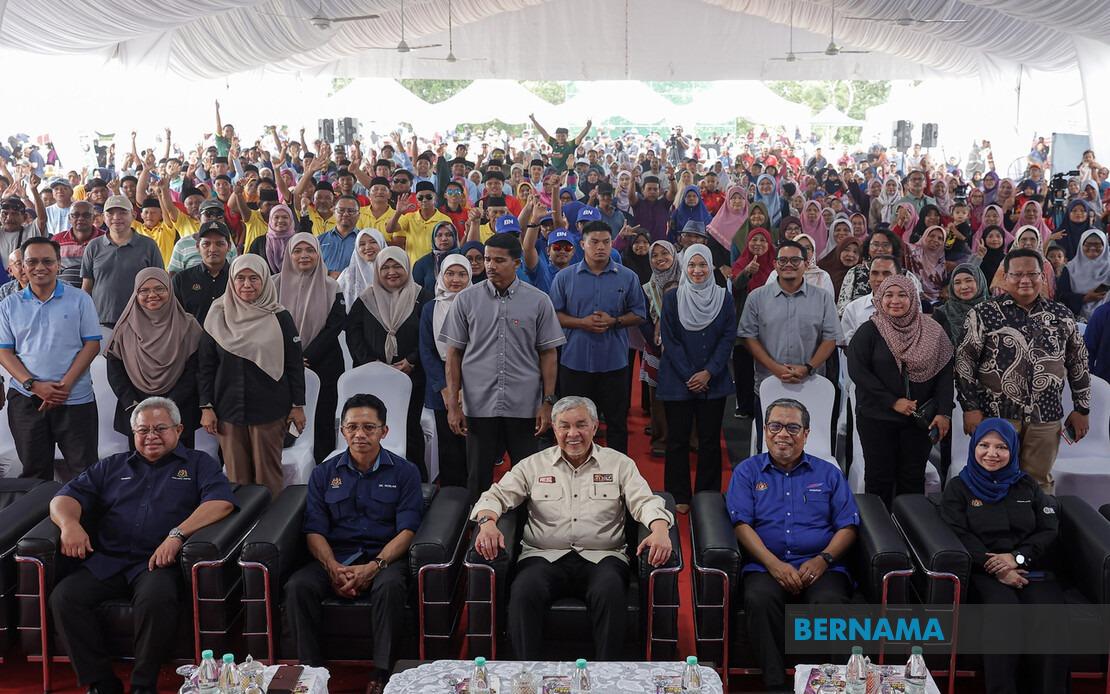
Malaysia's political landscape continues to shift, with Barisan Nasional chairman Datuk Seri Dr Ahmad Zahid Hamidi signalling that the country's major coalitions must develop fresh strategic approaches to maintain governmental stability. Speaking in Jempol on July 18, Ahmad Zahid outlined a pragmatic framework for managing coalition politics in an increasingly fragmented electoral environment, where vote-splitting and fractionalised support present ongoing challenges to political cohesion.
The understanding between BN and Perikatan Nasional for the forthcoming 16th Negeri Sembilan state election represents an experimental phase in what could become a broader recalibration of Malaysia's two largest political blocs. Rather than committing to a comprehensive merger or formal alliance, the two coalitions have adopted a more flexible arrangement designed specifically to prevent the wasteful duplication of contests that historically sees opposition votes scatter across multiple candidates. This approach reflects a recognition that Malaysia's first-past-the-post electoral system can punish divided opposition or coalition support, allowing minor players to win by capitalising on fragmented votes.
Ahmad Zahid emphasised that the current understanding should not be interpreted as a binding institutional agreement between BN and PN. Instead, he characterised it as a coordinated approach to seat allocation and campaign strategy, one that allows both coalitions to maintain their separate identities and organisational structures while preventing wasteful contests where candidates from the same general political persuasion split the vote. This distinction matters significantly for party members and grassroots supporters, many of whom maintain strong ideological or personal commitments to their respective organisations.
The Negeri Sembilan test case will provide crucial data for Malaysia's political strategists. By observing how this understanding performs during the state election—with early voting scheduled for July 28 and polling day set for August 1—BN and PN leadership can assess whether reduced candidate overlaps genuinely translate into improved electoral outcomes or whether other factors prove more determinative. The state, which has been a BN stronghold historically, offers a relatively controlled environment in which to trial new cooperative mechanisms.
The success or failure of the Negeri Sembilan model will directly influence calculations for subsequent electoral contests. Ahmad Zahid indicated that leadership from both coalitions will scrutinise performance metrics before deciding whether to extend similar arrangements to the Melaka state election, which remains a competitive battleground between BN and the opposition. The findings will also carry significant weight for preparations regarding GE16, Malaysia's next general election, where the composition of federal government hangs in the balance.
The political dynamics driving this cautious cooperation reflect broader structural challenges within Malaysia's multiparty democracy. The proliferation of viable political organisations across the peninsula has created a crowded electoral marketplace where no single coalition commands overwhelming support. BN, despite its decades-long dominance, has experienced diminished vote shares in recent general elections. PN, a newer coalition that emerged from internal UMNO divisions and absorbed Parti Islam Se-Malaysia, has rapidly established itself as a significant force, particularly in Malay-Muslim constituencies. Managing relationships between these major blocs without formal subordination or merger remains a delicate proposition.
The absence of binding legal agreements, as Ahmad Zahid stressed, preserves strategic flexibility for both organisations. Political circumstances can shift rapidly in Malaysia—parliamentary defections, intra-party disputes, or shifts in voter sentiment can reshape the playing field within months. By maintaining looser understanding-based cooperation rather than locked-in formal alliances, BN and PN retain the ability to recalibrate their relationship based on evolving conditions. This approach also allows individual party members to pursue their own advancement without being constrained by overarching coalition directives.
For Malaysian voters and political observers, this model presents both opportunities and uncertainties. On one hand, reduced vote-splitting should theoretically produce clearer electoral mandates and more stable governments. On the other hand, fluid, understanding-based cooperation can sometimes lack transparency, with ordinary citizens unsure precisely which parties are cooperating and under what terms. The absence of formal agreements means voters cannot easily hold leadership accountable for honouring specific commitments across electoral cycles.
The regional implications of Malaysia's evolving political alignments extend beyond the peninsula itself. Southeast Asia's democracies frequently grapple with coalition management, and Malaysia's experiments with flexible cooperation frameworks may inform political strategies across the region. How BN and PN navigate their relationship in the coming months will demonstrate whether multiparty democracies can achieve stability without sacrificing organisational autonomy or voter choice.
Ahmad Zahid's measured rhetoric about the importance of strategic flexibility reflects maturity within Malaysia's political establishment regarding the necessity of adaptation. Gone are the days when single-coalition dominance could be taken for granted. The coming years will demand continuous calibration of political relationships, careful assessment of electoral performance, and willingness to experiment with new organisational models. The Negeri Sembilan state election thus becomes far more than a routine electoral exercise—it serves as a laboratory for testing whether Malaysia's major coalitions can cooperate effectively while maintaining their separate identities and competitive positions.

