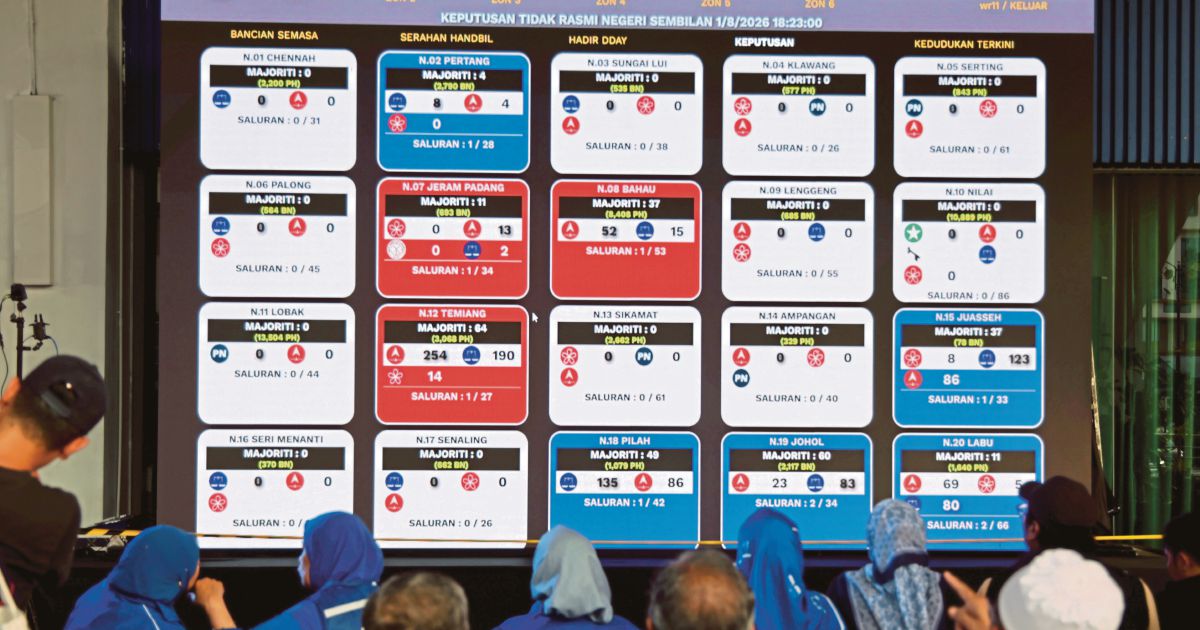
Umno's Datuk Dr Asyraf Wajdi Dusuki has claimed that a coalition between Barisan Nasional and Perikatan Nasional has secured 23 seats in the Negri Sembilan state assembly, enough to form the next government in the state. The assertion comes as the two coalitions attempt to demonstrate commanding support following the recent state election.
The 23-seat threshold represents a simple majority within the 36-seat legislative chamber, giving either coalition the numerical advantage required to form an administration. A state government requires a minimum of 19 seats to maintain a working majority and withstand confidence votes in the assembly. Achieving 23 seats would provide the BN-PN alliance with a comfortable buffer against potential defections or procedural challenges.
Negri Sembilan, strategically located in the central region of Peninsular Malaysia, has long been a competitive political battleground. The state's politics reflect the broader tension between federal coalitions, with both Barisan Nasional and Perikatan Nasional maintaining significant grassroots support across different constituencies. The outcome of state elections here often presages shifts in regional political dynamics affecting neighbouring Selangor and Kuala Lumpur.
The claim by Dusuki, a prominent Umno figure, underscores the significance of Negri Sembilan within the Barisan Nasional coalition's overall strategy for consolidating control across Malaysian states. Umno continues to position itself as the dominant force within BN, and demonstrating electoral strength in state-level contests strengthens the party's negotiating position in future coalition discussions at the federal level.
Perikatan Nasional, meanwhile, has emerged as a significant political force, particularly in states where it has demonstrated governing capacity. The coalition's willingness to partner with Barisan Nasional in Negri Sembilan suggests both pragmatism and recognition that electoral outcomes sometimes necessitate cooperation between rival coalitions. This reflects a broader pattern across Malaysian politics where formal opposition relationships at the federal level do not preclude local arrangements.
The composition of the BN-PN grouping in Negri Sembilan likely comprises multiple political parties beyond Umno, potentially including MCA, MIC, and PAS representatives. The multiethnic and multireligious nature of Malaysian electoral coalitions means that seat distribution across different communities and constituencies becomes crucial for sustaining long-term political stability in state administrations.
However, the informal nature of Dusuki's statement—presented as an unconfirmed claim rather than official electoral commission pronouncement—highlights an important dimension of Malaysian politics. State election results often trigger intense negotiations before final government formation, with seat claims frequently contested or adjusted as political parties engage in horse-trading. The gap between initial claims and eventual government configurations can be substantial, depending on whether independent candidates or smaller parties swing their support.
The implications for Malaysian politics extend beyond Negri Sembilan's boundaries. Successful state governments led by either BN or PN coalitions serve as platforms for demonstrating administrative competence and building momentum toward federal elections. State-level outcomes provide testing grounds for political messages, policy initiatives, and coalition management strategies that federal parties subsequently deploy nationally.
For Negri Sembilan residents, the composition and stability of the next state government will determine priorities for development spending, infrastructure investment, and social policies. The state faces ongoing challenges in diversifying its economy beyond traditional sectors, and a politically stable administration becomes essential for executing medium-term economic strategies effectively.
The potential BN-PN arrangement, if confirmed, would represent a significant departure from formal federal-level opposition positioning. Such arrangements require careful management to prevent accusations of unprincipled opportunism from opposition figures. Both coalitions would need to articulate a coherent governance platform that transcends their rivalry and focuses on tangible benefits for constituents.
Monitoring the final government formation process in Negri Sembilan becomes important as political observers attempt to understand how Malaysian coalitions operate at state level and what this portends for federal politics. The negotiated outcome, once concluded, may reshape assumptions about which coalitions are capable of working together and under what conditions. This flexibility in coalition-building, while pragmatic, also reflects the fluid and negotiated nature of Malaysian parliamentary democracy.

