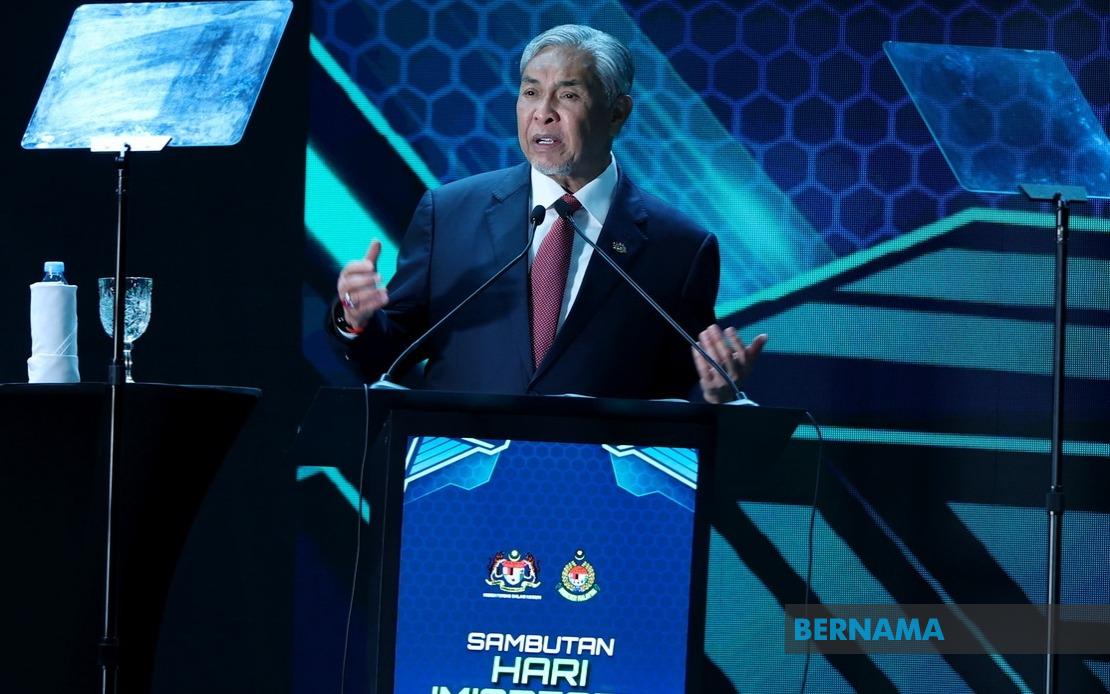
Barisan Nasional's commitment to the ruling Unity Government remains unchanged, with party chairman Datuk Seri Dr Ahmad Zahid Hamidi reaffirming the coalition's position during a public address in Cyberjaya on July 21. The declaration comes in the wake of deliberations at UMNO's most recent General Assembly, where delegates reached a consensus on the party's participation in the broader governing coalition that includes Pakatan Harapan and other political partners.
Ahmad Zahid, who holds the dual positions of UMNO president and Deputy Prime Minister, stressed that the General Assembly represents the supreme authority within the party structure, and its decisions carry binding weight across the organisation. He appealed to party members and the public to respect the resolution, emphasising that no body within UMNO ranks higher than the General Assembly itself. This statement seeks to address lingering speculation about potential fractures within the coalition or dissatisfaction from certain quarters regarding the power-sharing arrangement.
The reaffirmation comes at a sensitive juncture for Malaysia's political landscape. State elections scheduled for 2026 have intensified focus on how the different components of the Unity Government will work together on the ground, and whether coalition tensions might surface during campaigning. By publicly restating BN's commitment, Ahmad Zahid aims to project stability and unity, signalling to voters and international observers that the governing arrangement remains solid despite periodic murmurs of discontent from various factions.
In related remarks, Ahmad Zahid acknowledged that Prime Minister Datuk Seri Anwar Ibrahim possesses absolute authority over Cabinet appointments and removals. This statement reflects the constitutional reality of Malaysia's Westminster-style system, where the Prime Minister exercises executive power in staffing the government. However, the timing of this clarification suggests it was prompted by recent warnings issued by Anwar regarding ministerial conduct during state election campaigns.
The Prime Minister had cautioned government office-holders against using their positions to publicly attack Unity Government coalition partners while campaigning in state elections. Anwar made clear that any minister, deputy minister, or public sector official found to have breached this understanding would face dismissal from their posts. Such warnings indicate underlying tensions within the coalition, where individual ministers might feel tempted to differentiate their parties' positions or attack rivals in ways that undermine the broader alliance.
For Malaysian voters and observers, Ahmad Zahid's reaffirmation carries several implications. First, it suggests that BN, which includes UMNO, MCA, MIC and smaller parties, intends to contest the 2026 state elections as a unified entity rather than fracturing into separate competing camps. This positioning offers strategic advantages in multi-cornered contests where a consolidated vote is often decisive. Second, the public nature of the statement indicates that internal pressures have necessitated a clear show of discipline and loyalty to the party leadership's decision.
The broader context matters for understanding these developments. The Unity Government itself represents a significant departure from traditional Malaysian politics, bringing together UMNO—long accustomed to dominance—with Pakatan Harapan, which it had regarded as ideological rivals just years earlier. BN's continued participation requires ongoing negotiation of ego, resources, and political territory among parties with distinct identities and competing interests. Ahmad Zahid's message essentially reassures wavering members and partners that these complexities have been worked through at the highest level.
The emphasis on respecting General Assembly decisions also carries internal party significance. In Malaysian politics, party assemblies serve as forums where grassroots pressure can express itself, and leadership must demonstrate that it listens and accounts for member sentiment. By framing the commitment to the Unity Government as a General Assembly decision rather than a top-down directive, Ahmad Zahid grounds BN's coalition stance in democratic party processes, potentially neutralising criticism from those who might otherwise view the arrangement as imposed by elites.
Looking ahead to the 2026 state elections, maintaining coalition cohesion will prove essential. State elections in Malaysia often serve as mid-term assessments of federal government performance and can shift momentum significantly. A fragmented coalition attempting to campaign while attacking its own partners would project weakness and invite opposition capitalisation. Ahmad Zahid's reaffirmation of BN's commitment, coupled with his acknowledgement of the Prime Minister's executive prerogatives, establishes clear expectations for ministerial behaviour during the coming campaign season.
The statement also implicitly addresses concerns within BN parties themselves. Smaller coalition members, particularly MCA and MIC, benefit from unified positioning that protects them from one-on-one contests against larger rivals. Any splintering of the coalition could expose these parties to electoral vulnerability. By confirming BN's coalition status, Ahmad Zahid reassures MCA, MIC, and other BN members that the security of the broader alliance will be maintained through the election cycle.
For Malaysia's political economy, sustained coalition stability supports investor confidence and policy continuity. Markets and international partners value predictable governance arrangements. A government that appears cohesive and stable, even if internally complex, projects more confidence than one riven by public disputes. Ahmad Zahid's statement, therefore, carries economic as well as political significance for the nation's development trajectory over the next two years.

